Nearly a month after the "Warsh Shock" sent shockwaves through global commodities, the precious metals market is finally beginning to find its footing. As of February 27, 2026, gold has reclaimed the critical $5,100 per ounce level, a significant psychological milestone following the chaotic "flash crash" of late January. This recovery signals a shift in investor sentiment as the market moves past the initial panic of a more hawkish Federal Reserve and begins to price in the long-term implications of a "hard money" advocate at the helm of the world’s most powerful central bank.
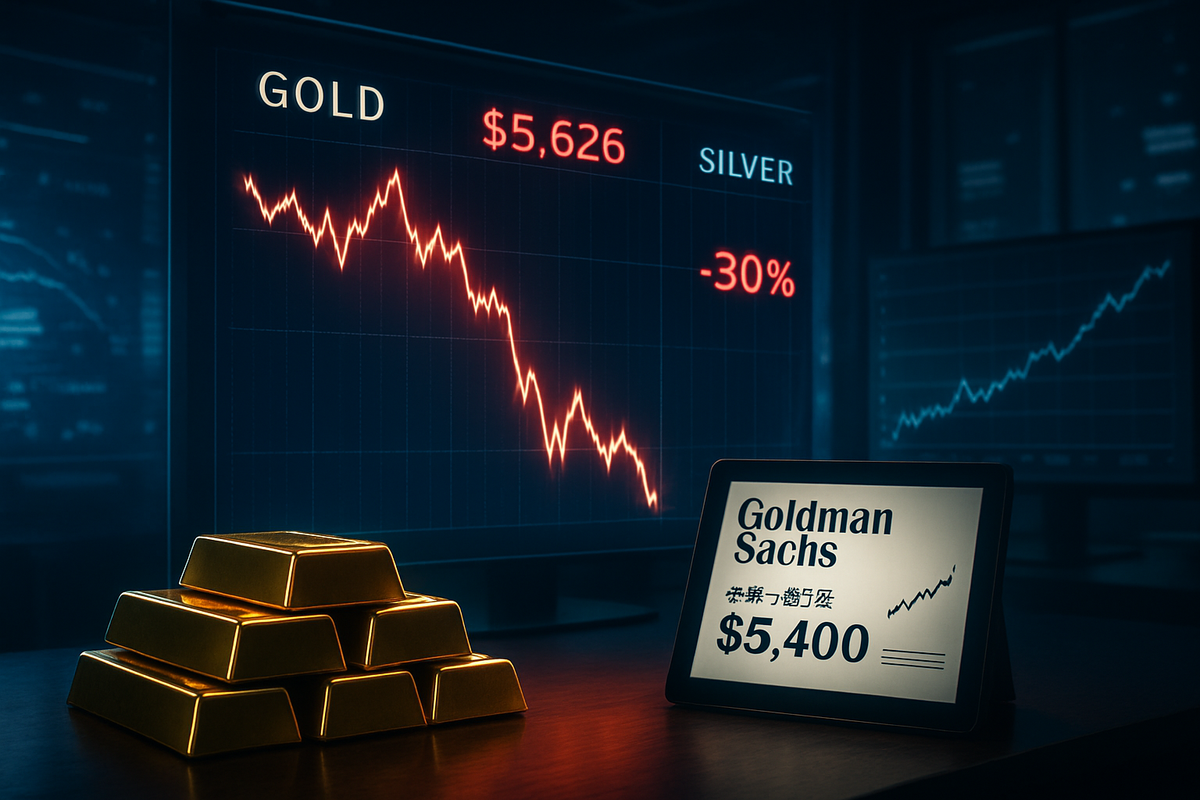
The immediate aftermath of the January 30 crash saw gold tumble from its historic peak of $5,626, while silver suffered a brutal 30% correction in a single week. However, the narrative is shifting from one of systemic fear to one of calculated value. With major institutions like Goldman Sachs (NYSE: GS) issuing a revised year-end forecast of $5,400 per ounce, investors are weighing the reality of a disciplined Fed against the backdrop of a $38 trillion national debt and persistent geopolitical tensions that continue to provide a structural floor for non-yielding assets.
The Day the Gold Bull Stumbled: Anatomy of the Jan 30 Flash Crash
The events of January 30, 2026, will likely be remembered as one of the most violent pivots in monetary history. Gold, which had been riding a "debasement trade" fueled by record U.S. deficits and tariff-driven inflation fears, reached an intraday all-time high of $5,626 per ounce on January 29. The atmosphere was euphoric, with silver trading near $122 per ounce and retail demand hitting levels not seen since the pandemic era. That euphoria evaporated instantly with the White House announcement that former Fed Governor Kevin Warsh had been nominated to succeed Jerome Powell as Chair of the Federal Reserve.
Warsh, known for his "hard money" stance and his high-profile 2011 resignation in protest of quantitative easing (QE2), represents a stark departure from the accommodative policies of the previous decade. Within minutes of the news, algorithmic trading programs triggered a massive liquidation in the SPDR Gold Shares (NYSE Arca:GLD) and the iShares Silver Trust (NYSE Arca:SLV). The "Warsh Shock" was exacerbated by a simultaneous move from the CME Group to hike margin requirements for silver from 11% to 15%, creating a "liquidation cascade" that saw silver prices plunge by 30% in less than 48 hours, bottoming out in the mid-$80s.
The timeline of the crash was a textbook example of a "hawkish awakening." On the morning of January 30, the U.S. Dollar Index (DXY) surged as bond yields spiked, reflecting a market that suddenly had to price in a Fed Chair who might actually prioritize "sound money" over market stability. By the close of trade on February 2, nearly $200 billion in paper gold value had been wiped out, leaving the mining sector in a state of paralysis. Stakeholders ranging from central banks in the Global South to retail "stackers" were forced to recalibrate their expectations for a higher-for-longer interest rate environment under Warsh’s presumed leadership.
Mining Giants and Royalty Plays: Winners and Losers in the Reset
The fallout from the Warsh Shock was not felt equally across the mining sector. Major producers like Newmont Corporation (NYSE: NEM) and Barrick Gold (NYSE: GOLD) saw their share prices crater by 14% and 12%, respectively, during the initial rout. For these industry titans, the sudden drop in the spot price of gold meant a rapid compression of their projected 2026 margins, which had been calculated based on $5,500 gold. Despite the dip, both companies remain fundamentally robust due to their high-grade assets and low all-in sustaining costs (AISC), which allow them to remain highly profitable even at the $5,100 level.
The "losers" of the shock were undoubtedly the silver-heavy producers and high-leverage junior miners. Pan American Silver (NYSE: PAAS) bore the brunt of the silver collapse, with its stock price dropping over 20% as investors fled the high-beta metal. Similarly, the VanEck Gold Miners ETF (NYSE Arca:GDX) plunged 13%, illustrating how mining equities often amplify the downside of the underlying commodity. For companies with high debt loads or those currently in the expensive construction phase of new mines, the sudden increase in the cost of capital—driven by the hawkish Warsh outlook—has forced a pause in several major exploration projects.
Conversely, royalty and streaming companies like Franco-Nevada (NYSE: FNV) and Wheaton Precious Metals (NYSE: WPM) demonstrated remarkable resilience. Because these firms do not operate mines themselves and instead take a percentage of production, they are shielded from the rising operational and energy costs that plague traditional miners. Wheaton Precious Metals (NYSE: WPM), in particular, managed to recover more quickly than its peers, as its diverse portfolio of streaming contracts provided a buffer against the silver-specific volatility. These "capital-light" models are now being viewed by institutional investors as the safest way to maintain exposure to the sector while navigating the unpredictability of the "Warsh Fed."
A New Era of Monetary Independence: Wider Significance
The nomination of Kevin Warsh signifies more than just a change in leadership; it represents a potential paradigm shift in the relationship between the Federal Reserve and the U.S. Treasury. For years, critics have argued that the Fed has become "fiscally dominated," forced to keep rates low to help the government service its ballooning debt. Warsh's reputation for prioritizing Fed independence and his historical skepticism of the Fed’s expanded balance sheet suggest a move back toward the "Volcker Era" of the late 1970s and early 80s.
This shift has profound implications for the global "debasement trade." If Warsh successfully re-establishes the Fed as a truly independent inflation-fighter, the case for gold as a hedge against central bank incompetence weakens. However, the current reality of $38 trillion in national debt complicates this historical comparison. Unlike Paul Volcker, who could raise rates to 20% because the debt-to-GDP ratio was below 35%, Warsh faces a landscape where every 100-basis-point increase in rates adds hundreds of billions to the federal deficit. This "debt trap" is precisely why analysts at Goldman Sachs (NYSE: GS) believe the current recovery in gold is justified—the market is betting that even a hawk like Warsh cannot fully escape the gravitational pull of fiscal reality.
Furthermore, the Warsh Shock has accelerated the trend of central bank diversification. Countries in the BRICS+ bloc, wary of a weaponized or volatile dollar, viewed the late January crash as a "buying opportunity" rather than a signal to exit. Reports indicate that central banks in China, India, and Turkey were significant buyers during the dip to $4,700, providing the support needed for gold to bounce back to its current $5,100 level. This underlying institutional demand remains a key pillar of the market, distinguishing the 2026 environment from previous hawkish cycles.
The Road to $5,400: What Comes Next
Looking ahead, the precious metals market is entering a phase of "hawkish consolidation." In the short term, markets will be hypersensitive to Warsh’s confirmation hearings and any rhetoric regarding the Fed’s balance sheet. A strategic pivot toward "Quantitative Tightening" (QT) could provide another headwind for gold, but any sign of economic cooling or a "hard landing" caused by higher rates would likely reignite the safe-haven bid. Investors should prepare for continued volatility, particularly in silver, as it continues to balance its dual role as a monetary asset and an essential industrial component for the burgeoning AI and green energy sectors.
The long-term outlook remains cautiously optimistic, as evidenced by the $5,400 year-end target. The prevailing theory among market strategists is that while Warsh can slow the pace of currency debasement, he cannot reverse the structural deficits of the U.S. government. This creates a "buy the dip" mentality that has already helped gold reclaim $5,100. Potential market opportunities may emerge in the form of "merger and acquisition" activity in the mining sector, as larger players like Newmont (NYSE: NEM) use their cash reserves to acquire junior miners whose valuations were unfairly punished during the January flash crash.
Summary and Investor Outlook
The "Warsh Shock" of early 2026 served as a violent reminder that the path to record highs is rarely a straight line. By nominating a known hawk like Kevin Warsh, the administration has introduced a level of monetary discipline that the market had not priced in, resulting in a necessary but painful "technical reset" for gold and silver. However, the fundamental drivers of the precious metals bull market—high sovereign debt, geopolitical instability, and central bank diversification—remain largely unchanged.
Moving forward, investors should watch for the "Warsh Pivot"—the moment when the new Fed Chair must choose between raising rates to fight inflation or keeping them low enough to prevent a fiscal crisis. For now, the recovery of gold to $5,100 suggests that the market believes the "debasement trade" is far from over. In the coming months, the key indicators to monitor will be the real interest rate (nominal rates minus inflation) and the pace of central bank gold purchases. While the "Warsh Shock" was a wake-up call, it may ultimately be remembered as the consolidation period that cleared the way for the next leg of the gold bull run.
This content is intended for informational purposes only and is not financial advice.