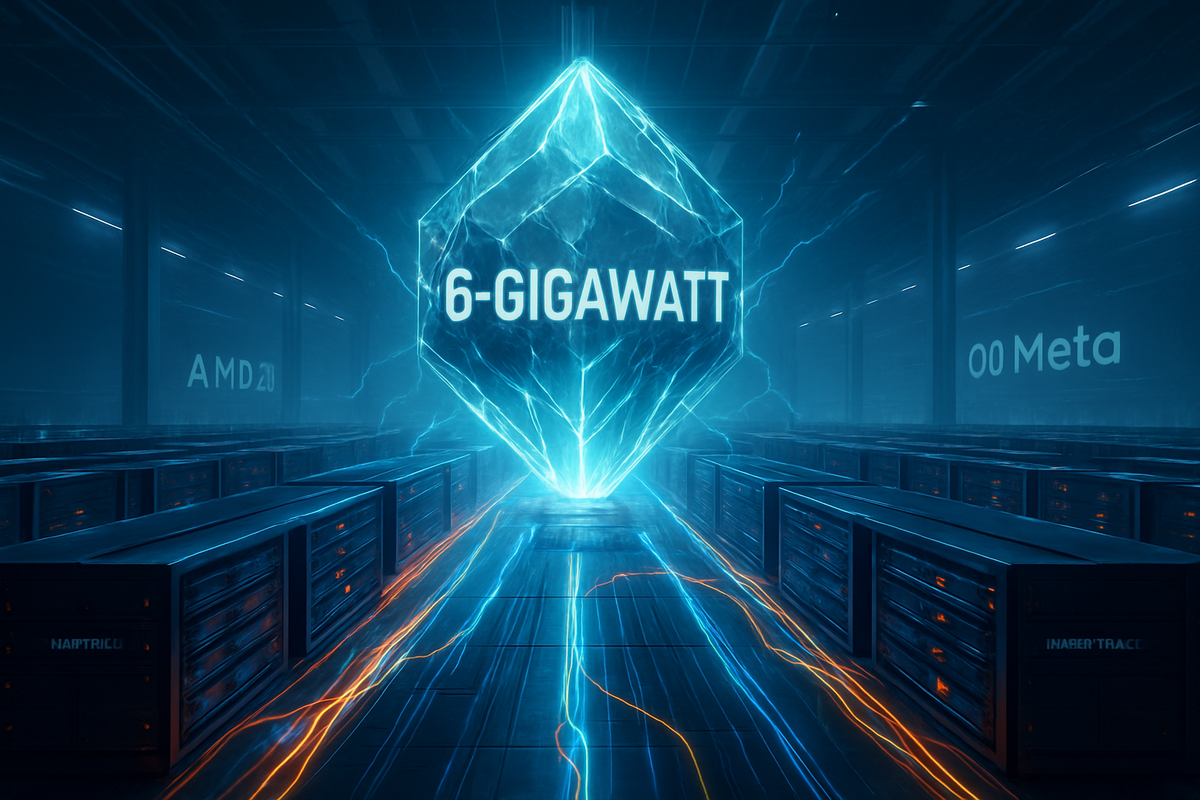
MENLO PARK, CA — In a move that signals a tectonic shift in the artificial intelligence hardware market, Advanced Micro Devices, Inc. (NASDAQ: AMD) and Meta Platforms, Inc. (NASDAQ: META) announced a definitive multi-year agreement today, February 24, 2026, to deploy up to 6 gigawatts (GW) of GPU capacity across Meta’s global data center fleet. This unprecedented commitment, estimated to be worth between $60 billion and $100 billion over the next five years, effectively ends the era of single-vendor dominance in high-end AI compute and establishes AMD as a primary pillar of the world’s AI infrastructure.
The deal centers on the mass deployment of AMD’s next-generation Instinct MI450 accelerators and 6th Gen EPYC "Venice" processors. By securing 6GW of power capacity—roughly equivalent to the energy consumption of six million homes—Meta is doubling down on its "Open Compute" philosophy while diversifying its supply chain away from NVIDIA Corporation (NASDAQ: NVDA). For large-cap tech investors, the agreement represents the most significant validation of AMD’s AI roadmap to date, suggesting that the "Nvidia-alternative" narrative has officially transitioned into a "dual-vendor duopoly" reality.
The 6GW Era: A Breakdown of the Historic Partnership
The agreement finalized today is the culmination of a three-year technical collaboration that began with Meta’s early adoption of the AMD Instinct MI300X in 2023. Throughout 2025, the two companies co-developed the "Helios" rack-scale architecture, an integrated hardware design that optimizes power delivery and liquid cooling for massive GPU clusters. This 6GW commitment is not merely a purchase order but a structural blueprint for Meta’s future "Personal Superintelligence" initiatives, which require vast amounts of real-time inference and training capacity.
Industry analysts estimate that 6GW of power capacity translates to the deployment of approximately 2.4 million to 3 million individual GPUs. Unlike previous piecemeal orders, this deal locks in a multi-generational roadmap, ensuring Meta has priority access to AMD’s CDNA 4 and CDNA 5 architectures through 2030. To cement the partnership, AMD has issued Meta performance-based warrants for up to 160 million shares, which will vest as Meta achieves specific deployment milestones, further aligning the interests of the two tech giants.
Initial market reaction was swift, with AMD shares jumping 9.4% in early trading, while Meta saw a 3.2% gain as investors cheered the company's move to lower its total cost of ownership (TCO) for AI infrastructure. The deal also highlights a shift in how the industry measures scale; in 2026, the primary metric for AI leadership has moved from simple "chip counts" to "gigawatts of deployed power," reflecting the severe energy constraints currently facing the global data center market.
Winners, Losers, and the Silicon Bifurcation
The primary beneficiary of this deal is undoubtedly AMD, which is now projected to grow its AI accelerator market share from roughly 9% in 2025 to over 15% by the end of 2026. By securing Meta as a "beehive" customer, AMD has solved its most significant hurdle: large-scale software validation. Meta’s successful migration of its Llama 4 and Llama 5 models to AMD’s ROCm software ecosystem provides a "green light" for other hyperscalers like Microsoft Corporation (NASDAQ: MSFT) and Alphabet Inc. (NASDAQ: GOOGL) to follow suit.
However, the ripple effects extend far beyond the GPU designers. Networking giant Broadcom Inc. (NASDAQ: AVGO) stands as a major "hidden winner," as its high-end Ethernet switching and PCIe Gen7 fabric are the connective tissue for these 6GW clusters. Similarly, Vertiv Holdings Co (NYSE: VRT) and Eaton Corporation plc (NYSE: ETN) are expected to see a surge in demand for the specialized liquid cooling and high-voltage power distribution systems required to manage the intense thermal profiles of the MI450 chips, which can pull upwards of 1.2kW per accelerator.
On the losing side, Intel Corporation (NASDAQ: INTC) continues to face headwinds in the data center. Meta’s choice of AMD’s "Venice" EPYC CPUs to pair with its GPU fleet suggests that Intel is losing its traditional grip on the server-side "head node" market. While Nvidia remains the overall market leader, the Meta deal introduces genuine price competition for the first time in the generative AI era, likely forcing Nvidia to adjust its aggressive pricing strategy for its upcoming "Rubin" architecture to prevent further customer churn.
Power as the New Currency of AI
This 6GW deal fits into a broader industry trend where electricity availability has become the ultimate bottleneck for AI progress. In early 2026, lead times for new grid interconnections in major hubs like Northern Virginia have stretched to nearly a decade. By securing 6GW of capacity through a multi-year partnership, Meta is effectively "land-banking" power, ensuring that its AI development will not be throttled by energy shortages that are currently stalling smaller competitors.
The deal also underscores the regulatory and environmental pressures facing large-cap tech. Deploying 6GW of compute requires a radical rethinking of energy sourcing. Meta has indicated that much of this new capacity will be supported by "behind-the-meter" power solutions, including on-site solar, large-scale battery storage, and even investments in small modular reactors (SMRs). This trend toward self-generation is transforming tech companies into de facto utility operators, a shift that is drawing increased scrutiny from energy regulators and environmental policymakers.
Historically, this event mirrors the "Wintel" era of the 1990s, but with a twist. While Microsoft and Intel once dominated the PC landscape, the AI era is proving to be more fragmented. The Meta-AMD alliance proves that the software layer—specifically open-source frameworks like PyTorch—has become robust enough to bridge the gap between different hardware architectures, breaking the proprietary "moat" that many believed would protect Nvidia indefinitely.
The Road to 2030: What Comes Next?
In the short term, the market will be watching for the first 1GW "milestone" deployment, expected in the second half of 2026. Success here will depend on AMD's ability to maintain a steady supply chain amidst global semiconductor fluctuations. For Meta, the challenge will be integrating this massive influx of compute into its consumer-facing products without a corresponding spike in energy costs that could erode margins.
Looking further ahead, this deal likely triggers a "copycat" effect among other Tier-1 cloud providers. If Meta can demonstrate that AMD hardware delivers equivalent performance at a 20-30% lower TCO, the pressure on Amazon (NASDAQ: AMZN) and Google to diversify their own fleets will become irresistible. We may also see a strategic pivot toward "Custom Silicon" partnerships, where AMD provides the foundational IP for Meta to build even more specialized chips, a move that would further squeeze traditional merchant silicon providers.
The ultimate scenario is a transition from a hardware-constrained market to a power-constrained one. As compute becomes more of a commodity due to the AMD-Nvidia rivalry, the competitive advantage for tech giants will shift toward who can acquire the most efficient energy and the best proprietary data to train their models.
Investor Takeaway: A New Market Equilibrium
The 6GW deal secured on February 24, 2026, marks the end of the "AI Monopoly" phase of the market. Investors should view this as a signal that the AI infrastructure sector is maturing into a healthy, competitive ecosystem. AMD’s transformation from a "scrappy underdog" to a $100-billion-deal partner for Meta validates its long-term strategy and places it on a collision course with Nvidia for the title of the world’s most important chipmaker.
Moving forward, the key metrics for investors to watch are AMD’s quarterly "AI Data Center" revenue growth and Meta’s capital expenditure efficiency. The battle for AI supremacy is no longer just about who has the fastest chip, but who can deploy the most gigawatts of intelligence most efficiently. For the broader market, this deal is a bullish indicator that the AI build-out is nowhere near its peak, as the world’s largest companies continue to invest at a scale that was previously unimaginable.
This content is intended for informational purposes only and is not financial advice.