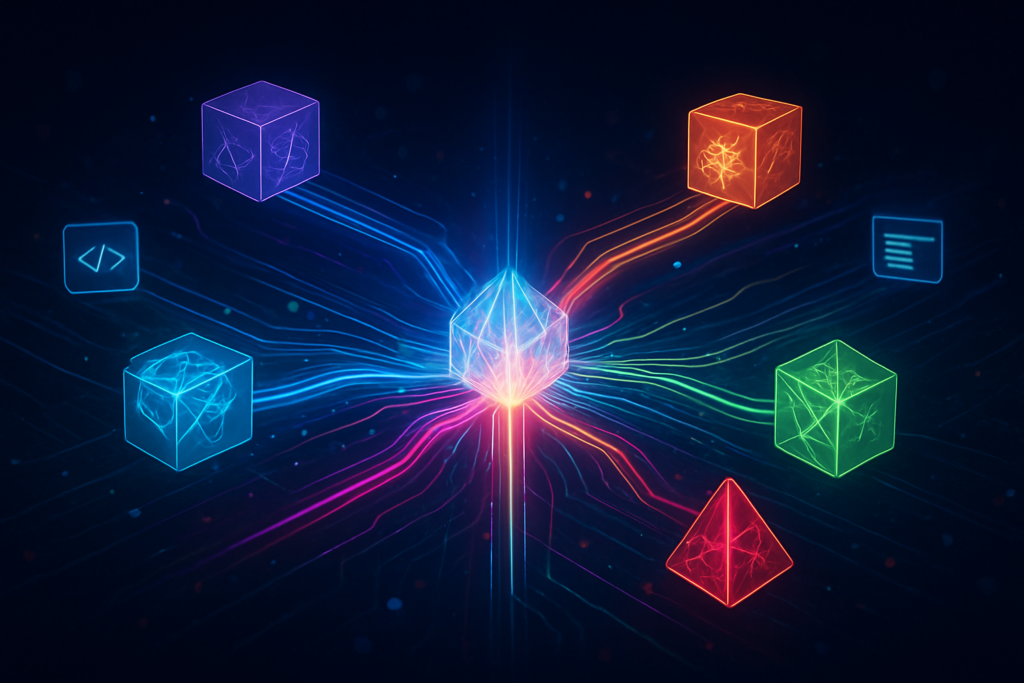
As of January 2026, the artificial intelligence industry has reached a watershed moment. The "walled gardens" that once defined the early 2020s—where data stayed trapped in specific platforms and agents could only speak to a single provider’s model—have largely crumbled. This tectonic shift is driven by the Model Context Protocol (MCP), a standardized framework that has effectively become the "USB-C port for AI," allowing specialized agents from different providers to work together seamlessly across any data source or application.
The significance of this development cannot be overstated. By providing a universal standard for how AI connects to the tools and information it needs, MCP has solved the industry's most persistent fragmentation problem. Today, a customer support agent running on a model from OpenAI can instantly leverage research tools built for Anthropic’s Claude, while simultaneously accessing live inventory data from a Microsoft (NASDAQ: MSFT) database, all without writing a single line of custom integration code. This interoperability has transformed AI from a series of isolated products into a fluid, interconnected ecosystem.
Under the Hood: The Architecture of Universal Interoperability
The Model Context Protocol is a client-server architecture built on top of the JSON-RPC 2.0 standard, designed to decouple the intelligence of the model from the data it consumes. At its core, MCP operates through three primary actors: the MCP Host (the user-facing application like an IDE or browser), the MCP Client (the interface within that application), and the MCP Server (the lightweight program that exposes specific data or functions). This differs fundamentally from previous approaches, where developers had to build "bespoke integrations" for every new combination of model and data source. Under the old regime, connecting five models to five databases required 25 different integrations; with MCP, it requires only one.
The protocol defines four critical primitives: Resources, Tools, Prompts, and Sampling. Resources provide models with read-only access to files, database rows, or API outputs. Tools enable models to perform actions, such as sending an email or executing a code snippet. Prompts offer standardized templates for complex tasks, and the sophisticated "Sampling" feature allows an MCP server to request a completion from the Large Language Model (LLM) via the client—essentially enabling models to "call back" for more information or clarification. This recursive capability has allowed for the creation of nested agents that can handle multi-step, complex workflows that were previously impossible to automate reliably.
The v1.0 stability release in late 2025 introduced groundbreaking features that have solidified MCP’s dominance in early 2026. This includes "Remote Transport" and OAuth 2.1 support, which transitioned the protocol from local computer connections to secure, cloud-hosted interactions. This update allows enterprise agents to access secure data across distributed networks using Role-Based Access Control (RBAC). Furthermore, the protocol now supports multi-modal context, enabling agents to interpret video, audio, and sensor data as first-class citizens. The AI research community has lauded these developments as the "TCP/IP moment" for the agentic web, moving AI from isolated curiosities to a unified, programmable layer of the internet.
Initial reactions from industry experts have been overwhelmingly positive, with many noting that MCP has finally solved the "context window" problem not by making windows larger, but by making the data within them more structured and accessible. By standardizing how a model "asks" for what it doesn't know, the industry has seen a marked decrease in hallucinations and a significant increase in the reliability of autonomous agents.
The Market Shift: From Proprietary Moats to Open Bridges
The widespread adoption of MCP has rearranged the strategic map for tech giants and startups alike. Microsoft (NASDAQ: MSFT) and Alphabet Inc. (NASDAQ: GOOGL) have pivotally integrated MCP support into their core developer tools, Azure OpenAI and Vertex AI, respectively. By standardizing on MCP, these giants have reduced the friction for enterprise customers to migrate workloads, betting that their massive compute infrastructure and ecosystem scale will outweigh the loss of proprietary integration moats. Meanwhile, Amazon.com Inc. (NASDAQ: AMZN) has launched specialized "Strands Agents" via AWS, which are specifically optimized for MCP-compliant environments, signaling a move toward "infrastructure-as-a-service" for agents.
Startups have perhaps benefited the most from this interoperability. Previously, a new AI agent company had to spend months building integrations for Salesforce (NYSE: CRM), Slack, and Jira before they could even prove their value to a customer. Now, by supporting a single MCP server, these startups can instantly access thousands of pre-existing data connectors. This has shifted the competitive landscape from "who has the best integrations" to "who has the best intelligence." Companies like Block Inc. (NYSE: SQ) have leaned into this by releasing open-source agent frameworks like "goose," which are powered entirely by MCP, allowing them to compete directly with established enterprise software by offering superior, agent-led experiences.
However, this transition has not been without disruption. Traditional Integration-Platform-as-a-Service (iPaaS) providers have seen their business models challenged as the "glue" that connects applications is now being handled natively at the protocol level. Major enterprise players like SAP SE (NYSE: SAP) and IBM (NYSE: IBM) have responded by becoming first-class MCP server providers, ensuring their proprietary data is "agent-ready" rather than fighting the tide of interoperability. The strategic advantage has moved away from those who control the access points and toward those who provide the most reliable, context-aware intelligence.
Market positioning is now defined by "protocol readiness." Large AI labs are no longer just competing on model benchmarks; they are competing on how effectively their models can navigate the vast web of MCP servers. For enterprise buyers, the risk of vendor lock-in has been significantly mitigated, as an MCP-compliant workflow can be moved from one model provider to another with minimal reconfiguration, forcing providers to compete on price, latency, and reasoning quality.
Beyond Connectivity: The Global Context Layer
In the broader AI landscape, MCP represents the transition from "Chatbot AI" to "Agentic AI." For the first time, we are seeing the emergence of a "Global Context Layer"—a digital commons where information and capabilities are discoverable and usable by any sufficiently intelligent machine. This mirrors the early days of the World Wide Web, where HTML and HTTP allowed any browser to view any website. MCP does for AI actions what HTTP did for text and images, creating a "Web of Tools" that agents can navigate autonomously to solve complex human problems.
The impacts are profound, particularly in how we perceive data privacy and security. By standardizing the interface through which agents access data, the industry has also standardized the auditing of those agents. Human-in-the-Loop (HITL) features are now a native part of the MCP protocol, ensuring that high-stakes actions, such as financial transactions or sensitive data deletions, require a standardized authorization flow. This has addressed one of the primary concerns of the 2024-2025 period: the fear of "rogue" agents performing irreversible actions without oversight.
Despite these advances, the protocol has sparked debates regarding "agentic drift" and the centralization of governance. Although Anthropic donated the protocol to the Agentic AI Foundation (AAIF) under the Linux Foundation in late 2025, a small group of tech giants still holds significant sway over the steering committee. Critics argue that as the world becomes increasingly dependent on MCP, the standards for how agents "see" and "act" in the world should be as transparent and democratized as possible to avoid a new form of digital hegemony.
Comparisons to previous milestones, like the release of the first public APIs or the transition to mobile-first development, are common. However, the MCP breakthrough is unique because it standardizes the interaction between different types of intelligence. It is not just about moving data; it is about moving the capability to reason over that data, marking a fundamental shift in the architecture of the internet itself.
The Autonomous Horizon: Intent and Physical Integration
Looking ahead to the remainder of 2026 and 2027, the next frontier for MCP is the standardization of "Intent." While the current protocol excels at moving data and executing functions, experts predict the introduction of an "Intent Layer" that will allow agents to communicate their high-level goals and negotiate with one another more effectively. This would enable complex multi-agent economies where an agent representing a user could "hire" specialized agents from different providers to complete a task, automatically negotiating fees and permissions via MCP-based contracts.
We are also on the cusp of seeing MCP move beyond the digital realm and into the physical world. Developers are already prototyping MCP servers for IoT devices and industrial robotics. In this near-future scenario, an AI agent could use MCP to "read" the telemetry from a factory floor and "invoke" a repair sequence on a robotic arm, regardless of the manufacturer. The challenge remains in ensuring low-latency communication for these real-time applications, an area where the upcoming v1.2 roadmap is expected to focus.
The industry is also bracing for the "Headless Enterprise" shift. By 2027, many analysts predict that up to 50% of enterprise backend tasks will be handled by autonomous agents interacting via MCP servers, without any human interface required. This will necessitate new forms of monitoring and "agent-native" security protocols that go beyond traditional user logins, potentially using blockchain or other distributed ledgers to verify agent identity and intent.
Conclusion: The Foundation of the Agentic Age
The Model Context Protocol has fundamentally redefined the trajectory of artificial intelligence. By breaking down the silos between models and data, it has catalyzed a period of unprecedented innovation and interoperability. The shift from proprietary integrations to an open, standardized ecosystem has not only accelerated the deployment of AI agents but has also democratized access to powerful AI tools for developers and enterprises worldwide.
In the history of AI, the emergence of MCP will likely be remembered as the moment when the industry grew up—moving from a collection of isolated, competing technologies to a cohesive, functional infrastructure. As we move further into 2026, the focus will shift from how agents connect to what they can achieve together. The "USB-C moment" for AI has arrived, and it has brought with it a new era of collaborative intelligence.
For businesses and developers, the message is clear: the future of AI is not a single, all-powerful model, but a vast, interconnected web of specialized intelligences speaking the same language. In the coming months, watch for the expansion of MCP into vertical-specific standards, such as "MCP-Medical" or "MCP-Finance," which will further refine how AI agents operate in highly regulated and complex industries.
This content is intended for informational purposes only and represents analysis of current AI developments.
TokenRing AI delivers enterprise-grade solutions for multi-agent AI workflow orchestration, AI-powered development tools, and seamless remote collaboration platforms.
For more information, visit https://www.tokenring.ai/.