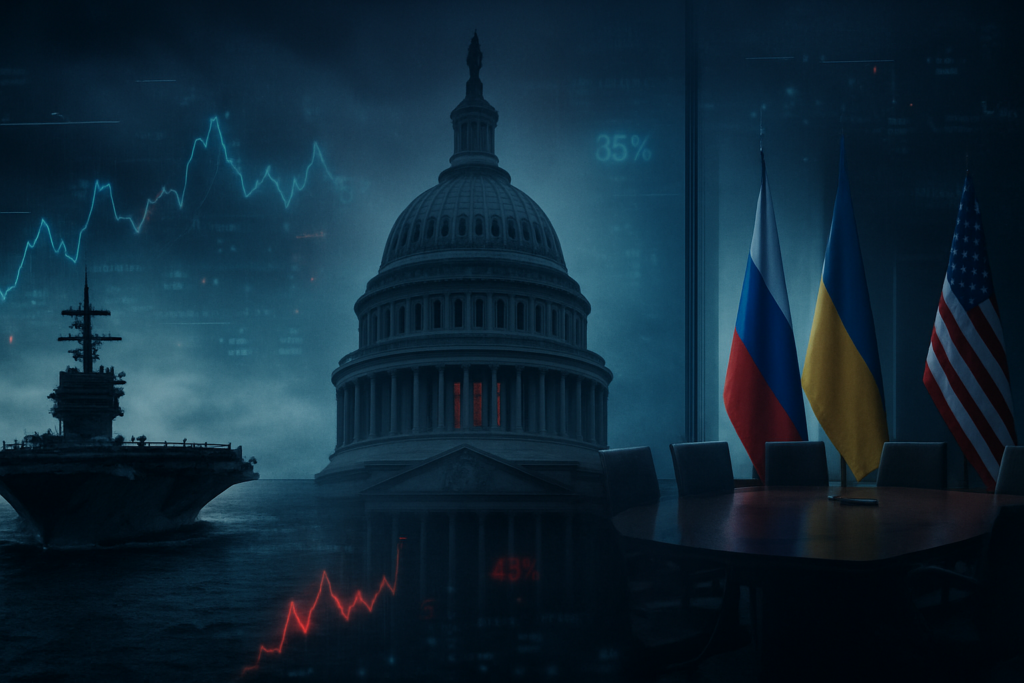
As the world wakes up on February 1, 2026, the traditional tools of diplomacy and statecraft are increasingly being viewed through a new, high-resolution lens: the prediction market. In a year already defined by unprecedented volatility, three major geopolitical flashpoints have emerged as the primary drivers of global speculation. Traders are currently navigating a landscape where the United States is locked in a high-stakes naval standoff with Iran, the federal government has just entered a partial shutdown, and a fragile hope for peace in Eastern Europe hangs in the balance.
The numbers are staggering. As of this morning, over $147 million has been wagered on whether the U.S. will launch a direct military strike against Iran, while a separate $87 million market tracks the fallout of the current domestic budget crisis. Meanwhile, the most watched contract of the year—the prospect of a Russia-Ukraine ceasefire—is currently hovering at a 45% probability. These markets are no longer just hobbies for the "pundit class"; they have become essential "truth events," providing a cold, hard-money assessment of global stability that often moves faster than official government briefings.
The Market: What's Being Predicted
The geopolitical "Big Three" of 2026 are primarily concentrated on Polymarket and Kalshi, with the former hosting the lion's share of international military speculation. The "US strikes Iran" market, which has seen its volume swell to $147 million, is specifically trading on whether the U.S. military will conduct a kinetic operation against Iranian territory or its assets by the end of the second quarter. Current odds have fluctuated wildly, spiking recently as the USS Abraham Lincoln carrier strike group reached its station off the Iranian coast.
On the domestic front, Kalshi has become the epicenter for the $87 million "Government Shutdown" contracts. These markets are uniquely designed for U.S. participants to hedge against the economic disruption caused by the current partial shutdown that began yesterday, January 31, 2026. Unlike military markets, these contracts are highly technical, resolving based on official Congressional funding status for specific departments, including the Department of Homeland Security (DHS).
Finally, the Russia-Ukraine ceasefire market has become the definitive sentiment barometer for the ongoing Abu Dhabi peace talks. Trading at a 45% probability for a signed agreement by March, the market reflects a "coin-flip" reality despite the optimistic rhetoric from the State Department. Liquidity in this market is at an all-time high, with major institutional players using the 45% mark to price risk in European energy and defense stocks, such as Lockheed Martin (NYSE: LMT) and Northrop Grumman (NYSE: NOC).
Why Traders Are Betting
The 83% implied probability of a U.S. strike on Iran—despite the 45% ceasefire odds in Ukraine—is fueled by the traumatic military escalations of 2025. Traders vividly remember "Operation Midnight Hammer" in June 2025, when the U.S. bombed the Fordow nuclear facility. The recent 2026 surge in betting volume was triggered by Iran's brutal crackdown on internal dissent earlier this month, leading to a "MIGA" (Make Iran Great Again) posture from the Trump administration. Large-scale "whales" in these markets are betting that the U.S. cannot afford to let its 2025 momentum dissipate without achieving total regime concessions.
In the "Government Shutdown" market, the driving force is a specific domestic flashpoint: the Minneapolis Shooting. In early January 2026, federal agents were involved in a fatal encounter with U.S. citizens, causing a massive rift in the Senate. Traders who correctly predicted the January 31 shutdown (then a 15% longshot) focused on the intransigence of House leadership regarding DHS funding reforms. Many high-volume traders are currently betting that the shutdown will be short-lived—less than 72 hours—expecting a stopgap measure to pass by Monday evening.
Regarding the Russia-Ukraine conflict, the 45% ceasefire probability represents a cautious optimism born from the "Energy Truce" brokered by President Trump in mid-January. While traditional diplomats cite "unreconcilable differences" regarding occupied territories, prediction market traders are looking at secondary signals: the massive reduction in artillery fire and the repositioning of General Dynamics (NYSE: GD) equipment away from the front lines. The market suggests that while a full "peace treaty" is unlikely, a formal cessation of hostilities is a near-even bet.
Broader Context and Implications
This surge in volume represents a maturation of prediction markets as a vital component of the global intelligence architecture. For years, skeptics dismissed these platforms as "gambling for geeks," but in 2026, they serve as a real-time sanity check against propaganda. When the Russian Foreign Ministry claims talks are failing, but the ceasefire market stays steady at 45%, global observers look to the market for the underlying "truth." This has created a feedback loop where even officials at companies like Palantir (NYSE: PLTR) and RTX Corporation (NYSE: RTX) are rumored to monitor these odds to assess operational risk.
Furthermore, the $87 million shutdown market highlights the regulatory evolution of platforms like Kalshi. By providing a legal, regulated venue for U.S. traders to hedge against legislative failure, these markets have effectively democratized "political insurance." However, the sheer scale of the $147 million Iran market has also drawn the attention of the Commodity Futures Trading Commission (CFTC), which remains concerned about the ethics of profiting from kinetic warfare.
Historically, these markets have outperformed traditional polling and expert panels. During the 43-day shutdown of late 2025, prediction markets correctly identified the resolution date three days before a deal was announced to the press. This track record is exactly why we are seeing such massive capital inflows today; traders believe the collective "wisdom of the crowd" can pierce the fog of war more effectively than a single analyst at a think tank.
What to Watch Next
The next 48 hours will be critical for all three markets. For the "US strikes Iran" contract, all eyes are on the Persian Gulf. Any reports of Iranian naval provocation or a "freedom of navigation" exercise by the U.S. Navy will likely send the 83% probability toward the 95% range. Conversely, any last-minute diplomatic outreach from Tehran could see a sharp "crash" in the contract price, creating a high-volatility environment for intraday traders.
In Washington, the "Shutdown" market will react to the House's Monday session. If a vote on the stopgap funding bill fails to materialize by 4:00 PM EST tomorrow, the probability of a "long-term shutdown" (defined as >14 days) will likely double. Traders should watch for any movement on DHS funding reforms, as this remains the primary "poison pill" in current negotiations.
Finally, the Abu Dhabi peace talks entering their second round today (February 1) is the "make-or-break" moment for the 45% ceasefire probability. If the parties agree to an extension of the Energy Truce by tomorrow evening, expect the ceasefire odds to jump to 60%. If the talks break down without a scheduled Round 3, the market will likely plummet toward 10%, signaling a return to full-scale winter offensive operations.
Bottom Line
As we enter February 2026, prediction markets have become the "central nervous system" of geopolitical risk. The $147 million volume in Iran-related markets and the $87 million shutdown bets prove that participants are no longer just guessing; they are aggressively pricing the future. The 45% ceasefire probability for Russia and Ukraine is perhaps the most telling figure of all—it is a clear-eyed rejection of both total war and total peace, signaling a "frozen conflict" scenario that markets are uniquely equipped to navigate.
Ultimately, these markets tell us that the world is currently in a state of precarious equilibrium. Whether it is the tension in the Strait of Hormuz or the legislative gridlock in D.C., the odds reflect a global community that is bracing for impact while simultaneously looking for an exit ramp. For observers and investors alike, the primary takeaway is clear: in the "truth economy" of 2026, the most reliable signal is not what world leaders say, but where the money is moving.
This article is for informational purposes only and does not constitute financial or betting advice. Prediction market participation may be subject to legal restrictions in your jurisdiction.
PredictStreet focuses on covering the latest developments in prediction markets.
Visit the PredictStreet website at https://www.predictstreet.ai/.