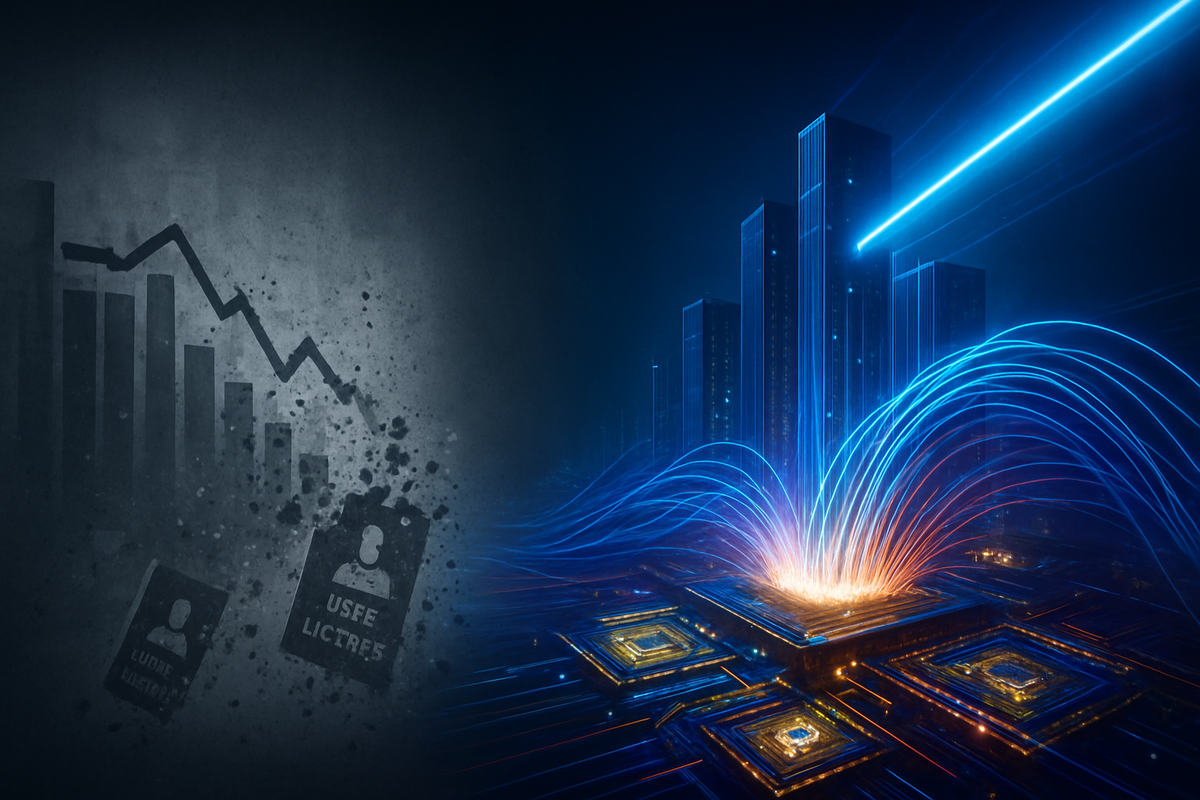
SANTA CLARA, CA — As the calendar turns to March 2, 2026, the global financial markets are witnessing a profound and violent decoupling in the technology sector. What began as a unified "AI gold rush" two years ago has splintered into two distinct narratives: a crushing "AI Panic" that is decimating traditional software valuations, and an "AI Reality" where the physical infrastructure of the intelligence age continues to attract unprecedented levels of capital. This morning, the divergence reached a fever pitch as Nvidia (Nasdaq: NVDA) announced a massive $2 billion strategic investment in the optical giant Lumentum (Nasdaq: LITE), even as legacy software giants faced another day of double-digit sell-offs.
The current market environment is characterized by a brutal reappraisal of how artificial intelligence actually generates value. While enterprise software companies are struggling to prove that "agentic AI" can offset the collapse of their traditional per-user licensing models, the companies providing the lasers, chips, and high-speed switches required to move "AI tokens" are seeing their order books stretch into the next decade. For investors, the message is clear: the market has stopped betting on the promise of AI applications and has shifted its focus entirely to the requirement of AI infrastructure.
The Infrastructure Pivot: A $2 Billion Bet on Light
The defining moment of this new market era occurred today, March 2, 2026, with Nvidia's $2 billion investment in Lumentum. The deal, structured as convertible preferred stock, includes a multi-year purchase commitment for advanced photonic components, cementing Lumentum’s role as the primary architect of the "Optical Layer." This move comes as the industry hits a "physical wall" where traditional copper wiring is no longer capable of handling the heat and speed required for the 1.6-Terabit (1.6T) and 3.2T data flows that define modern AI clusters.
The timeline leading to this moment has been one of accelerating technical necessity. Throughout late 2025, hyperscalers like Alphabet (Nasdaq: GOOGL) and Meta (Nasdaq: META) began building "Gigawatt-scale" AI factories, discovering that the bottleneck was no longer just the GPU, but the interconnects between them. Lumentum, which has seen its stock price surge nearly 900% over the past year to approximately $765 per share, has transitioned from a cyclical component maker to a strategic gatekeeper. Their proprietary Co-Packaged Optics (CPO) and Optical Circuit Switching (OCS) technologies are now the only viable solutions for reducing the massive power consumption of the world’s largest data centers.
Winners in the Trenches and Losers in the Cloud
The fallout from this "Great Divergence" has created a clear list of winners and losers. In the winner’s circle, infrastructure plays like Arista Networks (NYSE: ANET) and Marvell Technology (Nasdaq: MRVL) continue to trade at record multiples, supported by a "Sovereign AI" movement where nations like the United Kingdom and Singapore are investing tens of billions of dollars into domestic GPU clusters. Nvidia itself remains the undisputed king of the era, reporting a record-breaking $215.9 billion in full-year revenue for fiscal 2026, with a net profit margin exceeding 55%.
Conversely, the "SaaS-pocalypse" has claimed high-profile victims. Salesforce (NYSE: CRM) and ServiceNow (NYSE: NOW) have seen their valuations reset by 25% to 40% in early 2026. The crisis stems from "seat compression"—a phenomenon where AI agents handle the work of dozens of employees, leading corporate clients to slash their subscription counts. Adobe (Nasdaq: ADBE) has similarly struggled as the "democratization of high-end output" through agentic tools reduces the need for specialized software licenses. These companies are now desperately pivoting to "Generative Credit" and "Outcome-Based" pricing models to capture value from AI-driven results rather than human users.
Beyond the Bubble: A Structural Shift in Computing
This event fits into a broader industry trend where the "Application Layer" of the internet is being fundamentally rewritten. Unlike the Dot-com bubble of 2000, which was built on speculative traffic and eyeballs, the 2026 infrastructure boom is anchored in hyper-profitable hardware giants. The significant ripple effect is that "compute" has become the new global currency. For companies like Microsoft (Nasdaq: MSFT), the challenge is no longer selling more copies of Office, but managing the massive capital expenditures—projected at $700 billion across the "Magnificent Seven" in 2026—required to stay relevant in the agentic economy.
Regulatory and policy implications are also emerging as the physical layer of AI becomes a matter of national security. The reliance on specialized optical components from companies like Lumentum has prompted Western governments to provide subsidies for domestic photonics manufacturing, mirroring the CHIPS Act for semiconductors. This shift highlights a historical precedent: just as the railroad barons and telegraph operators of the 19th century built the backbone of the industrial age, the optical and silicon providers of 2026 are building the nervous system of the autonomous age.
The Road Ahead: From Training to Inference at Scale
Looking toward the remainder of 2026 and 2027, the market is bracing for a "digestion period." While the buildout of infrastructure remains an absolute requirement, the sheer scale of recent investments may lead to a short-term plateau in hardware orders as hyperscalers focus on operational efficiency. Strategic pivots are already underway; software companies that fail to integrate deep agentic capabilities will likely face obsolescence or hostile takeovers by the very infrastructure giants that currently dominate the market.
Potential scenarios include a consolidation of the SaaS sector, where the "Old Guard" is forced to merge with "AI-native" startups that were born in the agentic era. Furthermore, the transition to 3.2T data flows and the integration of quantum networking components into AI clusters present the next multi-billion dollar opportunity. The challenge for the market will be maintaining the current pace of innovation while the revenue models for AI software are still being field-tested in a world of declining human "seats."
A Market Divided, but a Future Secured
The key takeaway for the early months of 2026 is that the "AI Panic" is a crisis of software monetization, not a lack of technological utility. The massive capital flowing into Lumentum and Nvidia proves that the world’s most sophisticated investors believe the physical infrastructure of AI is the safest bet in the market. While the "SaaS-pocalypse" will likely continue to punish companies with legacy pricing models, the foundational layer of the industry is more robust than ever.
Moving forward, investors should watch for the ROI of enterprise AI agents and the upcoming 2027 capital expenditure projections from the major hyperscalers. If the "Outcome-Based" pricing models of the software giants can successfully bridge the revenue gap, the "AI Panic" may eventually subside. For now, however, the reality of the market is written in light and silicon—and in that reality, the infrastructure remains the only game in town.
This content is intended for informational purposes only and is not financial advice.