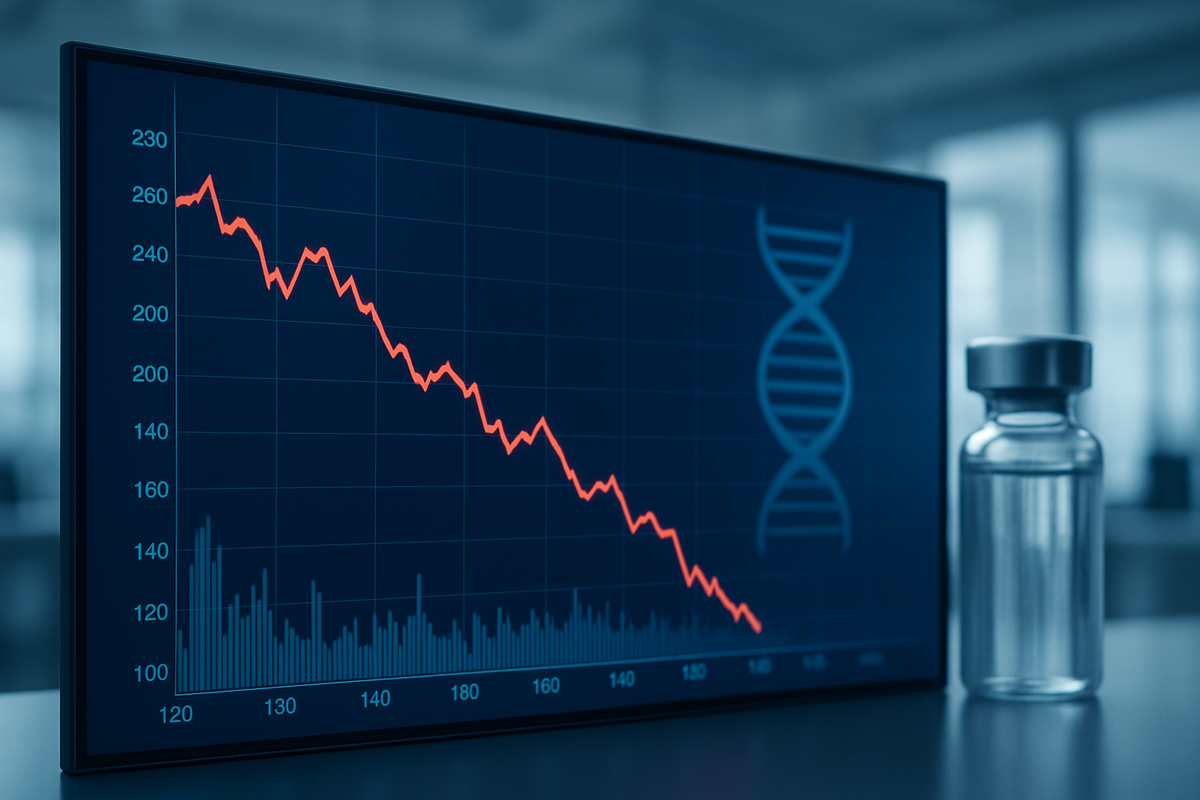
The pharmaceutical giant AbbVie (NYSE: ABBV) experienced a sharp decline on Wednesday, March 18, 2026, as its stock price tumbled to its lowest level since mid-2025. Shares of the Illinois-based company fell nearly 4% during the session, trading in the range of $211 to $219, a stark contrast to the all-time high of $244.81 reached just five months ago in October 2025. This downward trajectory reflects a growing sense of caution among investors as the company navigates the "post-Humira" landscape and faces intensifying competition in its core immunology franchise.
The immediate implications of this slump are twofold: it signals a technical breakdown that has triggered stop-loss orders and algorithmic selling, and it highlights the market's sensitivity to the shifting regulatory and competitive environment in the biopharma sector. While AbbVie has successfully launched successors to its blockbuster drug Humira, recent FDA approvals for rival treatments and a significant legal setback regarding drug discount programs have created a "perfect storm" that is currently weighing on shareholder sentiment.
A Perfect Storm: Analyzing the Descent from October Peaks
The retreat in AbbVie’s share price did not happen in a vacuum. After peaking in October 2025, the stock began a slow erosion that accelerated in early 2026. The primary catalyst for the most recent leg down was a duo of regulatory approvals for competitors in the immunology space. In early March 2026, Johnson & Johnson (NYSE: JNJ) received FDA approval for ICOTYDE, an oral treatment for plaque psoriasis that offers a convenient alternative to AbbVie’s injectable blockbuster, Skyrizi. Simultaneously, Bristol Myers Squibb (NYSE: BMY) secured a supplemental approval for Sotyktu in active psoriatic arthritis, further crowding a market that AbbVie has long dominated.
Beyond the competitive landscape, a significant legal blow dealt in February 2026 has contributed to the bearish narrative. The 5th U.S. Circuit Court of Appeals upheld a Louisiana law preventing drugmakers from restricting 340B discounts at contract pharmacies. AbbVie, a lead plaintiff in the challenge, now faces the reality of sustained margin pressure from these mandatory discounts. Furthermore, the company’s Q4 2025 earnings report, released on February 4, 2026, revealed that Humira sales plummeted by approximately 50% year-over-year due to aggressive biosimilar competition, a trend management expects to continue throughout 2026 as more healthcare plans exclude the branded drug.
Technically, the stock is showing signs of exhaustion. On March 13, 2026, ABBV shares slipped below their 50-day simple moving average (SMA), an indicator often used by traders to identify intermediate-term trends. With the Relative Strength Index (RSI) hovering near 40 and a bearish MACD crossover confirmed this week, momentum players have largely moved to the sidelines. This technical weakness has been compounded by reports of insider selling by high-level executives in late February, which, while often routine, has added to the cautious atmosphere surrounding the stock.
Winners and Losers in the Shifting Immunology Market
The current volatility in AbbVie’s stock highlights a broader realignment within the pharmaceutical industry. The primary beneficiaries of AbbVie’s current struggles are its immediate peers, Johnson & Johnson and Bristol Myers Squibb. By securing approvals for oral alternatives to biologics, these companies are successfully challenging the "injectable-first" paradigm in immunology. J&J’s ICOTYDE, in particular, is positioned as a disruptive force that could peel away market share from Skyrizi, which AbbVie had hoped would be its primary growth engine for the next decade.
Conversely, AbbVie finds itself in a defensive posture, forced to accelerate its pipeline execution to offset the $20 billion revenue hole left by Humira. While Skyrizi and Rinvoq are still projected to generate a combined $31.5 billion in 2026, the arrival of potent oral competitors like Sotyktu suggests that the "moat" around these products is narrower than previously thought. Additionally, biosimilar manufacturers like Amgen (NASDAQ: AMGN) and Samsung Bioepis continue to win on volume, further eroding AbbVie’s legacy revenue base.
Investors in the broader healthcare sector are also feeling the impact. AbbVie’s decline has dragged down several biotech ETFs, as the company is a heavyweight component in many dividend-growth and value-oriented portfolios. However, long-term value investors may see this as a "shakeout" period, where the market overreacts to short-term competitive noise while ignoring AbbVie’s underlying pipeline potential in oncology and obesity.
Broader Industry Trends and the Regulatory Shadow
The challenges facing AbbVie are emblematic of the "patent cliff" era, where large-cap pharma companies must reinvent themselves as their legacy blockbusters lose exclusivity. AbbVie’s transition is perhaps the most scrutinized in history, given Humira's status as the former top-selling drug in the world. This event fits into a wider industry trend of diversifying into high-growth areas like oncology and metabolic health to escape the pricing pressures of the mature immunology market.
Regulatory and policy implications are also playing a major role. The shadow of the Inflation Reduction Act (IRA) and the upcoming Medicare price negotiations scheduled for late 2026 are creating a "pricing reset" narrative. Investors are increasingly wary of companies with high Medicare exposure, fearing that government-mandated price cuts will further crimp margins. The 340B ruling in Louisiana serves as a reminder that the regulatory environment for drug pricing is becoming increasingly hostile for manufacturers, favoring providers and discount programs over corporate profits.
Historically, this situation mirrors the early 2010s, when several major pharmaceutical firms faced "patent cliffs" for blockbuster statins and antidepressants. Companies that successfully navigated those periods were those that had a robust secondary pipeline already in late-stage trials. AbbVie is attempting to follow this playbook, but the speed of innovation in oral biologics has moved faster than many analysts anticipated, forcing a re-evaluation of the company’s long-term terminal value.
What Lies Ahead: Obesity Data and Pipeline Pivots
Despite the current gloom, the short-term outlook for AbbVie is not without potential catalysts. The company recently released promising Phase 1 data for ABBV-295, a long-acting amylin analog for obesity. The drug showed dose-dependent weight loss of nearly 10% in just 13 weeks, positioning AbbVie as a potential third player in the lucrative weight-loss market currently dominated by Eli Lilly and Novo Nordisk. If subsequent trials maintain this efficacy with a clean safety profile, ABBV-295 could become the "wildcard" that restores investor confidence.
Strategically, AbbVie is likely to pivot more aggressively toward its oncology portfolio. Its partnership with Genmab (NASDAQ: GMAB) for the blood cancer drug Epkinly remains a bright spot, despite mixed trial results in early 2026. Management has also hinted at a potential subcutaneous formulation of Skyrizi, which could be filed for approval mid-year, potentially neutralizing the "convenience advantage" held by J&J’s oral treatments.
The long-term scenario for AbbVie depends on whether its 2026 revenue target of $67 billion remains achievable. If Skyrizi and Rinvoq can hold their ground against oral competitors, and if the obesity pipeline proves viable, the current dip may eventually be viewed as a classic "valuation reset." However, failure to meet these targets in the face of IRA-related price cuts could lead to further downward revisions in the stock’s multiple.
Summary and Investor Outlook
The descent of AbbVie shares to their lowest level since mid-2025 is a multi-faceted event driven by competitive breakthroughs, legal setbacks, and technical sell-offs. While the "post-Humira" transition was always expected to be volatile, the speed with which rivals like Johnson & Johnson and Bristol Myers Squibb have introduced oral alternatives has surprised the market, leading to the current 15% drawdown from the stock's October highs.
Moving forward, the market will be hyper-focused on AbbVie’s Q1 2026 earnings report and any updates regarding the obesity pipeline. The "Moderate Buy" consensus from analysts suggests that many believe the company’s fundamentals remain intact, but the technical breakdown indicates that the path to recovery will be arduous. Investors should watch for stabilization in the aesthetics business (Botox) and clinical progress in the oncology segment as key indicators of a potential bottom.
Ultimately, AbbVie’s current struggle serves as a cautionary tale of the risks inherent in the biopharma sector: even with a well-telegraphed patent cliff and successful follow-on products, the rapid pace of innovation and a tightening regulatory landscape can quickly turn a market leader into a defensive play.
This content is intended for informational purposes only and is not financial advice.