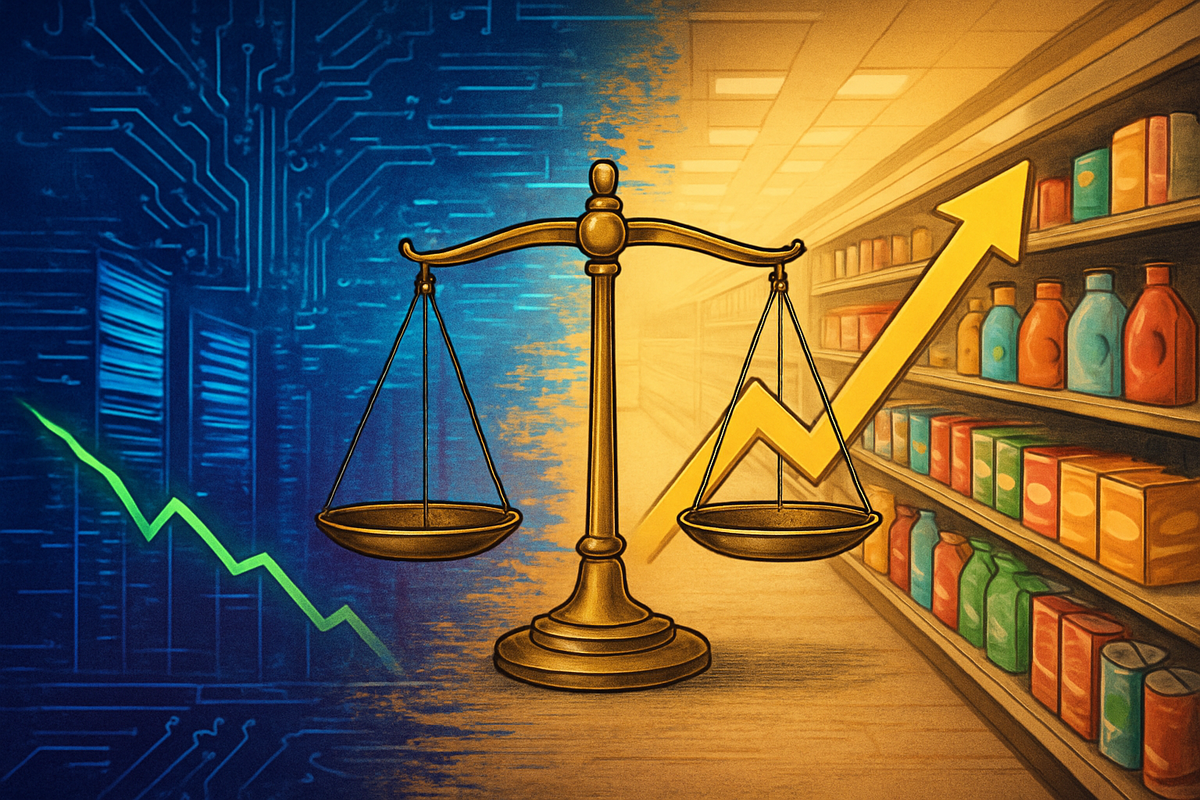
As of March 12, 2026, a fundamental shift in the tectonic plates of the global financial markets has reached a fever pitch. Investors are aggressively fleeing the high-octane, AI-driven growth stories that defined the early 2020s, opting instead for the perceived safety and "boring" reliability of the Consumer Staples sector. This "Great Rotation" has seen the Consumer Staples Select Sector SPDR Fund (NYSE: XLP) surge by a staggering 13.2% year-to-date, marking its best opening quarter in over a decade.
The implications of this shift are profound, signaling a "decoupling" of market segments where the traditional relationship between growth and value is being rewritten. While the Technology Select Sector SPDR Fund (NYSE: XLK) continues to languish in negative territory, the sudden appetite for inflation-resistant dividends and predictable earnings suggests that the market’s "AI honeymoon" is officially over, replaced by a cold, calculating focus on tangible cash flows and defensive positioning.
The Cracks in the AI Monolith and the Rise of the Defensive "Fortress"
The momentum behind this rotation began to build in late 2025 but accelerated sharply following the "Software-mageddon" of February 2026. After two years of nearly unchecked capital expenditure on artificial intelligence infrastructure, the market began to demand a "Return on AI Investment" (ROAI) that many Big Tech firms have struggled to provide. Reports of "CapEx fatigue" among hyperscalers—where infrastructure spending was projected to exceed $600 billion this year—met a wall of skepticism as immediate revenue growth from AI applications failed to scale as fast as the depreciation of the hardware.
The timeline of this pivot was further solidified by a series of "sticky" inflation reports and a disappointing February jobs report that saw the loss of 92,000 positions. As the Federal Reserve maintained a "higher-for-longer" stance with interest rates hovering in the 3.50% to 3.75% range, the 10-year Treasury yield climbed toward 4.25%, making the high valuation multiples of tech companies increasingly difficult to justify. In contrast, the Consumer Staples sector, which lagged significantly during the 2024-2025 AI bull run, suddenly appeared undervalued and over-prepared for an era of economic uncertainty.
Winners of the Real Economy: From Tide to Coca-Cola
The primary beneficiaries of this rotation are the "Dividend Kings" and large-cap defensive giants. Procter & Gamble (NYSE: PG) has emerged as a cornerstone of this new market regime, with its pricing power and essential household portfolio—including brands like Tide and Gillette—providing a necessary buffer against market volatility. Similarly, The Coca-Cola Company (NYSE: KO) has seen renewed interest, with investors flocking to its 63-year streak of dividend increases and its guidance for strong organic revenue growth in 2026. Retail powerhouses like Costco Wholesale Corporation (NASDAQ: COST) have also seen their stock prices reach all-time highs as consumers prioritize value-oriented shopping in a stubborn inflationary environment.
On the other side of the ledger, the former market darlings are facing a painful "valuation reset." NVIDIA Corporation (NASDAQ: NVDA), which could seemingly do no wrong in 2024, has faced intense pressure as investors move away from semiconductor plays in favor of diversified yield. Apple Inc. (NASDAQ: AAPL) has also struggled, as its AI integration is viewed by the market as "evolutionary" rather than the "revolutionary" catalyst needed to spark a new super-cycle of hardware upgrades. Microsoft Corporation (NASDAQ: MSFT), while still a fundamental powerhouse, has seen its multiple contract as shareholders grow weary of the massive, ongoing costs required to maintain its lead in the generative AI space.
A Historical Decoupling: Beyond the Hype
The "Great Rotation" of 2026 fits into a broader historical pattern of market cycles, often compared to the post-dotcom pivot of the early 2000s. Just as the euphoria of the internet age eventually gave way to a focus on "old economy" value, the AI era is undergoing its first real test of sustainability. This decoupling suggests that the market is no longer viewing "Tech" as a monolith that moves the entire S&P 500. Instead, we are seeing the "S&P 493"—the stocks outside of the massive tech giants—finally lead the charge.
This shift has significant ripple effects across the industry. For competitors and smaller startups, the drying up of easy capital from the tech giants means a harder path to acquisition and growth. Furthermore, regulatory scrutiny on Big Tech’s data dominance and AI monopolies has added a layer of political risk that Consumer Staples companies simply do not face. Historically, defensive pivots of this magnitude often precede a "normalization" of the economy, where the gap between speculative growth and real-world utility finally closes.
What Comes Next: The "Fortress" Approach and Strategic Pivots
In the short term, the market is likely to remain in a defensive "crouch." Investors should expect continued volatility in the tech sector as earnings reports are scrutinized for actual AI monetization rather than just promises. For Big Tech firms, the strategic pivot required is clear: they must transition from "growth at any cost" to "operational efficiency." We are likely to see a wave of cost-cutting measures and share buybacks as these companies attempt to woo back investors who are currently enamored with the 3% dividend yields of the Staples sector.
Long-term, the rotation could provide a healthier foundation for the next bull market. By flushing out the "excess" in AI valuations, the market is allowing a more balanced ecosystem to emerge. Potential scenarios include a "soft landing" where Staples remain the leaders through the end of 2026, or a more aggressive tech rebound if the ROI on AI finally begins to hit the bottom line by the fourth quarter. Regardless, the "Fortress" approach—prioritizing high free cash flow and low debt—is expected to be the dominant investment strategy for the foreseeable future.
Final Thoughts: Navigating the New Market Regime
The Great Rotation of 2026 serves as a stark reminder that in the world of finance, gravity eventually wins. The outperformance of the XLP and the stagnation of the XLK represent a return to fundamental investing principles: earnings quality, dividend reliability, and valuation discipline. While the technological advancements of AI remain transformative, the market is currently more interested in who can pay their dividends today than who might change the world tomorrow.
Moving forward, investors should keep a close eye on the Federal Reserve’s upcoming policy meetings and the next round of corporate earnings. If Consumer Staples continue to beat expectations while Tech misses on AI revenue, the rotation could transition from a seasonal shift into a multi-year cycle. For now, the "Supermarket Aisle" is the safest place on Wall Street, and the trend shows no signs of reversing before the summer of 2026.
This content is intended for informational purposes only and is not financial advice.