As of March 12, 2026, the global financial markets have undergone a profound transformation. The speculative fervor that defined the "AI hype" of 2023 and 2024 has matured into a disciplined, industrial-scale expansion. In what analysts are calling the "Year of Proof," the narrative has shifted from the mere possibility of artificial intelligence to the concrete reality of its backbone: the physical infrastructure that powers it. The 2026 market is no longer driven by promises of future productivity; it is anchored by the durable earnings of the companies building the world’s "AI factories."
This structural shift is most visible in the staggering capital expenditure (CapEx) projections of the world’s largest technology firms. Combined, the "Big Four"—Amazon (NASDAQ: AMZN), Alphabet (NASDAQ: GOOGL), Meta Platforms (NASDAQ: META), and Microsoft (NASDAQ: MSFT)—have signaled a 2026 investment package of nearly $700 billion. This capital is being funneled into specialized hardware, massive data center campuses, and, increasingly, proprietary energy sources. For investors, the takeaway is clear: the most reliable returns are currently found in the "picks and shovels" of the AI era, where demand remains far from saturated and barriers to entry are reaching stratospheric heights.
The Industrialization of Compute: From Speculation to Proof
The first quarter of 2026 has served as a validation point for the infrastructure-first investment thesis. Leading semiconductor firms have reported record-breaking earnings that underscore the relentless demand for high-performance compute. NVIDIA (NASDAQ: NVDA) recently reported a record Q4 revenue of $68.1 billion, a 73% year-over-year increase, driven primarily by its data center segment. The rapid ramp-up of the "Blackwell" and early "Vera Rubin" architectures has allowed NVIDIA to guide for nearly $78 billion in the coming quarter, signaling that the build-out of "AI factories" is accelerating rather than slowing.
This timeline of execution began in late 2024, when enterprises moved from testing small language models to deploying complex, multi-agent workflows. By 2026, the focus has shifted toward "tokens per watt per dollar"—a metric that measures the efficiency of AI infrastructure rather than just raw power. Key players like Advanced Micro Devices (NASDAQ: AMD) and Marvell Technology (NASDAQ: MRVL) have also carved out massive territories in this landscape. AMD’s data center segment hit a record $5.4 billion in its latest report, while Marvell has seen bookings for custom silicon and optical interconnects grow at a record pace. The initial market reaction was one of cautious optimism, but as the "Year of Proof" continues, the stability of these earnings is convincing even the most ardent skeptics that AI is the primary driver of S&P 500 returns.
Winners and Losers in the Infrastructure Supremacy
The winners in this new era are those who control the physical constraints of AI: silicon, networking, and cooling. Broadcom (NASDAQ: AVGO) has emerged as a vital pillar, acting as the "plumbing" of the AI ecosystem. Its custom AI accelerators (XPUs) and high-speed Ethernet switching revenue doubled year-over-year to $8.4 billion. Similarly, the physical infrastructure sector has seen a massive revaluation. Vertiv (NYSE: VRT), a leader in liquid cooling and power management, reported a 252% increase in orders as data center rack densities exceeded 100 kW. Eaton (NYSE: ETN) has seen similar success, with its data center segment growing at a 40% clip as it manages the immense power distribution needs of North American megaprojects.
Conversely, the "AI transition" has created a new class of market losers. Traditional networking firms like Cisco Systems (NASDAQ: CSCO) have faced margin compression as "standard" IT budgets are cannibalized by specialized AI compute spending. Furthermore, software intermediaries that once acted as human-process brokers—such as certain ad-tech firms and legacy service providers—are struggling. AppLovin (NASDAQ: APP), for instance, saw a sharp year-to-date decline in 2026 as fears grew that AI agents would fundamentally disintermediate traditional search and advertising workflows. Companies that rely on high-cost human labor for data synthesis are finding themselves on the wrong side of a "productivity cliff," as investors rotate into firms that provide the end-to-end execution of AI tasks.
The Energy Crunch and the Rise of Sovereign AI
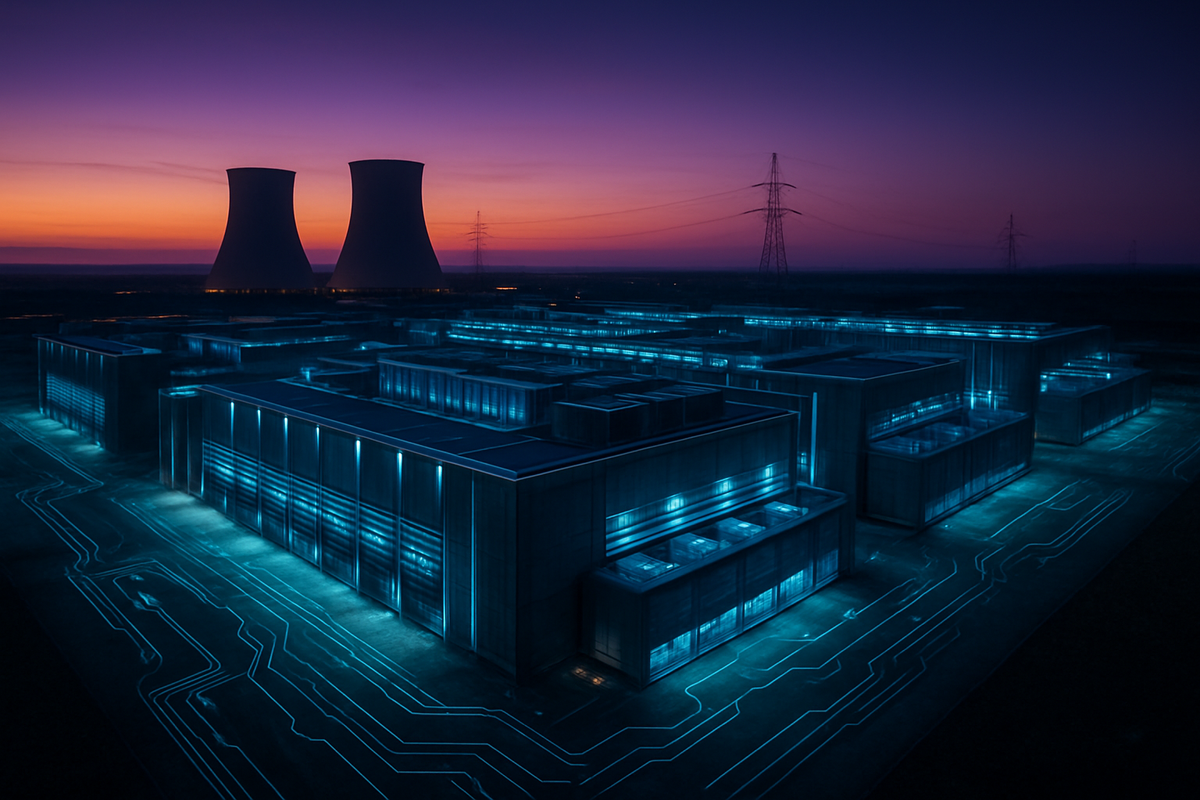
The wider significance of this infrastructure boom extends into the global energy grid and geopolitics. We are currently witnessing a "nuclear renaissance" specifically funded by Big Tech. To bypass grid congestion and meet sustainability goals, Microsoft recently funded the $16 billion restart of the Crane Clean Energy Center at Three Mile Island. Amazon and Google have followed suit, with Amazon deploying Small Modular Reactors (SMRs) and Google partnering with Kairos Power for molten salt reactors. This shift has forced a regulatory pivot; in the U.S., major tech firms have signed a "Ratepayer Protection Pledge" to fund 100% of the cost of new grid infrastructure, preventing a price shock for residential consumers.
Beyond energy, 2026 has marked the rise of "Sovereign AI." Nations now view compute power as a strategic asset on par with oil. Saudi Arabia’s $100 billion "HUMAIN" project and the European Union’s "AI Gigafactories" represent a defensive move to reduce reliance on U.S.-based hyperscalers. These sovereign initiatives are driving a new wave of demand for localized data centers and domestic model training, creating a "moat" that protects national data while stimulating local semiconductor ecosystems. This trend mirrors the historical precedent of nationalized telecommunications and energy grids in the 20th century.
Strategic Pivots and the Road to 2027
Looking ahead, the next phase of the market will likely focus on "Agentic ROI." As the physical infrastructure reaches maturity, the burden of proof will shift toward the applications running on these systems. Short-term, companies must adapt to the "energy-first" reality, where data center site selection is determined more by access to power than by proximity to urban hubs. Strategic pivots are already underway; hyperscalers are transitioning from being mere cloud providers to being energy producers and silicon designers.
Market opportunities will emerge in the integration of AI with physical robotics and the "industrial metaverse." However, challenges remain. The "depreciation cliff"—the massive cost of replacing aging AI hardware—could impair margins for hyperscalers by late 2026 if adoption rates moderate. Investors should watch for "tokens per watt" efficiency breakthroughs and the potential for a "capital intensity" correction if the productivity gains from agentic AI do not keep pace with the nearly $400 billion in annual depreciation expenses facing the tech giants.
Assessing the Market Moving Forward
The state of the market on March 12, 2026, is one of high-stakes industrialization. The infrastructure phase of the AI revolution is far from over, but the requirements for success have narrowed. Durable earnings are the new benchmark, and the ability to navigate the physical bottlenecks of power, cooling, and specialized silicon has become the ultimate competitive advantage. While the "Big Four" continue to dominate, the growth of infrastructure providers like Vertiv and Broadcom suggests that the value is being captured at the foundational layers of the stack.
Moving forward, investors should keep a close eye on the stability of the energy grid and the progress of sovereign AI projects in the Middle East and Europe. These factors will determine whether the current momentum is sustainable or if we are approaching a period of consolidation. For now, the "AI backbone" remains the structural anchor of the bull market, transforming the global economy one data center at a time. The transition from "possibility" to "proof" is complete; the era of execution has truly begun.
This content is intended for informational purposes only and is not financial advice.