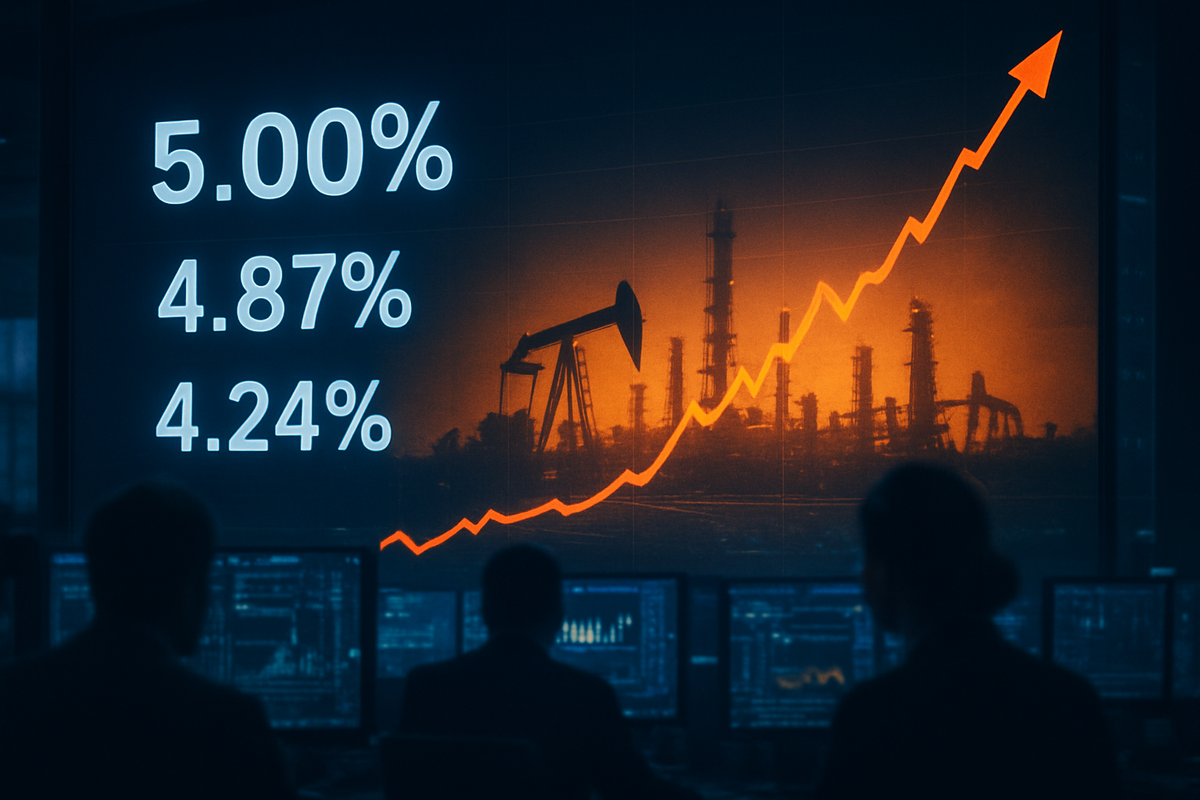
On March 12, 2026, the U.S. financial system reached a critical inflection point as Treasury yields surged toward levels not seen in years, sending shockwaves through global equity markets. The 30-year Treasury bond yield climbed to 4.87%, while the benchmark 10-year note rose to 4.24%, driven by a perfect storm of geopolitical instability and a sudden, sharp spike in energy prices. This aggressive "bear steepening" of the yield curve reflects a growing market conviction that inflation is no longer a ghost of the past, but a persistent threat fueled by oil prices that have recently breached the $115-per-barrel mark.
The immediate implications for the market are stark: as yields approach the psychologically significant 5% mark, the cost of capital is resetting for every corner of the economy. For investors, the era of "easy money" feels more distant than ever, replaced by a "policy trap" where the Federal Reserve is caught between a cooling labor market and a resurgence of cost-push inflation. As the 10-year yield anchors the pricing for everything from mortgages to corporate debt, the sudden move higher has triggered a massive rotation out of high-growth sectors, leaving the broader indices grappling with a new, high-rate reality.
The Yield Spike and the Oil Catalyst
The surge in yields on March 12, 2026, was catalyzed by a rapid escalation of tensions in the Middle East, specifically the effective closure of the Strait of Hormuz, which sent Brent crude prices skyrocketing. This energy shock has fundamentally altered the inflation narrative for 2026. While headline CPI had hovered near 2.4% at the start of the year, analysts are now projecting a jump toward 4.5% by the second quarter. The timeline leading to this moment began in early February when a series of supply-side disruptions met a surprisingly resilient consumer demand, creating a bottleneck that the Federal Reserve has struggled to manage.
Key players in this drama include the Federal Open Market Committee (FOMC), led by Chairman Jerome Powell, whose term is set to expire in just two months. The uncertainty surrounding the Fed’s future leadership has added a "transition premium" to long-term yields. Market participants are increasingly skeptical that the central bank can navigate a "soft landing" when energy costs are acting as a regressive tax on consumers. Initial market reactions saw the S&P 500 and the Nasdaq Composite drop significantly in pre-market trading, as the 30-year yield’s move to 4.87% triggered automated sell programs tied to historical volatility thresholds.
Institutional bondholders, including major pension funds and international sovereign wealth funds, have been the primary sellers, offloading long-duration assets to mitigate the risk of further price declines. This sell-off has been exacerbated by the sheer volume of U.S. government debt, which now exceeds $36 trillion. With the federal deficit widening, the Treasury Department's increased auction sizes are meeting a market that is demanding a much higher yield to absorb the supply, particularly as the "war premium" on oil makes cash and short-term equivalents look more attractive than long-term government paper.
Winners, Losers, and Corporate Fallout
The tech and growth sectors are bearing the brunt of this yield spike, as higher discount rates erode the present value of future earnings. Nvidia (NASDAQ: NVDA), which has been the cornerstone of the AI-driven market expansion, saw its stock price stumble as the 10-year yield crossed the 4.16% resistance level. Analysts note that Nvidia’s aggressive valuation is highly sensitive to borrowing costs, and any move toward a 5% yield could force a fundamental repricing of the semiconductor giant. Similarly, Microsoft (NASDAQ: MSFT) and Amazon (NASDAQ: AMZN) have faced pressure; Amazon’s projected $200 billion AI capital expenditure budget for 2026 is now significantly more expensive to finance than it was just six months ago.
On the other side of the ledger, the banking sector is experiencing a mixed reaction. While higher yields can improve net interest margins for lenders like JPMorgan Chase (NYSE: JPM) and Bank of America (NYSE: BAC), the speed of the move raises concerns about "duration risk" on their balance sheets, reminiscent of the 2023 banking crisis. Furthermore, the cooling labor market—highlighted by a shock loss of 92,000 jobs in February—suggests that loan defaults could rise if the economy tips into recession. For these financial giants, the benefit of higher rates may soon be offset by a sharp increase in credit loss provisions.
Consumer-discretionary companies are also in the crosshairs. Tesla (NASDAQ: TSLA) has seen its shares decline as higher interest rates make auto loans more expensive, further dampening demand in a market already struggling with high energy costs. Conversely, traditional energy companies like ExxonMobil (NYSE: XOM) and Chevron (NYSE: CVX) have emerged as short-term winners, with their valuations buoyed by the surge in crude prices. However, even these gains are tempered by the fear that $115 oil will eventually destroy demand and trigger a broader economic contraction.
Analyzing the Macro Significance
The current situation is widely viewed as a "policy trap" for the Federal Reserve, a term used to describe a scenario where the central bank’s dual mandate of price stability and maximum employment is in direct conflict. With unemployment climbing to 4.4% and oil-fueled inflation rising, the Fed cannot easily cut rates to support the labor market without risking a de-anchoring of inflation expectations. This mirrors the stagflationary environment of 1979, but with a critical difference: the sheer scale of the U.S. national debt today limits the Fed's ability to maintain high rates for an extended period without triggering a fiscal crisis.
This event fits into a broader trend of "geopolitical de-globalization," where supply-chain vulnerabilities in the energy sector continue to dictate domestic monetary policy. The ripple effects are already being felt by U.S. trading partners; a stronger dollar, fueled by rising Treasury yields, is putting immense pressure on emerging market economies that hold dollar-denominated debt. This global "yield grab" is draining liquidity from international markets, potentially forcing foreign central banks to intervene or raise their own rates, further slowing global growth.
Historical precedents like the October 2023 yield spike, where the 10-year yield briefly touched 5%, serve as a cautionary tale. However, in 2023, the move was driven by economic resilience; in 2026, the move is driven by cost-push factors and a weakening fiscal position. This shift suggests that the "neutral rate" of interest may be structurally higher than previously thought, requiring a permanent adjustment in how investors value risk and return in a post-globalization world.
The Path Ahead: Scenarios and Strategic Pivots
Looking ahead, the short-term focus will be on the Federal Reserve’s upcoming policy meeting and whether Chairman Powell will signal a pivot toward prioritizing the labor market or maintaining a hawkish stance against energy inflation. If the 30-year yield breaks the 5% barrier, it could trigger a technical sell-off that pushes rates toward levels not seen since the early 2000s. Strategic pivots are already underway in the corporate world, with many tech firms scaling back non-essential AI projects to preserve cash in a high-rate environment.
A potential scenario emerging for the latter half of 2026 is one of "managed stagflation," where the Fed allows inflation to run slightly above its 2% target to avoid a deep recession. This would require a sophisticated balancing act that the market has yet to see this committee perform. Market opportunities may emerge in defensive sectors and high-quality "cash cow" companies that can self-fund their growth without relying on the debt markets. However, the challenge for the U.S. financial system will be maintaining stability in the Treasury market, which serves as the bedrock for global finance.
The ultimate outcome may depend on the leadership transition at the Fed. With Powell's term ending in May, the appointment of a successor will be a pivotal moment. A "dovish" appointment could temporarily soothe the labor market but risk a run on the dollar, while a "hawkish" successor might prioritize price stability at the cost of a significant economic downturn. Investors should prepare for heightened volatility as these scenarios play out in the coming months.
Wrap-up and Investor Outlook
The events of March 12, 2026, represent a watershed moment for the U.S. economy. The convergence of a 4.87% 30-year yield, an oil shock, and a softening labor market has created a high-stakes environment for the Federal Reserve and investors alike. The key takeaway is that the era of low volatility and predictable interest rates has been replaced by a period of structural uncertainty, where geopolitical events have as much influence on the bond market as domestic economic data.
Moving forward, the market will likely remain in a state of high tension until there is more clarity on the Fed's "policy trap" and the future of energy prices. The resilience of tech giants like Nvidia and Microsoft will be tested, and the broader financial system must navigate a landscape of higher borrowing costs and shifting valuation models. For investors, the focus must shift from pure growth to capital preservation and income generation, as the "5% threshold" redefines what constitutes a "safe" return.
In the coming months, the most important indicators to watch will be the monthly non-farm payroll reports and the stability of the Strait of Hormuz. Any further signs of labor market deterioration or energy supply disruptions will likely push yields higher and stocks lower. As the world watches the 10-year and 30-year Treasuries, the message is clear: the financial system is entering a new chapter, and the rules of the game have fundamentally changed.
This content is intended for informational purposes only and is not financial advice.