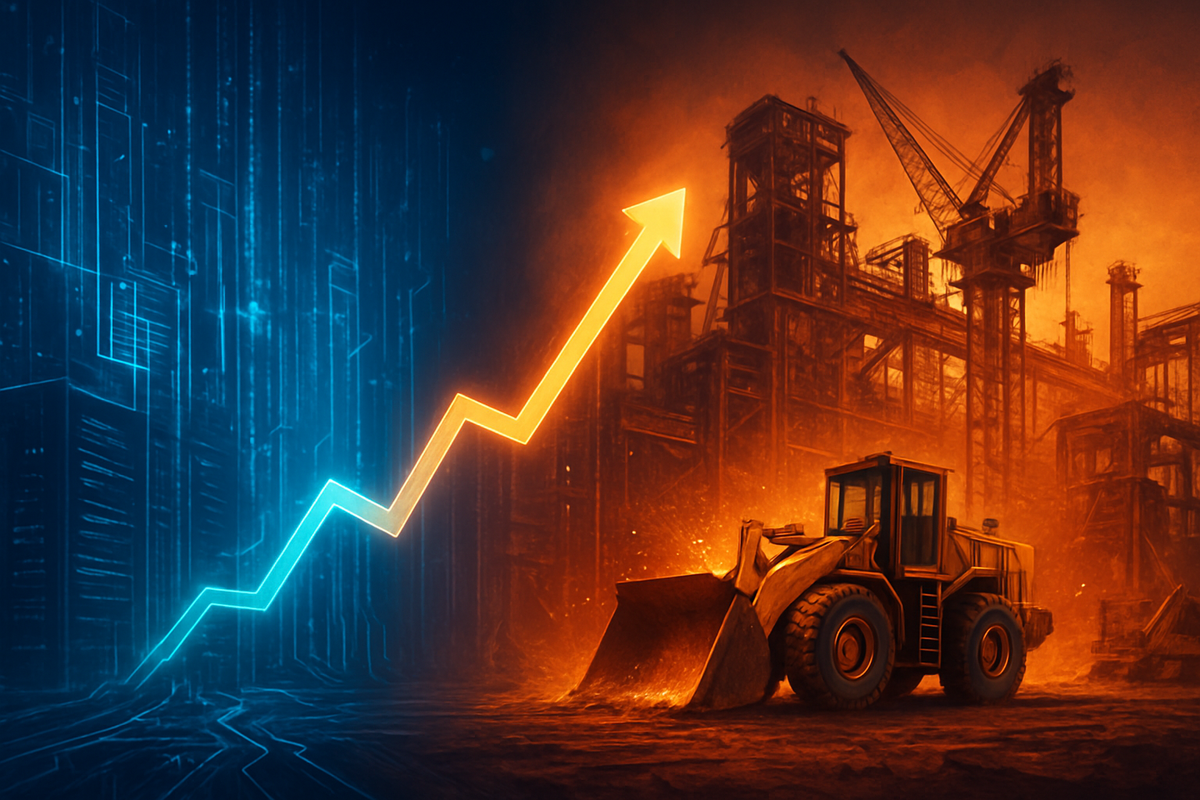
As of March 12, 2026, the U.S. stock market is undergoing its most profound structural realignment in a decade. The "Great Rotation"—a massive migration of capital away from the high-flying technology giants that defined the post-pandemic era and toward the foundational "Old Economy" sectors—has reached a fever pitch. While the tech-heavy Nasdaq has struggled to find its footing, the S&P 500 Equal Weight Index and the Russell 2000 have surged to record highs, signaling a long-awaited broadening of market participation that many analysts believe is a sign of a healthier, more sustainable bull market.
The immediate implications of this shift are visible in the stark divergence of sector performance. Since the start of the year, Energy and Industrials have outpaced Technology by a margin not seen since the early 2000s. Investors, once obsessed with the speculative potential of Artificial General Intelligence (AGI), are now prioritizing "atoms over bits." This pivot is driven by a sobering reassessment of AI’s return on investment (ROI) and a renewed focus on domestic manufacturing, infrastructure, and energy security, effectively ending the era of tech-led market concentration.
The Re-Rating of the Real Economy
The transition currently dominating headlines didn’t happen overnight; it is the culmination of a two-year journey that began in late 2024. Throughout 2025, the market’s patience with the "Magnificent Seven" began to wear thin. The primary catalyst was a massive "valuation crisis" triggered by the astronomical capital expenditures of firms like Microsoft Corp. (NASDAQ: MSFT) and Amazon.com Inc. (NASDAQ: AMZN). By the end of 2025, it was estimated that the top tech firms had spent over $500 billion on AI infrastructure with only incremental gains in high-margin software revenue to show for it.
The "DeepSeek Shock" of early 2025 served as a pivotal moment for the industry. When a lean Chinese startup released high-efficiency, open-source AI models that matched the performance of U.S. proprietary systems at a fraction of the cost, the narrative of "AI as a high-margin monopoly" collapsed. This forced a massive repricing of the semiconductor and software sectors. Investors began to realize that while AI was transformative, its primary beneficiaries might not be the model builders, but the companies providing the physical power and hardware to run them.
Simultaneously, the legislative landscape shifted. In July 2025, the "One Big Beautiful Bill Act" (OBBBA) was signed into law, providing a historic wave of fiscal stimulus for domestic production. The act’s permanent reinstatement of 100% bonus depreciation for machinery and targeted tax credits for "tangible production" acted as a massive springboard for the Industrial and Materials sectors. As a result, by Q1 2026, the market's focus had shifted from "who can write the best code" to "who can build the most efficient factory."
Winners and Losers in the New Regime
The primary beneficiaries of this rotation have been companies with tangible assets and reliable cash flows. Caterpillar Inc. (NYSE: CAT) has emerged as a market leader, with its stock price climbing over 30% since the start of 2026. The company is benefiting from a dual tailwind: the domestic manufacturing boom sparked by the OBBBA and the relentless demand for power generation equipment needed for the AI data center buildout. Similarly, Nucor Corp. (NYSE: NUE) has seen its valuation swell as the "reshoring" of American industry drives record demand for domestic steel.
In the Energy sector, the "Copper and Kilowatts Phase" of the AI revolution has breathed new life into traditional power players. Exxon Mobil Corp. (NYSE: XOM) and Chevron Corp. (NYSE: CVX) have seen substantial gains as geopolitical volatility in early March 2026 pushed crude oil prices toward $85 a barrel. Meanwhile, defensive-minded investors have flocked to Consumer Staples for stability. Walmart Inc. (NYSE: WMT) and Costco Wholesale Corp. (NASDAQ: COST) are trading at all-time highs, as their dominant physical footprints and "real-world" earnings provide a hedge against the volatility seen in the tech sector.
Conversely, the tech sector's former darlings are facing a period of "valuation normalization." While NVIDIA Corp. (NASDAQ: NVDA) remains a formidable force, it is no longer the sole driver of market direction. Investors are demanding more than just hardware growth; they are looking for software firms to prove that AI is actually expanding margins rather than just increasing cloud bills. High-multiple software companies that failed to show scalable AI revenue in their late 2025 earnings reports have seen their stock prices stagnate or decline as capital flows toward the "other 493" stocks in the S&P 500.
A Fundamental Shift in Market DNA
This rotation fits into a broader historical trend where market leadership shifts from growth to value as economic cycles mature. Much like the transition from the "Dot Com" era to the commodity boom of the early 2000s, 2026 represents a return to fundamentals. The era of "cheap money" is over, and with interest rates currently stabilized between 3.50% and 3.75%, the "cost of capital" now matters more than "growth at any price." This has created a ripple effect where partners and competitors in the industrial space are seeing increased M&A activity as they race to scale up for the domestic manufacturing surge.
The regulatory environment is also playing a role. Policymakers are increasingly focused on "sovereign capability" in energy and manufacturing. This has led to a policy framework that favors "tangible" industries over digital ones, especially as concerns over AI-driven job disruption grow. By incentivizing the "Old Economy," the government is attempting to balance the digital revolution with a physical one, ensuring that the U.S. remains a global leader in both software and steel.
Historical precedents suggest that such rotations often precede long-term periods of broader market growth. The "Code Phase" of 2023–2025 allowed for the rapid development of AI tools, but the current "Physical Phase" is where those tools are being applied to modernize the grid, optimize supply chains, and rebuild the industrial base. This is not a "tech crash," but rather a maturation of the market where the benefits of innovation are finally trickling down to the rest of the economy.
The Road Ahead: What to Expect Next
In the short term, the market is likely to remain bifurcated. Tech companies will need to go through a "cleansing" period where valuations are brought in line with actual earnings growth rather than speculative potential. This could lead to a "Software Renaissance" in late 2026 or 2027, but only for those firms that can demonstrate true AI-driven efficiency gains. In the meantime, the momentum remains firmly behind Energy and Industrials as the "Atoms over Bits" narrative continues to gain traction.
Strategic pivots are already underway. Many technology-focused hedge funds are diversifying into "green metals" and energy infrastructure to capture the next leg of the cycle. The challenge for investors will be identifying which "Old Economy" stocks are truly benefiting from structural shifts and which are merely enjoying a temporary cyclical lift. Market opportunities will likely emerge in mid-cap industrial and materials companies that have been overlooked for the better part of a decade.
The potential scenarios for the remainder of 2026 include a "sideways" Nasdaq as it digests its previous gains, while the Dow Jones Industrial Average and the Russell 2000 continue to outperform. If the domestic manufacturing data remains strong and the OBBBA incentives continue to flow, the rotation could solidify into a multi-year trend that fundamentally changes the composition of the average retirement portfolio.
Conclusion: A New Era of Diversification
The great sector rotation of 2026 marks the end of an era of unprecedented tech dominance and the beginning of a more balanced investment landscape. The shift from "Silicon to Steel" reflects a market that has become wiser about the actual costs and timelines associated with the AI revolution. By moving capital into Energy, Industrials, Materials, and Staples, investors are voting for "real-world" stability and tangible earnings over the speculative promises of the digital frontier.
Moving forward, market breadth will be the key metric to watch. A healthy market is one where more than just a handful of stocks are doing the heavy lifting. As of March 2026, market participation has reached its highest level in years, with over 65% of stocks participating in the broader rally. This diversification provides a much-needed buffer against volatility in any single sector, making the overall market more resilient to external shocks.
For investors, the coming months will require a disciplined focus on valuation and cash flow. The "set it and forget it" strategy of holding a concentrated tech portfolio is being replaced by a need for active diversification. Watching the progress of domestic infrastructure projects, energy prices, and the implementation of manufacturing tax credits will be essential. The "Great Rotation" isn't just a temporary trend; it’s a sign that the American economy is reconnecting with its industrial roots.
This content is intended for informational purposes only and is not financial advice.