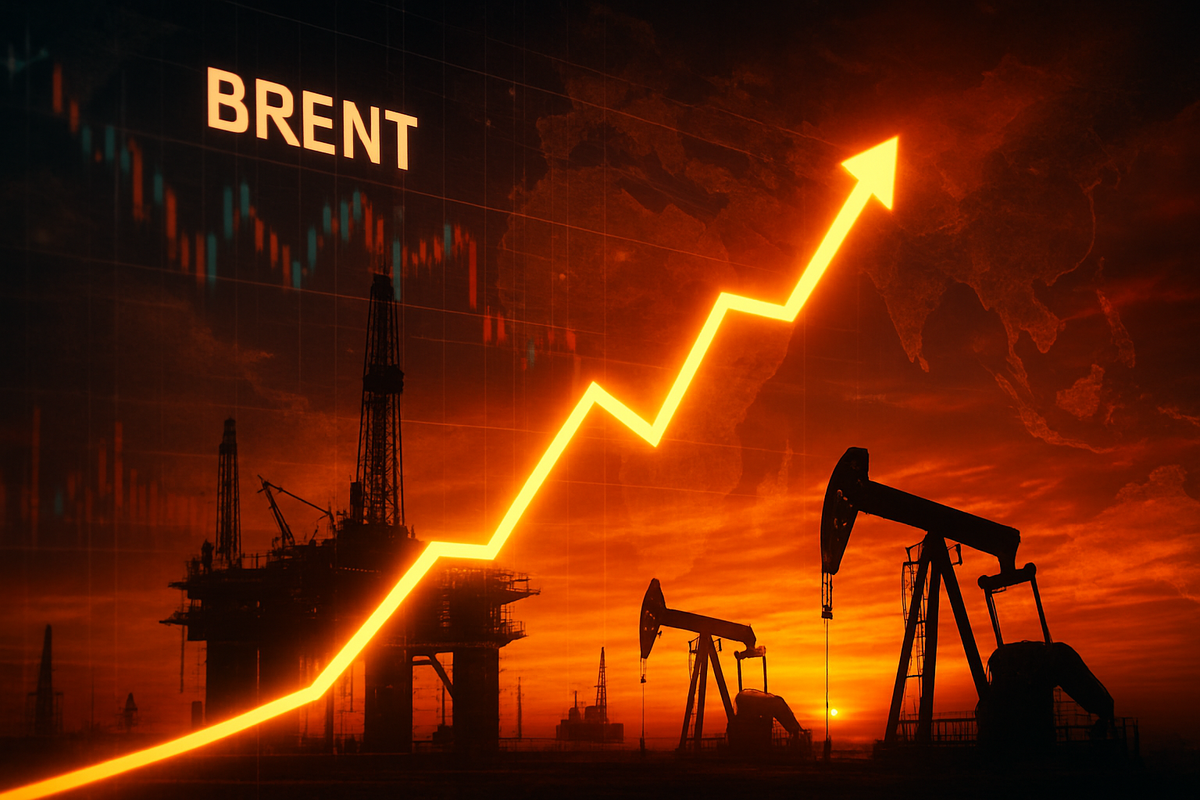
The global energy landscape has undergone a dramatic transformation in the first two months of 2026. Brent crude oil, the international benchmark, has decisively breached the $70 psychological resistance level, completing a remarkable 20% ascent from its late December 2025 lows. As of February 27, 2026, Brent is trading firmly between $70.70 and $71.80 per barrel, marking a definitive end to the stagnant, range-bound trading that characterized much of the previous year.
This sudden resurgence in oil prices has sent shockwaves through global financial markets. While the rally provides a significant windfall for major energy producers and oil-exporting nations, it has simultaneously reignited fears of "sticky" inflation. Central banks, which had spent 2025 signaling a potential shift toward monetary easing, are now being forced to recalibrate their forecasts as rising fuel costs threaten to bleed into broader consumer price indices.
The Perfect Storm: A Timeline of the $70 Breakout
The seeds of the current rally were sown in the final week of December 2025, when Brent was languishing near $60 per barrel amid concerns of a global supply glut. The turnaround began with a series of fundamental shifts, most notably a strategic "production pause" by the core members of OPEC+. Led by Saudi Arabia and Russia, the group opted to halt planned production increases through March 2026, effectively tightening the physical market during a period of seasonally high demand.
The momentum accelerated in early January 2026 following a U.S. military operation in Venezuela aimed at capturing Nicolás Maduro. The resulting political instability raised immediate concerns regarding the reliability of Venezuelan output, which currently stands at approximately 1 million barrels per day. However, the most potent catalyst arrived in mid-February when high-stakes nuclear negotiations in Geneva between the U.S. and Iran reached a total impasse. The diplomatic breakdown led to an immediate "war premium" being priced into the market, as investors feared potential disruptions in the Strait of Hormuz—a vital artery that handles 20% of the world's oil transit.
From a technical perspective, the breakout was a textbook maneuver. Analysts observed a classic "inverted head-and-shoulders" pattern forming on daily charts throughout January. When Brent finally crossed its 200-day moving average and surged past the $70 mark on February 19, it triggered a massive wave of short-covering. This technical momentum, combined with the geopolitical tailwinds, pushed prices to their highest levels in over a year, establishing $70.20 as a new, formidable floor of support.
Winners and Losers: US Energy Giants Lead the Charge
The primary beneficiaries of this price surge have been the "Big Oil" players, with the energy sector emerging as the top-performing segment of the S&P 500 year-to-date. Occidental Petroleum (NYSE: OXY) has been a standout performer, with its stock price jumping 9.4% in late February alone. The company's rally was bolstered by a stellar Q4 2025 earnings report that saw earnings per share hit $0.31, nearly double the analyst consensus of $0.18. With an 8% dividend hike recently announced, OXY has successfully pivoted from a debt-reduction story to a high-yield, cash-return narrative that is attracting significant institutional interest.
Chevron (NYSE: CVX) has similarly capitalized on the rally, trading near the $184 level. The company is currently benefiting from the seamless integration of its Hess assets and continued production growth in the Permian Basin. Analysts estimate that Chevron’s free cash flow could expand by as much as $12.5 billion in 2026 if prices remain at these levels. Meanwhile, ExxonMobil (NYSE: XOM) remains a cornerstone of energy portfolios, trading at approximately 16 times earnings. Investors view Exxon’s low-cost operations in Guyana as a strategic hedge, providing the company with high margins regardless of the volatility in the Middle East.
Conversely, the losers in this scenario are the energy-intensive sectors, most notably airlines and logistics. Companies like Delta Air Lines (NYSE: DAL) and United Parcel Service (NYSE: UPS) are facing immediate pressure on their operating margins as jet fuel and diesel prices climb. If the rally persists into the summer travel season, these firms may be forced to pass costs on to consumers through fuel surcharges, potentially dampening demand in an already fragile economic recovery.
Inflation and Policy: The Macroeconomic Ripple Effect
The broader significance of Brent breaking $70 extends far beyond the trading floor. This rally has effectively reset the global inflation narrative for 2026. In the Philippines, the Bangko Sentral ng Pilipinas (BSP) has already revised its 2026 inflation forecast upward to 3.6% from a previous 3.2%, citing the cascading effect of weekly petroleum price hikes. This pattern is being mirrored in Europe, where the European Central Bank (ECB) is closely monitoring "new inflationary pressures" that threaten to derail their path back to a 2% target.
Historically, sustained oil price spikes have acted as a "stealth tax" on consumers, reducing discretionary spending and slowing GDP growth. While S&P Global recently raised its 2026 global real GDP growth forecast to 2.9%, they cautioned that an escalation toward $100 per barrel remains the single greatest risk to a "soft landing." The current environment mirrors the stagflationary concerns of the mid-2020s, where supply-side shocks complicated the efforts of central banks to maintain price stability without triggering a recession.
Furthermore, this rally highlights the ongoing tension between the global energy transition and immediate energy security. Despite the multi-year push toward renewables, the 2026 surge proves that the global economy remains tethered to fossil fuels. The policy implications are significant: governments may be forced to delay the decommissioning of traditional energy infrastructure or provide new subsidies to shield vulnerable populations from soaring heating and transportation costs.
What Lies Ahead: Can the Rally Sustain Its Momentum?
In the short term, the market is focused on whether Brent can clear the next major resistance band between $73 and $75. Much will depend on the outcome of the next OPEC+ ministerial meeting in March. If the group maintains its discipline and the Geneva stalemate persists, a run toward $80 by the second quarter of 2026 is entirely plausible. However, any signs of a diplomatic breakthrough with Iran or a sudden increase in U.S. shale production could lead to a rapid retracement toward the $65 level.
Longer-term, the sustainability of this rally hinges on the "higher-for-longer" interest rate environment. If central banks are forced to maintain high rates to combat energy-driven inflation, the resulting economic slowdown could eventually sap global oil demand. Investors should watch for a potential "demand destruction" phase if gasoline prices reach levels that discourage consumer activity. For energy companies, the strategic pivot will likely involve balancing immediate shareholder returns with the need to invest in diversified energy portfolios to weather future price volatility.
Navigating the New Energy Reality
The breakout of Brent crude above $70 marks a pivotal moment for the 2026 market cycle. It confirms that the period of low volatility and sub-$60 prices is likely over, replaced by a regime defined by geopolitical risk and tight supply management. For investors, the key takeaways are clear: the energy sector has reclaimed its role as a vital inflation hedge, and the profitability of major producers like ExxonMobil and Chevron is set for a substantial upgrade.
Moving forward, market participants must remain vigilant. The "war premium" is notoriously fickle; a single diplomatic gesture or a change in military positioning could evaporate the current gains overnight. However, the underlying supply-demand balance suggests that the floor for oil has moved permanently higher. In the coming months, the most important indicators to watch will be the monthly inflation prints and the rhetoric from the Federal Reserve and ECB, as they navigate this unexpected "crude awakening."
This content is intended for informational purposes only and is not financial advice.