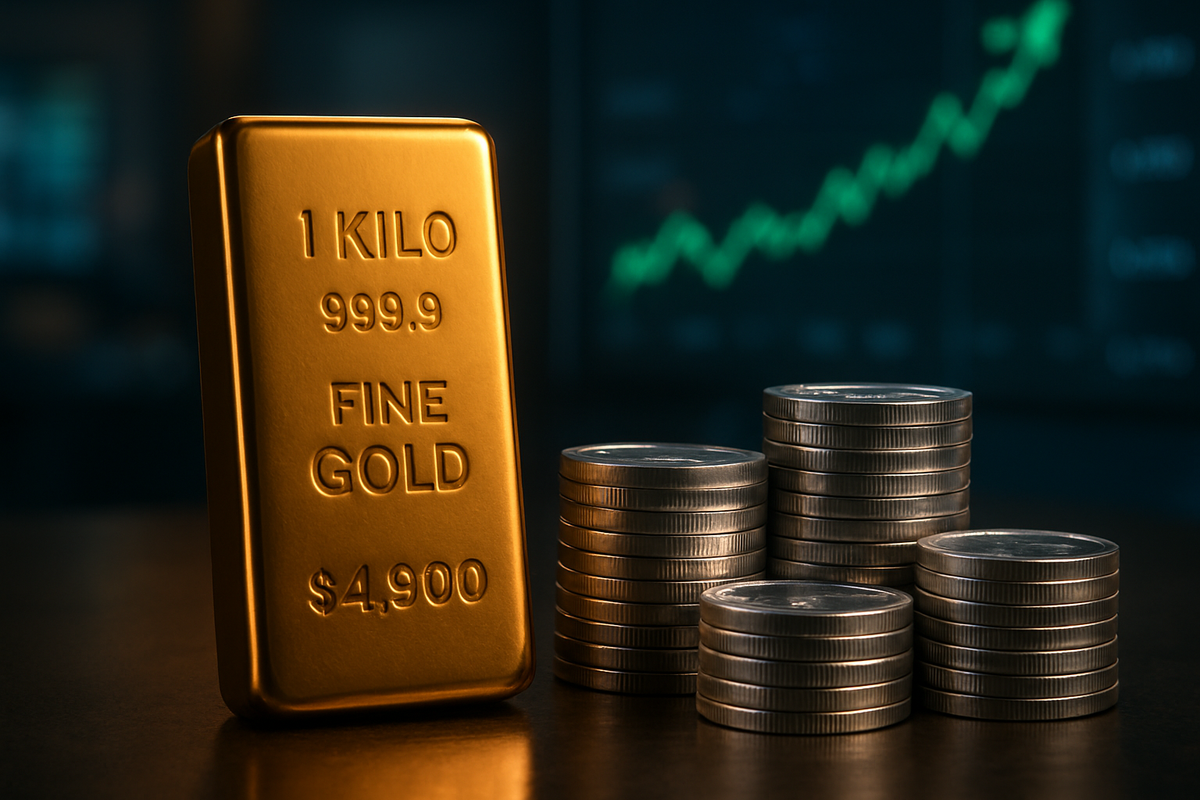
In a day that will be etched into the annals of financial history, precious metals have staged a monumental breakout, redefining the global valuation of hard assets. Gold futures officially closed at a staggering $4,908.80 per ounce, while silver breached the $95 mark for the first time, ending the session at $95.976 per ounce. This vertical ascent represents the culmination of a "perfect storm" in global macroeconomics, characterized by a fundamental decoupling from traditional currency benchmarks and a desperate scramble for inflation-protected security.
The immediate implications are profound. As the U.S. dollar undergoes its most significant six-month decline in half a century, institutional investors are pivoting toward what many are now calling the "2026 Supercycle." This surge is not merely a speculative bubble but a structural repricing driven by deep-seated geopolitical instability and a radical shift in Federal Reserve policy. The crossing of these psychological barriers—$4,900 for gold and $95 for silver—signals a new era where "safe haven" assets may no longer be just a hedge, but the bedrock of a modern diversified portfolio.
The Breach of $4,900: A Timeline of the Unprecedented Surge
The journey to Gold (XAUUSD:CUR) at $4,908.80 was catalyzed by a series of rapid-fire events throughout January 2026. After a volatile 2025 that saw prices climb 65%, the first three weeks of the new year added an explosive 18% to the tally. The final push occurred over the last 48 hours as the market reacted to a dual-threat of escalating trade wars and military activity in the Middle East. Reports of over 70 coordinated strikes in Syria and a tightening naval blockade on sanctioned energy corridors sent "tail-risk" premiums to levels not seen since the early 1970s.
While gold acted as the sovereign protector, Silver (XAGUSD:CUR) proved to be the day's true volatility engine. Closing at $95.976, silver has outpaced its yellow counterpart on a percentage basis, rising 53% in January alone. This move was fueled by a chronic physical shortage; 2026 marks the fifth consecutive year of a silver supply deficit. With silver being a critical component in the "Fourth Industrial Revolution"—specifically for AI data center infrastructure and solar panel manufacturing—the demand from tech giants has effectively "cornered" the physical market, leaving industrial users and retail investors in a frantic bidding war.
Initial market reactions have been characterized by extreme liquidity shifts. The gold-to-silver ratio has compressed dramatically, a classic indicator of a bull market in metals. Major central banks, particularly in the BRICS+ nations, have been identified as the "silent floors" of this rally, as they continue to diversify away from U.S. Treasuries in favor of bullion. By the time the closing bell rang, the narrative of a "transitory" rally had been replaced by the realization of a permanent shift in the global monetary hierarchy.
Winners and Losers in the Mining and Industrial Sectors
The primary beneficiaries of this price explosion are the major mining conglomerates, whose profit margins have expanded exponentially as their production costs remain relatively stable compared to the soaring price of their output. Newmont (NYSE: NEM), the world’s largest gold producer, saw its stock price surge as its operating margins hit a historic 43.5%. The company’s recent completion of "Project Catalyst," a massive restructuring effort, has positioned it perfectly to capitalize on the $4,900 gold floor, with analysts projecting record-breaking dividend yields for the upcoming quarter.
Barrick Gold (NYSE: GOLD) similarly reached new 52-week highs, with the market reacting favorably to its proposal to spin off its North American assets, including the massive Nevada Gold Mines, into a separate publicly traded entity. This move is seen as a way to unlock even more value for shareholders who are hungry for direct exposure to high-grade Western assets. Meanwhile, Pan American Silver (NASDAQ: PAAS) has emerged as the clear champion of the silver surge. Benefiting heavily from its acquisition of the Juanicipio mine, which contributed a record 7.3 million ounces in the final quarter of 2025, PAAS has seen its stock price more than double in the last twelve months.
However, the "loser" column is growing equally fast. Industrial manufacturers and green-tech companies, such as those in the electric vehicle (EV) and solar sectors, are facing a "silver crisis." With silver prices near $96, the cost of manufacturing high-efficiency photovoltaic cells has skyrocketed, potentially delaying the global energy transition. Furthermore, the retail jewelry sector is facing a "sticker shock" moment, as the intrinsic value of raw materials now exceeds the total price of many finished goods from just two years ago.
Geopolitics and the Fed: The Wider Significance
This historic move fits into a broader trend of "de-dollarization" that has accelerated since the mid-2020s. The current administration's aggressive trade policies, including a 100% tariff threat against Canada and the diplomatic fallout from the U.S. proposal to purchase Greenland, have alienated traditional allies and forced a re-evaluation of the U.S. dollar as the world's sole reserve currency. As foreign holdings of U.S. debt hit decade-long lows, the market has turned to gold as the only "neutral" asset that carries no counterparty risk.
The Federal Reserve’s role cannot be overstated. Market participants are now pricing in a total of 150 basis points of interest rate cuts throughout 2026. This pivot, occurring despite "sticky" inflation, has driven real yields into deeply negative territory. Historically, when the real interest rate (nominal rate minus inflation) is negative, gold and silver experience their most aggressive bull runs. We are seeing a repeat of the 1970s stagflationary environment, but on a much larger, more digitized global scale.
The regulatory implications are also beginning to surface. There are growing whispers in Washington and Brussels about the need for "strategic metal reserves" similar to the Strategic Petroleum Reserve. If governments begin competing with private industry for physical silver to ensure their technological sovereignty, the current price of $95 may eventually look like a bargain. This event marks the definitive end of the "low inflation, high stability" era that dominated the early 2010s.
What Comes Next: A Floor or a Ceiling?
In the short term, the market is bracing for a period of extreme volatility as traders "digest" these new price points. Technical analysts suggest that $5,000 for gold and $100 for silver are now the inevitable next targets. However, the risk of a "blow-off top"—a rapid price spike followed by a sharp correction—remains high. Strategic pivots are already occurring; some institutional funds are moving from physical bullion into junior mining explorers (the "picks and shovels" of the industry) to capture higher leverage for the next leg of the rally.
Longer-term, the challenge will be for the global economy to adapt to high-cost silver. If prices remain near $100, we may see a massive push toward "thrifting"—finding ways to use less silver in industrial processes—or a resurgence in deep-sea mining and higher-cost recycling initiatives. For the Federal Reserve, the "gold-at-five-thousand" scenario presents a nightmare for monetary policy, as it serves as a public scorecard of currency debasement that is difficult to ignore or explain away.
Summary of the 2026 Precious Metals Breakout
The closing of gold at $4,908.80 and silver at $95.976 represents more than just a good day for commodities; it is a signal of a fundamental shift in the global financial order. Driven by a combination of geopolitical "tail-risks," a softening U.S. dollar, and a dovish Federal Reserve, precious metals have reclaimed their throne as the ultimate arbiters of value. For investors, the takeaway is clear: the era of "real assets" has arrived.
Moving forward, the market will be watching the Fed’s next meeting with bated breath to see if the central bank acknowledges the inflationary signals sent by the metals. Additionally, any de-escalation in trade tensions with Canada or the EU could provide a temporary cooling effect. However, with structural supply deficits in silver and a world that feels increasingly fragmented, the "flight to quality" appears to have plenty of runway left. The coming months will determine if $4,900 is the new ceiling or merely the new floor.
This content is intended for informational purposes only and is not financial advice.