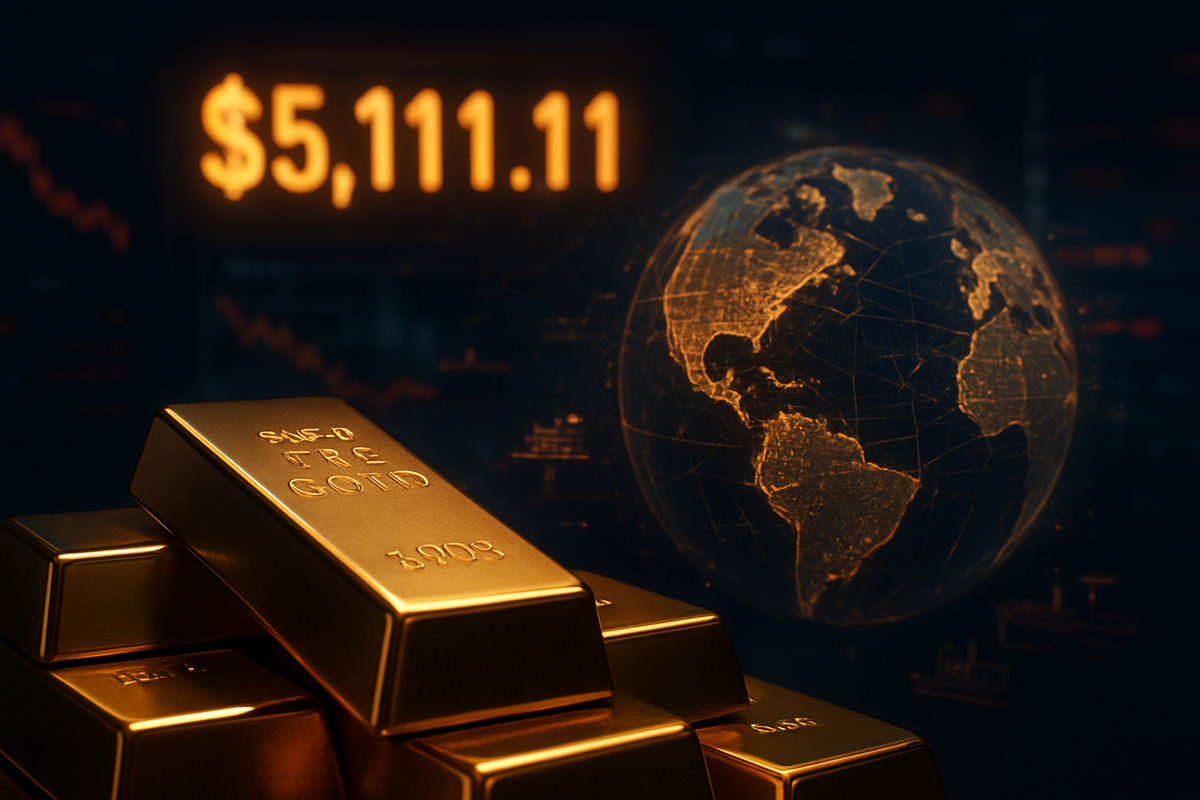
As of January 27, 2026, the global financial landscape is witnessing a historic realignment as gold prices surged past the unprecedented $5,000 per ounce threshold. This morning, spot gold reached an intraday high of $5,111.11, marking a definitive shift in investor sentiment away from traditional equities and toward hard assets. The rally comes as the S&P 500 faces intensifying volatility, currently hovering around the 6,100 mark, while market participants grapple with a "perfect storm" of aggressive trade policies and escalating international disputes.
The immediate implications of this surge are profound, reflecting a deep-seated anxiety regarding the stability of the global trade order. Investors are aggressively shedding risk-on assets in favor of the SPDR Gold Shares (NYSE Arca: GLD) and physical bullion, driven by a combination of a looming 100% tariff threat against major trading partners and a critical Federal Reserve policy meeting scheduled for later this week. As the "de-dollarization" trend accelerates, the breach of $5,000 is no longer viewed as a mere milestone but as a signal of a new era in global commodity valuation.
The Road to $5,000: A Timeline of Volatility and "Tariff Shocks"
The ascent to current record levels began in earnest during the final quarter of 2025, when gold first broke the $4,000 resistance level. Throughout the past year, the precious metal recorded over 50 all-time highs, but the momentum shifted into overdrive in January 2026. The catalyst for the most recent $500-per-ounce jump has been the resurgence of "Tariff Shock" diplomacy. In late January, the Trump administration shocked markets by threatening a 100% tariff on Canadian imports should Ottawa proceed with a controversial trade agreement with China. This move was followed by a sharp escalation in proposed duties on South Korean automobiles and industrial lumber, which saw rates climb from 15% to 25% overnight.
Beyond trade, geopolitical tensions have reached a fever pitch. A rare diplomatic rift between the United States and Denmark over the renewed campaign to acquire Greenland has unsettled European markets, adding to the persistent "fear premium" stemming from ongoing conflicts in the Middle East and Ukraine. The timeline of this rally is inextricably linked to these flashpoints, as each new geopolitical headline has served as a springboard for the gold price. On the domestic front, the market is bracing for the Federal Reserve's two-day policy meeting concluding on January 28, where investors will look for clues on whether the central bank can withstand political pressure for rate cuts in the face of a slowing global economy.
Key players in this drama include global central banks, particularly those in the "Global South," which have been accumulating gold at record rates to insulate their reserves from U.S. dollar volatility. The People’s Bank of China has remained a dominant buyer, signaling a structural shift in how nations view sovereign wealth. Meanwhile, major institutional investors have rotated billions out of high-growth tech stocks and into precious metals, seeking a hedge against the debasement of fiat currencies and the massive government deficits that continue to mount in the U.S. and Europe.
Winners and Losers in the New Golden Age
The primary beneficiaries of the current price surge are the major mining conglomerates, which are seeing their profit margins expand at a record pace. Newmont Corporation (NYSE: NEM), the world’s largest gold miner, has seen its stock price skyrocket as it leverages its massive reserve base. Similarly, Barrick Gold Corporation (NYSE: GOLD) has emerged as a top performer, benefiting from its diversified global portfolio and high operational efficiency. Agnico Eagle Mines (NYSE: AEM) has also reported stellar quarterly results, with analysts noting that the company's strong operational focus in 2025 has positioned it perfectly for the 2026 windfall.
On the other side of the ledger, the manufacturing and automotive sectors are bearing the brunt of the trade uncertainty and rising costs. Companies heavily reliant on cross-border supply chains, such as major Canadian exporters and South Korean automakers, have seen their valuations dip as tariff fears weigh on their forward guidance. Traditional banking institutions are also facing a complex environment; while trading desks are profiting from the gold volatility, the broader "de-dollarization" trend poses a long-term threat to the hegemony of the U.S. dollar-based financial system, potentially impacting the long-term profitability of global lending operations.
Royalty and streaming companies like Franco-Nevada Corporation (NYSE: FNV) have provided a middle ground for investors, offering exposure to gold prices with reduced operational risk. Meanwhile, junior miners such as Aris Mining (TSX: ARIS) and Taseko Mines (NYSE American: TGB) have attracted speculative interest, with some seeing triple-digit gains as investors hunt for high-beta plays on the gold price. However, the volatility that accompanies such rapid price appreciation remains a significant risk factor for these smaller players.
The Wider Significance: De-dollarization and a Fragmented Global Market
The current gold rally is more than a simple market trend; it is a symptom of a fundamental shift in the global economic order. The move toward $5,111 per ounce represents a historical precedent similar to the stagflation era of the 1970s, but with the added complexity of modern digital finance and a multi-polar geopolitical landscape. This "de-dollarization" trend—where central banks diversify away from the U.S. dollar—has reached a tipping point, as nations increasingly view gold as the ultimate neutral asset in a world divided by sanctions and trade barriers.
This event fits into a broader industry trend of "hard asset" preference. As equity valuations become perceived as stretched—highlighted by the S&P 500’s struggle to maintain momentum—capital is flowing into commodities not just as a hedge, but as a primary wealth preservation strategy. The ripple effects are being felt across the board, from the silver market, where Pan American Silver (NYSE: PAAS) has seen correlated gains, to the broader commodities sector. Regulatory implications are also emerging, as governments may look to tax the windfall profits of mining companies or implement new reporting requirements for physical gold holdings to curb capital flight.
Historically, such dramatic moves in gold have often preceded periods of significant economic restructuring. The current situation draws comparisons to the 2011 gold peak, but the drivers today—specifically the weaponization of trade policy and the sheer scale of global debt—suggest a more permanent shift in the market's architecture. The fragmentation of the global trade system, exemplified by the "Tariff Shock" of 2026, suggests that the "just-in-time" supply chain era is being replaced by a "just-in-case" era, where gold plays a central role in national and corporate security.
The Path to $6,000: What Lies Ahead?
In the short term, all eyes remain on the Federal Reserve. If the Fed maintains its steady hand despite White House pressure for cuts, gold may experience a brief consolidation. However, many analysts believe the momentum is now too strong to be derailed by a single policy decision. In the long term, if trade tensions with Canada and South Korea are not resolved, the "fear premium" could easily push gold toward the $6,000 mark by the end of 2026. This would require strategic pivots from mining companies, which may seek to accelerate the development of high-cost projects that were previously considered unfeasible.
Market opportunities will likely emerge in the junior exploration sector as capital-starved projects suddenly become highly attractive. However, challenges remain, including potential supply chain disruptions for mining equipment and increasing labor costs in a high-inflation environment. Investors should watch for potential scenarios where a sudden de-escalation in trade rhetoric could lead to a sharp "profit-taking" correction, though the structural demand from central banks provides a significant floor for the price.
A New Benchmark for Global Finance
The breach of the $5,000 gold barrier marks a watershed moment for investors and policymakers alike. The key takeaway from this event is that gold has reclaimed its role as the ultimate arbiter of value in an increasingly uncertain world. While the immediate cause of the spike is the "Tariff Shock" and geopolitical friction, the underlying driver is a loss of confidence in traditional fiscal and monetary stability. Moving forward, the market is likely to remain highly sensitive to every headline regarding trade policy and central bank reserves.
For the coming months, investors should keep a close watch on the S&P 500’s ability to hold the 6,000 level and the progress of the Greenland dispute. Any further escalation in trade barriers will likely act as fuel for the ongoing gold rally. Ultimately, the significance of $5,111 per ounce lies not in the number itself, but in what it says about the state of the global economy: in a world of rising walls and shifting alliances, the oldest form of money has once again become the most important.
This content is intended for informational purposes only and is not financial advice