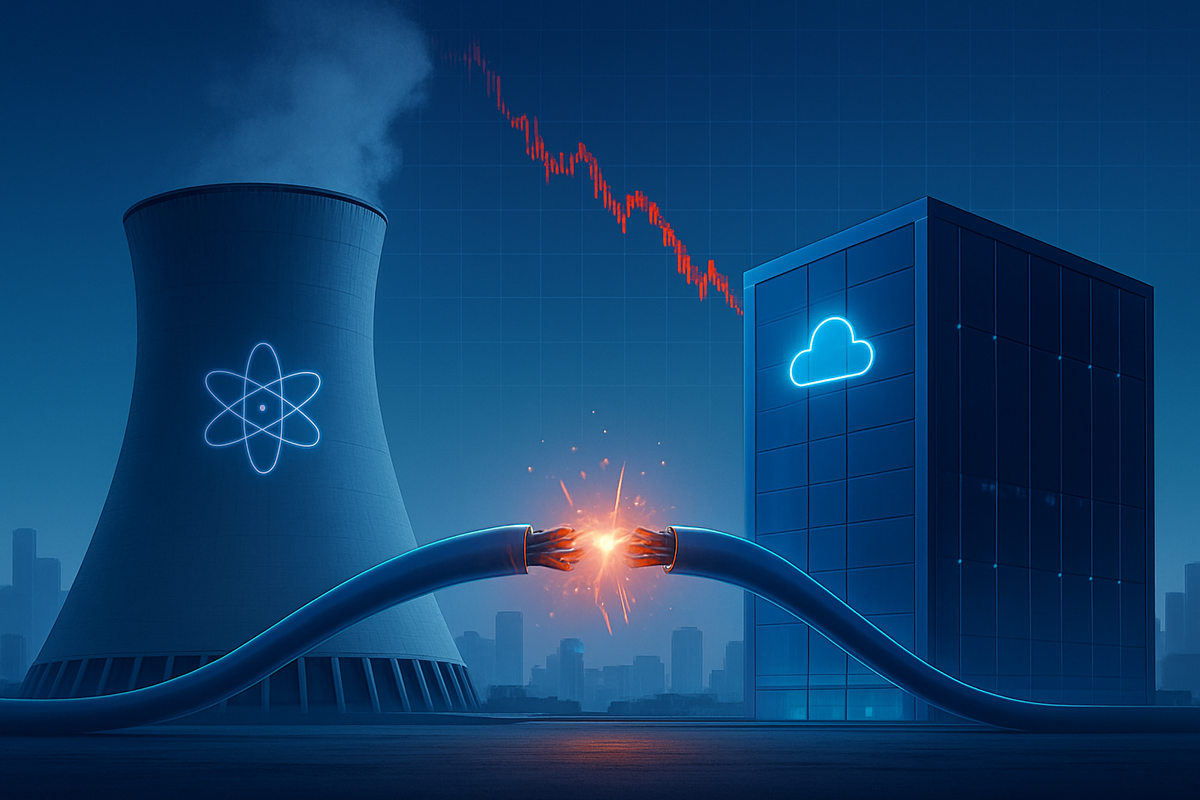
The nuclear energy sector, once the darling of the artificial intelligence boom, faced a brutal reckoning this week as rumors of cloud infrastructure shifts turned into a stark regulatory reality. On Friday, January 16, 2026, shares of major independent power producers plummeted following a series of strategic pivots by Microsoft (NASDAQ: MSFT) and a surprise "Bring Your Own Generation" (BYOG) mandate from federal regulators. The market reaction was swift, wiping out billions in market capitalization as investors reconsidered the profitability of "behind-the-meter" nuclear deals that had previously promised tech giants exclusive access to carbon-free power.
The turmoil stems from a fundamental shift in how the world’s largest cloud providers intend to power their next generation of AI "inference factories." For months, whispers had circulated that Microsoft was looking to cancel or renegotiate several high-profile data center leases due to escalating grid interconnection costs. Those rumors solidified into a new strategic initiative dubbed "Community-First AI Infrastructure," which seeks to decouple data center energy needs from the public utility rates—a move that effectively ends the era of tech giants "cannibalizing" existing grid capacity at the expense of residential consumers.
The BYOG Mandate and the Friday Sell-Off
The catalyst for the current market volatility was a directive issued by the Trump administration on January 13, 2026, targeted at the PJM Interconnection, the nation's largest power grid operator. The administration’s "Bring Your Own Generation" policy requires new large-scale data centers to either build or directly fund their own power generation assets rather than pulling from the current supply. This policy shift was driven by surging electricity inflation, which hit 6.7% year-over-year in early 2026, more than double the national average.
The market impact on January 16 was immediate and severe. Constellation Energy (NASDAQ: CEG), which had previously soared on the back of its landmark deal to restart the Three Mile Island reactor for Microsoft, saw its stock drop 9.8%, marking its worst single-day performance in nearly a year. Vistra Corp (NYSE: VST) fell by 8%, while Talen Energy (NASDAQ: TLN) took the hardest hit, sliding 11.3% as investors panicked over the potential nullification of high-premium "behind-the-meter" contracts.
These developments mark a sharp departure from the optimism of late 2024 and 2025, when the "Nuclear Three"—CEG, VST, and TLN—were seen as the essential backbone of the AI revolution. The shift started in February 2025 with reports of Microsoft canceling roughly 200 megawatts of data center capacity in high-cost regions. By mid-January 2026, Microsoft President Brad Smith confirmed that the company would move toward a "pay-your-own-way" model, agreeing to utility rates high enough to fund $15 billion in new infrastructure and grid upgrades to avoid political backlash and regulatory penalties.
Winners and Losers in the New Energy Paradigm
While the independent power producers (IPPs) are currently reeling, the energy sector is not seeing a uniform decline. The clear "winner" in this shakeup has been the uranium mining sector. Cameco (NYSE: CCJ) defied the broader energy slump, hitting a 52-week high of $116.44 on the same day the power producers crashed. Investors realize that while the delivery and pricing models for nuclear power are changing, the demand for the underlying fuel remains constant. Regardless of who owns the reactor or how the grid is structured, the "BYOG" mandate necessitates more nuclear fuel to power the private generation assets tech companies must now build.
On the losing side, the "Nuclear Three" face a period of intense valuation compression. For companies like Talen Energy, the high price-to-earnings multiples were predicated on the assumption that they could sell power to tech firms at a massive premium over market rates. With the BYOG mandate and Microsoft's shift to a community-funded model, those "scarcity rents" are evaporating. Furthermore, Meta (NASDAQ: META) and Google (NASDAQ: GOOGL) are now reportedly reviewing their own long-term power purchase agreements to ensure they do not fall afoul of the new federal "grid neutrality" standards.
Grid-scale battery storage and modular energy providers could emerge as secondary winners. As Microsoft pivots from massive, centralized "training" clusters to smaller, distributed "Inference Factories" located closer to urban centers, the demand for modular and flexible power solutions is expected to rise. This shift favors firms that can provide rapid-deployment energy solutions that don't require 10-year regulatory lead times for reactor restarts or new transmission lines.
A Structural Shift in the AI Infrastructure Race
This event fits into a broader industry trend toward vertical integration. Much like how Amazon (NASDAQ: AMZN) and Google eventually began designing their own AI chips to reduce reliance on third parties, they are now being forced to vertically integrate their power supply. The "Bring Your Own Generation" policy effectively turns every major tech company into a de facto utility provider. This has historical precedents in the early industrial era, when massive manufacturing plants often built their own dedicated hydroelectric or coal-fired power stations to ensure reliability.
The regulatory implications are profound. The move to decouple tech demand from the public grid is a direct response to growing public anger over rising utility bills. By forcing Microsoft and its peers to fund their own infrastructure, the administration is attempting to insulate voters from the "AI tax" on electricity. However, this could have the ripple effect of slowing down AI deployment in the U.S. if the cost of building private generation becomes prohibitively expensive or if the 15-year emergency auctions proposed for PJM fail to attract enough private capital.
Furthermore, this represents a pivot in AI architecture itself. The industry is moving from the "training phase"—which required massive, localized power draws—to the "inference phase," where AI models are queried by millions of users simultaneously. This requires a more geographically dispersed infrastructure. The "Great Decoupling" of 2026 is essentially the energy sector's version of the "edge computing" trend that transformed the internet a decade ago.
The Road Ahead: Adaptation and Vertical Integration
In the short term, investors should expect continued volatility as existing contracts are audited for compliance with the new BYOG standards. The IPPs will likely need to pivot their strategies toward becoming "construction partners" for the tech giants, shifting from selling power to building and managing the private energy assets that Microsoft and Google are now mandated to own. Strategic partnerships, rather than simple power purchase agreements, will become the new norm.
Long-term, the nuclear industry may actually find a more sustainable path forward. By moving away from the "behind-the-meter" controversy, nuclear power can shed its image as a "resource for the elite" and reposition itself as the primary engine for a new era of American industrial expansion. The challenge will be the capital expenditure required to meet these new mandates. We may see a flurry of M&A activity as tech giants look to acquire small modular reactor (SMR) startups to bring their power generation in-house and satisfy federal requirements.
Market opportunities will likely emerge in the "Inference Factory" space. Companies that specialize in high-density, modular data centers paired with on-site micro-reactors or advanced geothermal systems will be well-positioned to capture the next wave of capital. The shift is no longer about who has the most power today, but who can build the most independent power for tomorrow.
Conclusion: A New Chapter for Energy and AI
The events of January 2026 mark a definitive end to the "honeymoon phase" of the AI-nuclear partnership. The crash of the "Nuclear Three" and Microsoft's "Community-First" pivot represent a necessary market correction as the physical reality of the power grid catches up with the digital ambitions of Silicon Valley. The decoupling of data center demand from the public grid is a structural shift that will redefine the energy sector for the next decade.
Investors should watch for the upcoming emergency PJM capacity auctions and any further directives from the Department of Energy regarding the BYOG mandate. The key takeaway is that while the AI revolution is far from over, the way it is powered is undergoing a radical transformation. The focus has shifted from "green energy at any cost" to "sustainable infrastructure that pays its own way." As the market settles, the companies that successfully navigate this regulatory minefield—and those that provide the fuel to keep the lights on—will be the ones that define the next era of growth.
This content is intended for informational purposes only and is not financial advice.