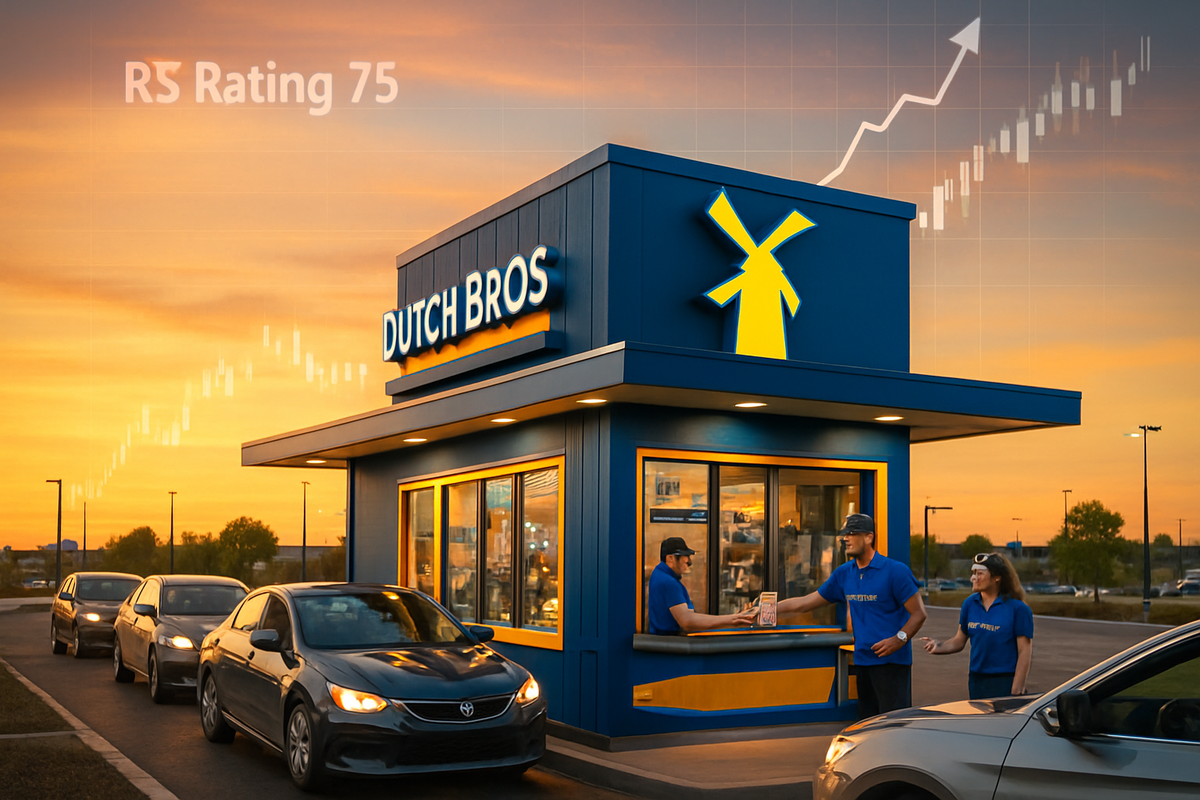
As the financial markets open for the 2026 calendar year, Dutch Bros Inc. (NYSE: BROS) is capturing the attention of technical analysts and growth investors alike. The Oregon-based drive-thru coffee titan recently received a significant Relative Strength (RS) Rating upgrade from 70 to 75, signaling that the stock is now outperforming three-quarters of the entire market over the past 12 months. This technical milestone comes on the heels of a robust year-end rally and suggests that the company’s aggressive expansion into the Midwest and Southeast is resonating with both consumers and Wall Street.
The upgrade to an RS Rating of 75 serves as a definitive "green light" for momentum traders who look for stocks displaying superior price action relative to the broader indices. For Dutch Bros, this momentum is not merely a byproduct of market sentiment but is rooted in a fundamental shift toward a "capital-light" growth model and a rapidly maturing digital infrastructure. As the company enters 2026, the technical strength reflects a growing confidence that the brand can successfully transition from a regional West Coast favorite to a national powerhouse capable of challenging established giants.
Technical Momentum Meets Operational Execution
The ascent to a 75 RS Rating is the culmination of a highly productive 2025 for Dutch Bros. Throughout the previous year, the company successfully navigated the "middle-child" phase of its public life—a period often marked by growing pains and volatile margins—to emerge as a dominant player in the high-frequency drive-thru segment. By the end of December 2025, the stock had completed a 22% rally, momentarily consolidating in early January 2026 to digest these gains. This consolidation is viewed by many as a constructive "base-building" phase, setting the stage for further appreciation as the company prepares its next round of quarterly reports.
The timeline leading to this upgrade was marked by several key operational wins. In late 2025, Dutch Bros reported that its "Order Ahead" mobile feature had reached a 13% transaction mix, a critical metric for improving throughput during the high-volume morning hours. Furthermore, the company successfully opened approximately 160 new shops in 2025, bringing its total system count to 1,081 locations. This disciplined expansion, particularly in the "smile" states and the Midwest, has proven that the brand's unique culture and speed-focused service model are highly portable across diverse demographics.
Key stakeholders, including institutional heavyweights and analysts from firms like TD Cowen and KeyBanc, have increasingly leaned into the BROS narrative. These analysts have labeled the stock a "Top Idea for 2026," citing the clarity of its growth trajectory. The initial market reaction to the RS upgrade has been positive, with trading volumes showing sustained interest from institutional "strong hands" who typically favor stocks with rising relative strength during periods of broader market uncertainty.
Winners and Losers in the 2026 Coffee Wars
In the competitive landscape of early 2026, Dutch Bros stands out as a clear winner, but its gain often highlights the struggles of its peers. Starbucks Corporation (NASDAQ: SBUX) continues to navigate a complex "back to basics" turnaround plan under its current leadership. While Starbucks remains the global leader, it struggled throughout 2025 with margin compression and a 13.6% decline in share price. As Starbucks focuses on restoring the "third place" experience and trimming its menu, Dutch Bros is aggressively poaching the younger, convenience-oriented demographic that prioritizes speed and customizable energy drinks over a traditional cafe atmosphere.
Another notable player, Black Rifle Coffee Company (NYSE: BRCC), has taken a different strategic path that sets it apart from the Dutch Bros model. While BROS doubles down on physical drive-thru expansion, Black Rifle has shifted its primary focus toward wholesale distribution and its new "Black Rifle Energy" line. While this move into the energy drink sector—facilitated by a partnership with Keurig Dr Pepper (NASDAQ: KDP)—offers high upside, the stock remains highly volatile with a lower RS Rating than BROS. For investors, Dutch Bros currently offers a "cleaner" growth story focused on unit economics and geographic footprint.
The broader retail coffee sector is also seeing a divide between legacy brands and "new-age" beverage companies. Smaller regional players are finding it increasingly difficult to compete with the digital loyalty programs and supply chain scale of a company like Dutch Bros. As BROS scales toward its long-term goal of 4,000+ shops, it is effectively raising the barrier to entry for any new drive-thru coffee concepts seeking to capture the Gen Z and Millennial market share.
The Significance of Premiumization and Gen Z Loyalty
The RS upgrade of Dutch Bros is a microcosm of a larger trend in the U.S. consumer discretionary sector: the "premiumization" of daily habits. Despite inflationary pressures that have lingered into 2026, consumers have shown a remarkable willingness to spend on "affordable luxuries" like specialized caffeinated beverages. Dutch Bros has mastered this by positioning itself not just as a coffee shop, but as a lifestyle brand. Its focus on "Blue Rebel" energy drinks and proprietary "Soft Top" foams caters to a younger audience that views coffee as a customizable treat rather than a bitter morning necessity.
Historically, few companies have managed to maintain a high RS Rating while undergoing such a massive physical expansion. The precedent set by companies like Chipotle Mexican Grill (NYSE: CMG) in its early growth years is often cited by BROS bulls. Like Chipotle, Dutch Bros is focusing on a limited, high-efficiency menu that allows for rapid throughput. The wider significance of the BROS ascent lies in its ability to maintain "consistently long lines" even as it moves into markets far removed from its Oregon roots, suggesting that the brand's appeal is not merely regional but structural.
From a regulatory and policy perspective, the company’s shift toward a "capital-light" model—which involves more efficient shop designs and a streamlined permitting process—has allowed it to bypass some of the headwinds that slowed down physical retail in previous years. This agility is becoming a hallmark of successful 2026 growth stocks, where the ability to deploy capital quickly and see an immediate return on investment is prized above all else.
What Lies Ahead: The 2026 Roadmap
Looking forward, the remainder of 2026 holds several high-stakes catalysts for Dutch Bros. The company has reiterated its plan to accelerate openings to 175 system shops this year, a necessary step to stay on track for its target of 2,029 locations by 2029. A major strategic pivot currently underway is the national rollout of an expanded hot food menu. By introducing egg-based breakfast items and other heated snacks, Dutch Bros aims to increase its average check size and capture a larger portion of the breakfast daypart that has traditionally been dominated by Starbucks and fast-food chains.
However, this expansion is not without its challenges. As the company grows, it must maintain its unique "culture of speed" and high level of employee engagement—factors that have been central to its success. Any dilution of the brand experience as it scales could lead to a cooling of the technical momentum it currently enjoys. Investors will be closely watching the "Order Ahead" transaction mix; if this figure continues to climb toward 20%, it would signal a significant boost in operational efficiency that could drive further RS Rating upgrades.
In the long term, Dutch Bros may face increased competition from the energy drink sector itself, as brands like Monster Beverage (NASDAQ: MNST) and Celsius Holdings (NASDAQ: CELH) continue to innovate. The potential scenario for BROS involves evolving into a "total beverage" destination where coffee is just one of several high-margin offerings. If the 2026 hot food rollout is successful, it could fundamentally re-rate the stock from a "coffee play" to a broader "quick-service restaurant (QSR) powerhouse."
Final Assessment for Investors
The upgrade of Dutch Bros to an RS Rating of 75 is a clear signal that the company’s growth narrative is firing on all cylinders. By combining aggressive physical expansion with digital innovation and a menu that appeals to the next generation of consumers, Dutch Bros has positioned itself as a formidable challenger in the U.S. coffee and beverage sector. The technical strength of the stock reflects a market that is increasingly willing to reward companies with clear visibility into their future earnings and a proven ability to scale.
Moving forward, investors should keep a close eye on the company's quarterly margin performance and the success of its Midwest expansion. While the technical indicators are currently bullish, the "real-world" execution of the 175-shop opening target for 2026 will be the ultimate arbiter of the stock's trajectory. If Dutch Bros can maintain its throughput efficiency while successfully integrating hot food, the current RS Rating of 75 may just be a pit stop on the way to even higher ground.
As we progress through the first half of 2026, the coffee sector remains a battleground of strategies. While legacy players are retrenching, Dutch Bros is leaning in, proving that in the world of high-growth retail, speed and relative strength are the ultimate competitive advantages.
This content is intended for informational purposes only and is not financial advice.