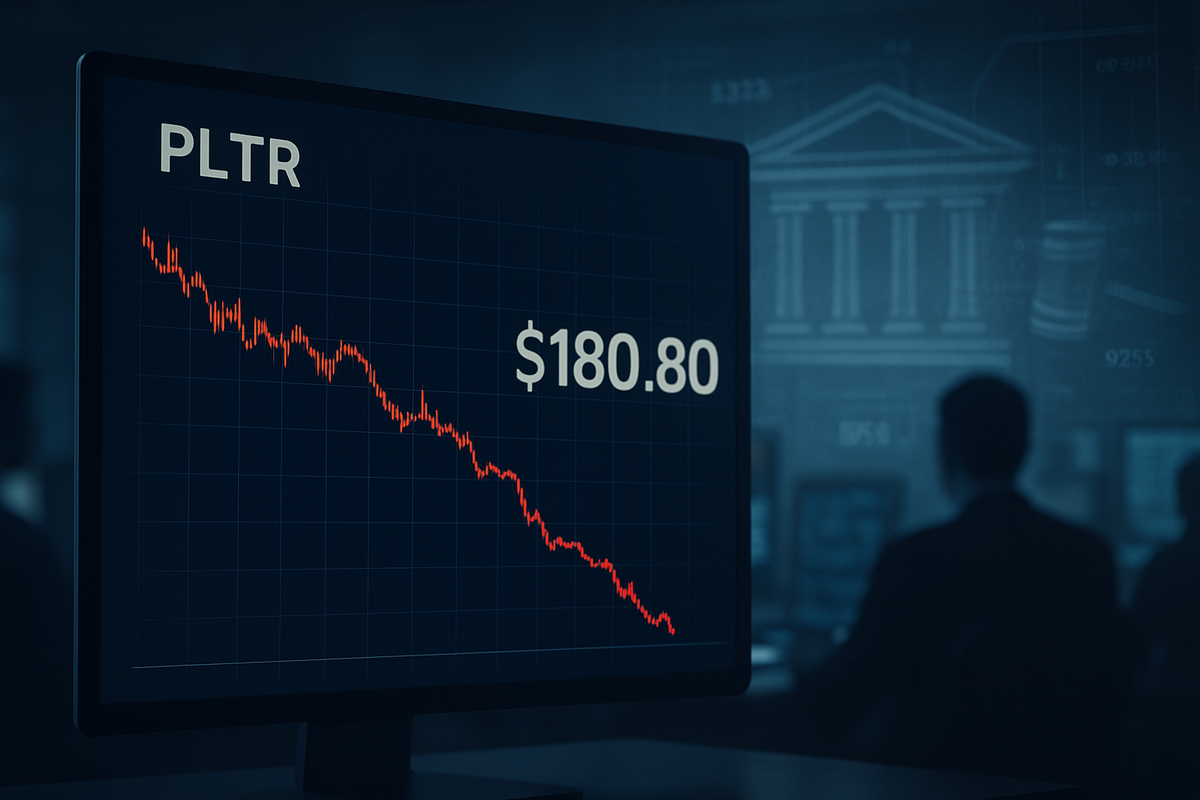
Palantir Technologies (NYSE: PLTR) saw its shares slide in after-hours trading on Tuesday, December 30, 2025, as a combination of hawkish signals from the Federal Reserve and aggressive year-end profit-taking by institutional investors dampened the holiday spirit on Wall Street. The stock, which has been a titan of the 2025 artificial intelligence bull run, slipped toward the $180.80 mark, marking a significant retreat from its all-time highs reached just weeks ago.
The downturn comes as the broader market grapples with the release of the Federal Open Market Committee (FOMC) minutes, which suggested that while the central bank is easing, the path forward for interest rate cuts in 2026 will be far more "cautious and slow" than many growth-oriented investors had hoped. For a high-valuation darling like Palantir, which entered the final week of the year trading at a staggering multiple of sales, the shift in sentiment triggered an immediate "de-risking" phase among the world’s largest asset managers.
The immediate catalyst for Tuesday’s slide was the 2:00 PM release of the minutes from the Fed’s December 9–10 meeting. Although the central bank had previously delivered a 25-basis-point cut—bringing the federal funds rate to a range of 3.50%–3.75%—the minutes revealed a deeply divided committee. A 9-3 vote showed that a significant minority of officials are concerned about lingering inflationary pressures in the services sector, leading to a "hawkish cut" narrative that has rattled the Nasdaq.
The timeline of Palantir’s December decline began in earnest after the stock peaked at $207.52 on November 3, 2025. Throughout December, the stock has been in a "local bear market," dropping roughly 13% as investors recalibrated their 2026 expectations. The sell-off intensified in the final 48 hours of the year as liquidity thinned and institutional giants like BlackRock (NYSE: BLK) and Vanguard—who collectively hold nearly 57% of PLTR shares—began rebalancing portfolios that had become heavily over-weighted in the AI sector following Palantir's 150% year-to-date surge.
Compounding the macro pressure was a series of insider sales earlier in the month. CFO David Glazer and Director Alexander Moore offloaded a combined total of over $5 million in shares in the first half of December. While such sales are often scheduled, the optics of executive liquidations near the top of the market added to the bearish sentiment among retail traders, who watched the stock break through key psychological support levels during the after-hours session.
Palantir (NYSE: PLTR) stands as the primary loser in this week’s session, with its market capitalization taking a multi-billion dollar hit as it tests support near the $180.80 level. The decline is also dragging down other high-beta AI names, such as C3.ai (NYSE: AI) and SoundHound AI (NASDAQ: SOUN), as the "cost of capital" argument returns to the forefront of analyst notes. Investors in these companies are realizing that the "priced for perfection" valuations of 2025 may not hold if the Fed remains restrictive into the second half of 2026.
Conversely, the "winners" in this scenario appear to be the institutional desks that successfully executed "gain harvesting" strategies. By locking in triple-digit profits on Palantir before the year-end close, these managers have protected their annual performance metrics. Furthermore, defensive sectors and value-oriented stocks, such as Johnson & Johnson (NYSE: JNJ) and Procter & Gamble (NYSE: PG), have seen a modest rotation of capital as investors seek "safe harbors" amid the volatility in the tech sector.
This late-December slide is a microcosm of a broader industry trend: the transition from "AI Hype" to "AI Reality." Throughout 2025, Palantir benefited from a narrative of total market dominance in data analytics and government AI. However, as the stock reached a valuation of 115 times sales, it became increasingly susceptible to any shift in the macroeconomic or regulatory environment. The current pullback mirrors the tech corrections of late 2021, where high-multiple growth stocks were the first to buckle under the weight of rising real yields.
Regulatory headwinds are also beginning to create ripple effects. Recent reports from Switzerland regarding data access security and renewed inquiries from U.S. lawmakers into Palantir’s immigration-related contracts (ICE) have introduced a layer of political risk that was largely ignored during the mid-year rally. For competitors like Microsoft (NASDAQ: MSFT) and Snowflake (NYSE: SNOW), Palantir’s current struggles serve as a warning that even the most robust AI tailwinds cannot fully insulate a company from the gravity of federal policy and geopolitical scrutiny.
Looking ahead to the first quarter of 2026, Palantir faces a critical juncture. The short-term focus for traders will be whether the stock can hold the $175.00 support level or if it will continue to slide toward its 200-day moving average. Strategic pivots may be required; if government contract growth slows due to increased scrutiny, Palantir will need to demonstrate even more aggressive expansion in its commercial "AIP" (Artificial Intelligence Platform) segment to justify its remaining premium valuation.
The market may also see a "wait-and-see" approach until the next round of earnings reports in February. If Palantir can prove that its fundamentals are outpacing the Fed’s "higher for longer" stance, a rebound to the $200 level is possible. However, a more likely scenario involves a period of consolidation, where the stock trades sideways as the market digests the massive gains of the past year and adjusts to a less accommodative Federal Reserve.
The end of 2025 has provided a stark reminder that even the most successful stocks are not immune to the laws of finance. Palantir’s retreat to $180.80 is a result of a "perfect storm": a hawkish central bank, institutional profit-taking, and a valuation that left no room for error. While the company remains a fundamental leader in the AI space, the exuberance that characterized its 150% climb has clearly hit a ceiling.
Moving forward, investors should keep a close eye on the January "Barometer"—the trend established in the first month of the new year—as it often dictates the market's direction for the following quarters. For Palantir, the key metrics to watch will be commercial customer acquisition costs and any further signals from the Fed regarding the 2026 rate path. The AI revolution is far from over, but the era of "easy money" for these stocks may be entering a more disciplined and volatile chapter.
This content is intended for informational purposes only and is not financial advice.