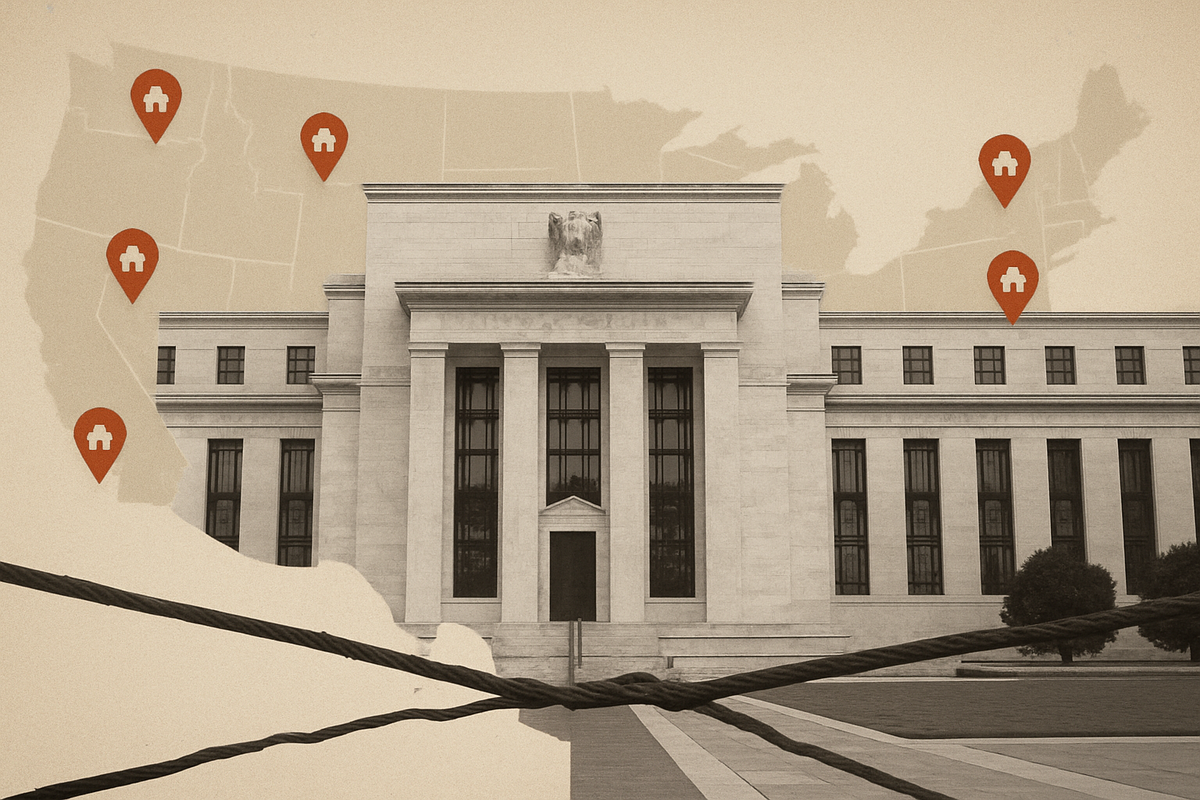
Washington D.C., December 3, 2025 – U.S. Treasury Secretary Scott Bessent today unveiled a controversial proposal mandating that regional U.S. Federal Reserve bank presidents must reside in their respective districts for at least three years prior to their appointment. Announced at the New York Times DealBook Summit, this administrative change aims to re-anchor the Federal Reserve's regional leadership to local economic perspectives, but immediately ignited a fierce debate about the central bank's cherished independence and the future trajectory of U.S. monetary policy. The move is widely seen as an attempt by the White House to exert greater influence over the Federal Reserve, particularly amidst ongoing disagreements over interest rate policy.
The proposal carries immediate and profound implications for the composition and decision-making of the Federal Open Market Committee (FOMC), the Fed's principal monetary policymaking body. By potentially altering the pool of eligible candidates for these influential positions, Secretary Bessent's plan could indirectly reshape the FOMC's economic outlooks and, consequently, its stance on interest rate policy. This administrative intervention raises critical questions about the balance between regional representation and the need for an independent central bank capable of making decisions free from political pressure.
A Deeper Look at Bessent's Bold Maneuver
Secretary Bessent, who took office on January 28, 2025, detailed his plan to actively advocate for this new residency requirement. His strategy involves leveraging the Federal Reserve Board of Governors' existing power to veto appointments that do not meet the proposed three-year residency threshold. Bessent articulated his belief that the original intent of the Federal Reserve System was for regional bank presidents to be deeply embedded in their communities, providing a vital local perspective to national economic debates. He expressed concern that the current practice often leads to the appointment of individuals from outside their designated districts, citing that three, and potentially four, current Fed presidents were appointed from outside their districts, with some reportedly residing in New York.
The announcement on Wednesday, December 3, 2025, during the New York Times DealBook Summit, was not made in a vacuum. It follows weeks of intensified criticism from Secretary Bessent regarding certain regional Fed presidents who have resisted calls for immediate interest rate cuts. This public pressure campaign, coupled with President Donald Trump's consistent critiques of the Fed's monetary policy, positions Bessent's proposal as a direct challenge to the Fed's operational autonomy. The immediate reaction from financial markets and industry observers has been one of apprehension, viewing the proposal as a clear effort to steer the Fed's leadership and policy direction. Such changes could have broad ramifications for financial markets, impacting everything from mortgage rates and auto loans to credit card interest rates, affecting consumers and businesses alike.
Key stakeholders in this unfolding drama include Treasury Secretary Scott Bessent, the primary architect and advocate of the requirement; the White House and President Donald Trump, who are perceived as seeking greater control over the Federal Reserve and its policies; the Federal Reserve Board of Governors, whose approval power is central to Bessent's strategy; the regional U.S. Federal Reserve Bank Presidents themselves, whose roles and selection processes are directly targeted; and potentially the U.S. Congress, as such a significant policy shift might ultimately require legislative approval.
Potential Winners and Losers in a Reshaped Fed Landscape
The proposed residency requirement, if implemented, could indirectly yet significantly impact various sectors and public companies (NYSE: SPY) by altering the composition and policy leanings of the Federal Open Market Committee (FOMC). Companies that are highly sensitive to interest rate fluctuations are likely to be the most affected.
Potential Losers:
- Financial Institutions (NYSE: JPM, NYSE: BAC): Major banks and financial services firms thrive on predictable and independent monetary policy. Increased political influence over the Fed could introduce uncertainty, potentially leading to more volatile interest rate environments that complicate lending, investment, and risk management strategies. A Fed perceived as less independent might also face questions about its credibility, impacting global financial stability.
- Companies reliant on cheap capital (NASDAQ: TSLA, NASDAQ: AMZN): High-growth technology firms and other companies heavily reliant on borrowing for expansion could face higher capital costs if the FOMC's composition shifts towards a more hawkish stance on inflation, or if policy becomes less predictable. Any perceived politicization of the Fed could also spook investors, leading to higher risk premiums.
- Companies with less regional representation: If the new requirement leads to a more uniform, rather than diverse, set of regional perspectives on the FOMC, it could inadvertently neglect the unique economic conditions of certain regions or industries. For instance, a focus on specific regional concerns might overshadow broader national economic indicators, leading to suboptimal policy for some sectors.
Potential Winners:
- Regional Businesses and Industries: The stated goal of the proposal is to ensure regional Fed presidents are deeply rooted in their local economies. This could theoretically lead to monetary policy that is more attuned to specific regional needs, potentially benefiting local businesses or industries that have historically felt overlooked by national policy. For example, agricultural companies (NYSE: DE) or regional manufacturing firms (NYSE: CAT) might find their concerns better represented.
- Companies in "Swing" Regions: If the political objective is to foster policy more aligned with certain political outcomes, companies in economically important "swing" states or regions might indirectly benefit from policies designed to stimulate local economies, potentially through targeted lending programs or infrastructure initiatives.
- Companies that thrive on specific interest rate environments: If the new FOMC composition leans towards a more dovish stance (e.g., favoring lower rates to stimulate employment), certain sectors like housing (NYSE: DHI, NYSE: LEN) or automotive (NYSE: GM, NYSE: F) could see increased demand due to lower borrowing costs for consumers. Conversely, if the focus shifts to combating inflation more aggressively, some sectors might benefit from a stronger dollar or more stable price environment.
Ultimately, the impact on specific companies will hinge on how the residency requirement alters the overall balance of perspectives within the FOMC and, crucially, how those altered perspectives translate into actual monetary policy decisions. The increased political scrutiny alone could introduce a new layer of risk and opportunity for market participants.
Wider Significance: Eroding Independence and Shifting Power Dynamics
Secretary Bessent's proposal extends far beyond a mere administrative tweak; it represents a significant push against the long-held principle of Federal Reserve independence, a cornerstone of U.S. economic stability. This event fits into a broader trend of increased political pressure on central banks globally, where governments, facing economic challenges, seek greater influence over monetary policy. The current administration, under President Donald Trump, has consistently expressed dissatisfaction with the Fed's interest rate decisions, making Bessent's move a direct manifestation of this ongoing tension.
The potential ripple effects are substantial. Domestically, it could fundamentally alter the relationship between the executive branch and the central bank, potentially setting a precedent for future administrations to impose similar or even more intrusive requirements. This erosion of independence could undermine investor confidence, both domestically and internationally, as the perceived politicization of monetary policy might lead to greater uncertainty and volatility in financial markets. Internationally, other central banks might view this as a worrying development, potentially influencing their own governance structures or increasing their vigilance regarding external pressures. The credibility of the U.S. dollar (USD) as a global reserve currency could also face scrutiny if the Fed's independence is seen as compromised.
Regulatory and policy implications are profound. While Secretary Bessent aims to use the Board of Governors' veto power, such a significant change in the selection criteria for regional presidents could face legal challenges and may ultimately require formal approval from Congress. This could spark a legislative battle over the Federal Reserve Act, potentially leading to broader reforms of the central bank's structure and mandate. Historically, attempts to politicize the Fed have been met with strong resistance from within the institution and from proponents of its independence. For example, the original design of the Federal Reserve System, with its regional banks and rotating FOMC seats, was precisely intended to balance national policy with diverse regional input while insulating decision-making from short-term political cycles. Bessent's proposal, by attempting to enforce a specific type of "regional rootedness," could inadvertently disrupt this delicate balance.
The Road Ahead: Navigating a Politicized Monetary Landscape
The immediate future will likely see intense debate and potential confrontation over Secretary Bessent's residency proposal. In the short term, the Federal Reserve Board of Governors will be under immense pressure to respond, either by adopting Bessent's interpretation of their veto power or by pushing back against what many perceive as an overreach. This could lead to a period of uncertainty regarding future appointments of regional Fed presidents, with potential candidates carefully scrutinizing their residency history. The market will be closely watching for any signals from the Fed about its stance on independence and governance.
Longer term, the proposal could usher in a new era for the Federal Reserve. If successfully implemented, it could lead to a FOMC composed of individuals with more localized economic perspectives, potentially shifting the committee's collective bias on issues like inflation, employment, and interest rates. This might necessitate strategic pivots from market participants, who will need to adapt to a potentially less predictable and more politically sensitive monetary policy environment. Investors may seek opportunities in sectors that benefit from specific regional economic trends or from policies that prioritize local growth over broader national stability.
Potential scenarios range from a complete rejection of the proposal by the Fed and Congress, reaffirming central bank independence, to its full implementation, leading to a significantly altered FOMC. Another outcome could be a compromise, where some form of enhanced regional engagement is adopted without a strict residency mandate. Market opportunities may emerge for astute investors who can anticipate these shifts and position themselves accordingly, while challenges will arise from increased policy uncertainty and potential volatility. The ongoing search for a successor to Fed Chair Jerome Powell, in which Bessent is also involved, further underscores the administration's intent to shape the future leadership of the central bank.
Wrapping Up: A Critical Juncture for the Federal Reserve
Treasury Secretary Scott Bessent's proposal for a residency requirement for regional Federal Reserve bank presidents marks a critical juncture for the U.S. central bank. The core takeaway is the overt attempt to increase political influence over the Federal Reserve, challenging its long-standing independence and potentially reshaping the composition and decision-making dynamics of the FOMC. While framed as an effort to enhance regional representation, critics view it as a direct assault on the Fed's ability to conduct monetary policy free from short-term political considerations.
Moving forward, the market will be assessing the implications of a potentially more politicized Federal Reserve. The debate over the proposal highlights fundamental questions about the balance between democratic accountability and central bank autonomy. Investors should prepare for increased scrutiny of Fed appointments and communications, as any perceived shift in the FOMC's ideological balance could lead to significant market reactions. The lasting impact of this event will depend on how the Federal Reserve, Congress, and the broader financial community respond to this challenge to its independence. Investors should watch for further developments from the Board of Governors, potential Congressional action, and the rhetoric surrounding future Fed appointments, as these will be key indicators of the central bank's future direction and its ability to maintain its crucial role in ensuring economic stability.
This content is intended for informational purposes only and is not financial advice