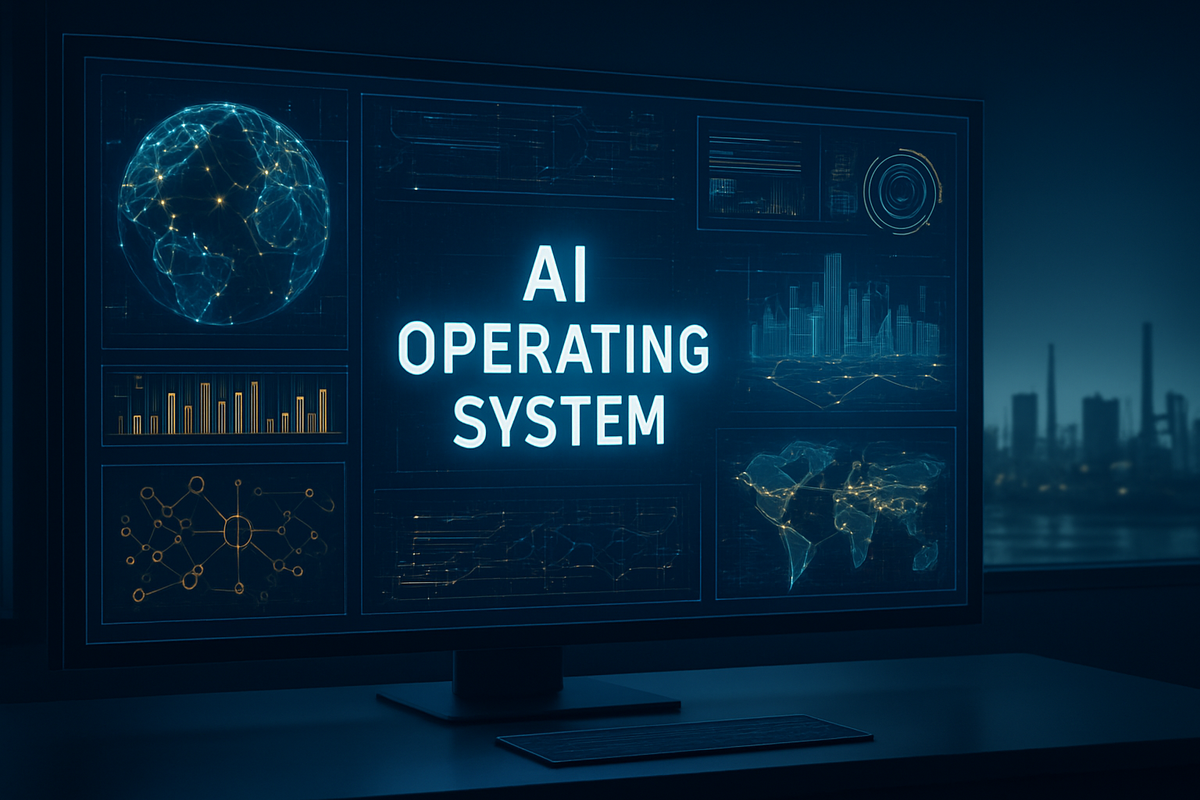
As the final trading days of 2025 draw to a close, the financial world is reflecting on a year defined by the "Great AI Decoupling"—a period where the market finally distinguished between companies merely talking about artificial intelligence and those deploying it at a mission-critical scale. At the epicenter of this shift stands Palantir Technologies (NYSE: PLTR), which has transitioned from a controversial government data contractor into the undisputed "operating system" for the modern enterprise. Following a historic rally that saw the stock surge nearly 150% year-to-date, Palantir enters 2026 as a cornerstone of the S&P 500, having silenced skeptics with a series of blowout earnings reports and massive industrial contract wins.
The immediate implications for the market are profound. Palantir’s success has recalibrated investor expectations for the entire software sector, shifting the focus from "generative" chatbots to "agentic" AI—autonomous systems capable of executing complex business logic. With the stock currently trading in the $185–$195 range after hitting an all-time high of $207.52 in November, the question for investors is no longer whether Palantir’s technology works, but whether its premium valuation can withstand the inevitable cooling of the broader AI hype cycle.
From S&P 500 Inclusion to Triple-Digit Growth: A Year in Review
The meteoric rise of Palantir in 2025 was set in motion by a watershed moment on September 23, 2024, when the company was officially added to the S&P 500 index. This inclusion served as a formal validation of the company's GAAP profitability and institutional maturity, triggering a wave of index-fund buying that provided the initial fuel for its current rally. However, the true catalyst for the 2025 performance was the aggressive rollout of its Artificial Intelligence Platform (AIP) through a unique "Bootcamp" sales model. These intensive, hands-on workshops allowed potential clients to build live AI workflows in as little as five days, effectively bypassing the traditional, multi-month enterprise sales cycle.
The results of this strategy became apparent in the company’s Q3 2025 earnings report, released on November 3, 2025. Palantir reported a staggering 121% year-over-year growth in its U.S. commercial revenue, which reached approximately $397 million for the quarter. Perhaps more impressive was the company’s "Rule of 40" score—a metric combining revenue growth and profit margin—which hit an unprecedented 114%. This level of hyper-growth combined with high profitability is rarely seen in large-cap software, forcing analysts at major firms to tear up their previous valuation models. Throughout the year, CEO Alex Karp and CTO Shyam Sankar successfully positioned the company’s "Ontology"—the proprietary data layer that allows AI to understand a business’s physical operations—as a moat that competitors have struggled to replicate.
The AI Hierarchy: Winners and Losers in the Agentic Era
The dominance of Palantir has created a clear bifurcation in the enterprise software market. While Palantir has thrived, legacy giants like Salesforce (NYSE: CRM) have faced a "credibility gap." Despite the high-profile launch of its "Agentforce" platform in late 2024, Salesforce has struggled with reliability in 2025. Internal audits and third-party reports surfaced in December 2025 suggesting that Salesforce’s AI agents often fail when tasks exceed eight steps, succeeding only about 35% of the time in complex, multi-turn workflows. While Salesforce remains a dominant force in CRM, its consumption-based pricing model has faced pushback from enterprises seeking more predictable costs.
Similarly, Snowflake (NYSE: SNOW) has found itself increasingly relegated to the "data lake" layer of the stack. In a defensive move in October 2025, Snowflake partnered with Palantir to allow AIP to run directly on Snowflake’s Data Cloud, effectively conceding that while Snowflake is excellent at storing data, Palantir is superior at making it "intelligent." Meanwhile, the once-hyped C3.ai (NYSE: AI) has faced a crisis of execution. Following the departure of longtime CEO Tom Siebel due to health reasons in September 2025, the company reported a 19% revenue decline and a collapse in operating margins, leading many to speculate that it may be a prime acquisition target or face a slow decline into irrelevance.
On the winning side, Microsoft (NASDAQ: MSFT) continues to be the primary beneficiary of the AI infrastructure boom, though it is not without its own challenges. While Azure revenue has soared past $75 billion, "Copilot fatigue" has set in among some corporate users who find generic AI assistants less valuable than the specialized, industrial-grade agents offered by Palantir. To counter this, Microsoft has deepened its partnership with Nvidia (NASDAQ: NVDA) and recently announced the "Chain Reaction" initiative alongside CenterPoint Energy (NYSE: CNP) to manage the growing "AI power crunch"—a strategic move to secure the electricity needed to run the next generation of data centers.
The "AI Power Crunch" and the Shift to Applied Intelligence
The broader significance of Palantir’s 2025 performance lies in its ability to navigate the physical constraints of the AI revolution. By late 2025, the industry’s primary bottleneck shifted from a shortage of GPUs to a shortage of electricity. This "AI Power Crunch" has forced a move away from massive, energy-hungry Large Language Models (LLMs) toward more efficient, specialized "Applied AI." Palantir’s software, which focuses on optimizing existing infrastructure—such as its $448 million "ShipOS" contract with the U.S. Navy to streamline submarine production—is perfectly suited for this environment.
This trend mirrors historical precedents like the electrification of factories in the early 20th century, where the winners were not just those who built the power plants, but those who developed the machines to use that power efficiently. Palantir has successfully positioned itself as the "machine" that turns raw compute into operational ROI. Furthermore, the regulatory landscape has begun to favor Palantir’s "human-in-the-loop" philosophy. As governments worldwide implement stricter AI safety standards, Palantir’s focus on auditability and data sovereignty has made it the preferred partner for highly regulated industries, including a landmark partnership with Fannie Mae (OTCQB: FNMA) to use AIP for mortgage fraud detection.
The 2026 Outlook: Scenarios for the Next Phase
Looking ahead to 2026, Palantir faces a "valuation wall." With a forward price-to-earnings (P/E) ratio exceeding 450x, the stock is undeniably priced for perfection. In the short term, any deceleration in U.S. commercial growth could trigger a significant correction. However, the long-term potential remains vast as the company begins to move more aggressively into international markets and the energy sector. A potential strategic pivot could see Palantir launching its own specialized "small language models" (SLMs) tailored for specific industries like healthcare or logistics, further reducing its reliance on third-party LLM providers.
Market opportunities are also emerging in the realm of "Sovereign AI." As nations seek to build their own independent AI capabilities, Palantir’s experience with the U.S. Department of Defense—evidenced by the $795 million expansion of the Maven Smart System in May 2025—makes it a natural partner for allied governments. The primary challenge will be maintaining its culture of rapid innovation as it scales from a mid-cap growth story into a mega-cap technology staple.
Final Thoughts: What Investors Should Watch
The story of Palantir in 2025 is one of transformation. The company has moved beyond its origins as a secretive tool for the intelligence community to become a transparent, high-growth engine for the global economy. The key takeaway for investors is that the AI market has entered its "utility phase," where the most valuable companies are those that can prove immediate, measurable business value.
Moving forward, investors should keep a close eye on the company’s international commercial growth, which has historically lagged behind its U.S. performance. Additionally, the progress of the "Chain Reaction" partnership with Nvidia and CenterPoint Energy will be a critical indicator of whether Palantir can successfully expand its footprint into the critical infrastructure layer of the economy. While the stock’s current valuation requires nerves of steel, Palantir’s 2025 performance has established it as the definitive benchmark for the enterprise AI era.
This content is intended for informational purposes only and is not financial advice