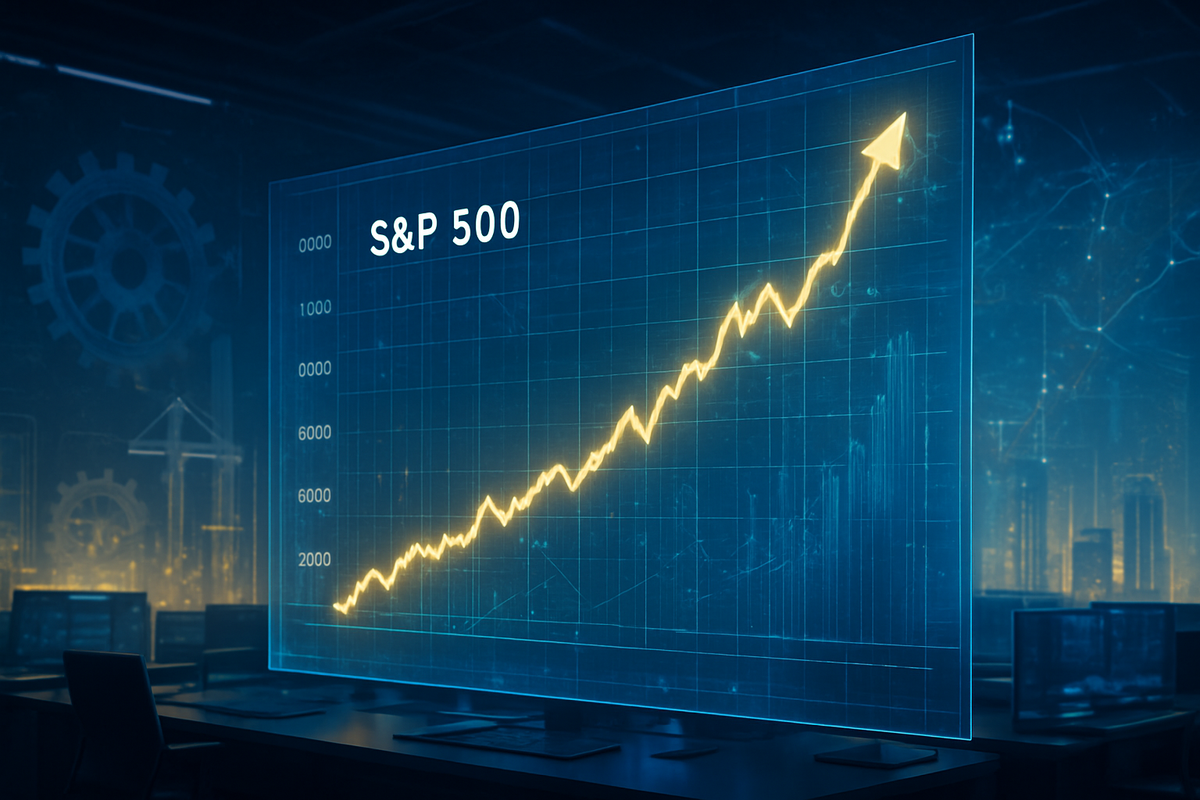
As the calendar turns toward 2026, Goldman Sachs (NYSE: GS) has released a strikingly optimistic market outlook, positioning the United States for a period of robust growth that defies cooling labor markets. Led by Chief Economist Jan Hatzius and Chief US Equity Strategist David Kostin, the firm’s "Macro Outlook 2026" suggests that a combination of fiscal tailwinds, easing monetary policy, and AI-driven productivity will push the S&P 500 (INDEXSP: .INX) to a record target of 7,200 by year-end.
This forecast comes at a critical juncture for investors who have spent the last two years navigating the volatile transition from high inflation to a "soft landing." Goldman’s projections indicate that 2026 will not just be a year of survival, but one of acceleration, where the benefits of technological innovation finally bleed into the "real economy." For long-term US investors, the message is clear: the bull market is evolving from a narrow tech-led sprint into a broad-based marathon.
A Sturdy Foundation: GDP and Earnings Drivers
The cornerstone of Goldman Sachs' 2026 thesis is a projected real GDP growth rate of 2.6%, a figure that sits well above the broader market consensus of 2.0%. Jan Hatzius attributes this outperformance to a "front-loaded" economic boost in the first half of the year. A significant driver is the expected $100 billion in additional tax refunds resulting from previous fiscal policy adjustments, which Goldman believes will provide a massive jolt to consumer spending. This fiscal stimulus is expected to coincide with a Federal Reserve that has successfully navigated the economy to a terminal interest rate range of 3.0% to 3.25%, the lowest levels seen in years.
On the equity side, David Kostin anticipates that the S&P 500 will see earnings per share (EPS) growth of 12% in 2026. Unlike the 2023-2024 period, where gains were heavily concentrated in a handful of artificial intelligence pioneers, the 2026 growth story is expected to be more egalitarian. The firm notes that while the "Magnificent Seven" tech giants—including the likes of NVIDIA (NASDAQ: NVDA) and Microsoft (NASDAQ: MSFT)—will remain highly profitable, their margin of outperformance over the rest of the index is expected to shrink significantly. This shift marks a transition from a valuation-driven market to one fueled by fundamental earnings across diverse sectors.
The timeline leading to this optimistic outlook has been defined by the Federal Reserve's long battle with inflation. By late 2025, with inflation stabilized near the 2% target, the focus has shifted entirely to growth and productivity. Goldman's analysts highlight a "Labor Market Paradox": while GDP is expected to climb, job growth may remain stagnant. This is not viewed as a weakness, but rather as a sign of rising productivity. Companies are beginning to harness AI and automation to produce more with fewer man-hours, a trend that Goldman believes will sustain high corporate margins even as the labor market cools.
Winners and Losers in the 2026 Rotation
The primary beneficiaries of Goldman’s 2026 outlook are the "real-world" cyclical sectors that have lived in the shadow of Big Tech for years. The Industrials sector, represented by giants like Caterpillar Inc. (NYSE: CAT), is expected to see EPS growth jump from a modest 4% to a staggering 15%. This surge is predicated on a recovery in global manufacturing and an end to the inventory destocking that plagued the sector in 2024 and 2025. Similarly, the Materials sector is poised for a breakout as trade tensions ease and global demand for infrastructure components accelerates.
Real Estate is another major winner in the Goldman playbook. With interest rates settling into a more accommodative range, the firm projects sector EPS growth to triple from 5% to 15%. Companies like American Tower (NYSE: AMT) or Prologis (NYSE: PLD) could see renewed interest as borrowing costs stabilize and the demand for data center and logistics space remains insatiable. Furthermore, the Financials sector, led by institutions like JPMorgan Chase (NYSE: JPM), is expected to benefit from a "steepening" yield curve and a resurgence in dealmaking and M&A activity that had been sidelined during the high-rate era.
Conversely, the "losers" in this scenario are not necessarily companies in decline, but rather those that have become victims of their own success. Mega-cap technology stocks are expected to see their "growth premium" narrow. While they will continue to grow, the rotation into undervalued cyclicals and small-cap stocks—tracked by the Russell 2000 (INDEXRUSSELL: RUT)—means that the easy money in overcrowded AI trades may have already been made. Small-caps, in particular, are expected to see 10% returns in early 2026, finally benefiting from the lower interest rates that high-debt smaller firms require to thrive.
Broader Significance and Historical Precedents
The Goldman Sachs outlook reflects a broader structural shift in the US economy: the transition from a post-pandemic recovery to a productivity-led expansion. This era mirrors the mid-1990s, where initial investments in internet technology eventually led to a broad-based economic boom. Goldman suggests that 2026 will be the year AI moves from the "hype" phase of infrastructure building to the "utility" phase of widespread implementation, boosting the efficiency of everything from healthcare to logistics.
This shift has significant policy implications. With the $100 billion tax refund stimulus acting as a secondary engine, the US economy is becoming less dependent on direct Federal Reserve intervention. However, the "stagnant jobs" forecast could present a political challenge. If GDP grows while hiring remains flat, regulators may face pressure to address the societal impacts of AI-driven displacement. This creates a delicate balance for the government, which must foster innovation while ensuring the benefits of productivity are broadly shared.
Historically, periods of "disinflationary growth"—where the economy grows while inflation stays low—have been the most fertile ground for long-term investors. Goldman’s 2026 outlook suggests we are entering such a cycle. The firm’s comparison of the current era to previous productivity booms suggests that the 7,200 target for the S&P 500 is not just a nominal increase, but a reflection of a fundamentally more efficient American corporate machine.
What Comes Next: Strategic Pivots for Investors
In the short term, investors should prepare for a "risk-on" environment in the first half of 2026. The combination of tax refunds and the final leg of the Fed's rate-cutting cycle creates a liquidity window that historically favors equities. Goldman suggests that the most successful strategy will involve a pivot toward "Industrial Tech"—companies that sit at the intersection of traditional manufacturing and high-tech automation.
Looking further ahead, the long-term challenge will be the sustainability of these productivity gains. If AI fails to deliver the expected efficiency, or if global trade tensions reignite, the 2.6% GDP target could be at risk. Investors must watch for signs of a "productivity cliff" or any reversal in the Fed's neutral stance. For now, the strategic adaptation required is a move away from the safety of cash and mega-cap tech toward a more diversified, cyclical-heavy portfolio that can capture the broadening of the bull market.
Conclusion: A New Era of Growth
Goldman Sachs’ 2026 outlook paints a picture of an economy that has finally found its footing after years of pandemic-induced distortion. With a 7,200 S&P 500 target and a robust GDP forecast, the firm is betting heavily on the resilience of the US consumer and the transformative power of technological efficiency. The key takeaway for investors is the shift from "narrow" to "broad"; the next phase of the market will reward those who look beyond the tech horizon toward the industrial and financial engines of the economy.
Moving forward, the market will be characterized by earnings-driven growth rather than speculative valuation expansion. This is a healthier, more sustainable form of a bull market, but it requires a more discerning eye for sector-specific fundamentals. Investors should keep a close watch on manufacturing data, consumer spending patterns in early 2026, and the Federal Reserve’s commentary on the terminal rate. If Goldman’s predictions hold, 2026 will be remembered as the year the "New Economy" finally began to work for the "Old Economy."
This content is intended for informational purposes only and is not financial advice.