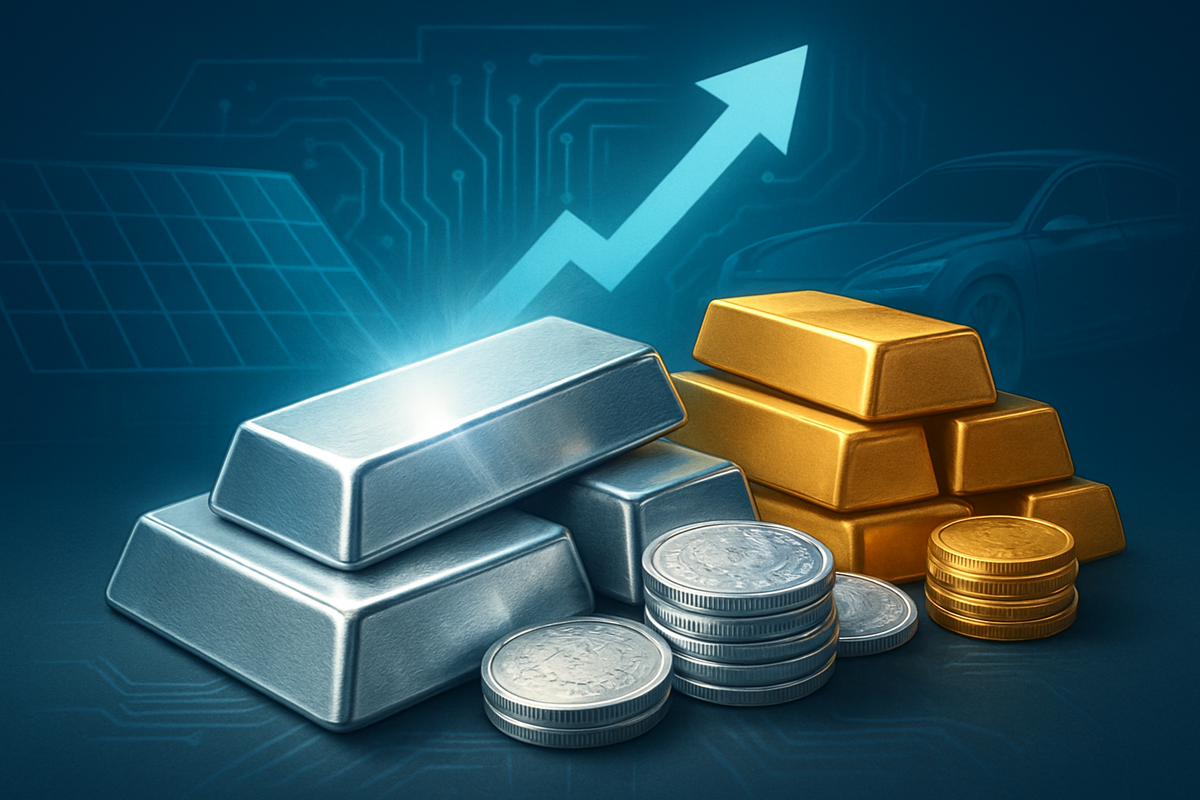
As of December 10, 2025, the precious metals market is witnessing a significant paradigm shift, with silver dramatically outpacing gold in terms of price appreciation. The white metal has surged to unprecedented levels, breaking the $60 per ounce barrier and reaching new all-time highs, while gold, though also seeing gains, has lagged behind. This remarkable divergence is largely attributed to a powerful combination of robust industrial demand, persistent supply deficits, and growing expectations of Federal Reserve interest rate cuts, creating a compelling narrative for silver's ascent.
This pronounced outperformance by silver has immediate and profound implications for investors and the broader financial landscape. The traditional gold-to-silver ratio, a key indicator of their relative value, has compressed significantly, signaling a potential re-evaluation of silver's intrinsic worth. As investors increasingly eye silver's dual role as both a monetary hedge and a critical industrial commodity, its higher volatility and potential for greater returns are drawing substantial speculative interest, reshaping investment strategies within the precious metals sector.
Silver's Meteoric Rise: A Deep Dive into the White Metal's Historic Outperformance
Silver's journey in 2025 has been nothing short of spectacular, culminating in a historic outperformance against its yellow counterpart, gold. As of December 10, 2025, spot silver prices have not only shattered the psychological $60 per ounce barrier but have soared to an unprecedented $60.92, with some reports even indicating a peak of $61.47. This represents an astounding year-to-date (YTD) gain of approximately 107%, dwarfing gold's respectable yet more modest 54-60% YTD increase, which saw the yellow metal trade above $4,000 per ounce. The significant divergence in their performances, particularly accelerating from September 2025 onwards, signals a profound shift in the precious metals landscape.
The timeline of this divergence reveals a market responding to a perfect storm of economic and industrial forces. While silver began 2025 with strong momentum, building on gains from the previous year, the true acceleration and its pronounced outperformance against gold became unmistakably clear in the latter half of the year. The gold-silver ratio, a critical barometer of their relative valuation, dramatically compressed from an elevated 104:1 in May 2025—suggesting significant undervaluation for silver—to below 70 by December 9th, marking its lowest point in 53 months. This rapid compression underscored increasing institutional confidence and speculative interest in silver's upward trajectory, driven by its dual role as both a monetary metal and an indispensable industrial commodity.
Several powerful factors have converged to fuel silver's historic rally. Foremost among these is the robust and largely inelastic industrial demand. Over half of global silver consumption is now attributed to industrial applications, a proportion steadily on the rise. Its unparalleled electrical and thermal conductivity makes silver indispensable in high-growth technology sectors. The global push for renewable energy has positioned solar panels (Photovoltaics - PV) as the largest industrial application, with PV sector consumption projected to reach 7,560 metric tons by 2025, accounting for 55% of total global silver demand. Furthermore, the rapid expansion of Electric Vehicles (EVs), charging infrastructure, and the booming Artificial Intelligence (AI) data center industry are intensifying demand for silver-intensive electronics and components.
Compounding this demand-side strength are persistent and structural supply deficits. The silver market is currently experiencing its fifth consecutive year of supply deficit in 2025, with a projected gap ranging from 95 million to 149 million ounces. Mine output has been in decline since 2016, and approximately 72% of silver is produced as a byproduct of other metal mining, making its supply largely unresponsive to silver-specific price signals. Environmental scrutiny of mining operations and geopolitical instability in key producing regions, particularly Latin America, further exacerbate production constraints. Adding to the supply squeeze, U.S. tariff uncertainty surrounding silver, following its inclusion in the U.S. Geological Survey's list of critical minerals, has triggered a "historic squeeze," with metal being pulled from London to the U.S., leading to sharp declines in available silver stocks in London and Shanghai.
Monetary policy shifts have also played a crucial role. Renewed expectations of a Federal Reserve interest rate cut in December 2025, with an 89.4% probability of a 25 basis point reduction, have significantly boosted sentiment for non-yielding assets like precious metals. Lower interest rates reduce the opportunity cost of holding silver, making it more attractive. This, coupled with a weaker U.S. dollar—a consequence of the Fed's rate-cutting cycle ongoing since August 2024—further enhances the appeal of dollar-denominated precious metals for international investors. Additionally, ongoing geopolitical tensions, global economic slowdown, and trade uncertainties have fueled safe-haven demand, benefiting both gold and silver, with silver's affordability attracting a broader base of investors.
Key players in this dynamic market include major silver mining companies that have seen their valuations soar. Companies like Canada's Wheaton Precious Metals (NYSE: WPM), Mexico's Fresnillo (LSE: FRES), Industrias Peñoles (BMV: PE&OLES), and Pan American Silver (TSX: PAAS) have all reported substantial stock price increases, reflecting the strong market. Institutional and retail investors have also shown increased interest, with significant net inflows into silver-backed Exchange-Traded Products (ETPs) and a staggering 163% increase in net managed money positions on the CME for silver from the end of 2024 to mid-2025. Market analysts are largely bullish, forecasting continued strength for silver, with some projecting prices to reach $65-$95 per ounce over the next 12-24 months, solidifying 2025 as a "breakout year" and a potential "generational investment phenomenon" for the white metal.
Shifting Fortunes: Winners and Losers in the Silver Surge
The dramatic outperformance of silver against gold as of December 10, 2025, is creating a clear delineation of winners and relative losers across the financial markets, particularly within the mining sector and industries reliant on the white metal. With silver's price soaring to approximately $60 per ounce and a year-to-date gain of roughly 107%, companies with significant exposure to silver are reaping substantial benefits, while those predominantly focused on gold, though still profitable, face the prospect of relative underperformance.
The most immediate beneficiaries are the major silver mining companies. Higher silver prices directly translate into increased revenue per ounce produced, significantly expanding profit margins, assuming production costs remain relatively stable. These pure-play silver miners are experiencing leveraged returns, with their stock prices potentially appreciating at multiples of the underlying metal's gain. Leading this charge are companies like Pan American Silver Corp. (NASDAQ: PAAS), which has strategically expanded its silver portfolio, including a recent acquisition of a stake in the high-grade Juanicipio Silver Mine. Similarly, First Majestic Silver Corp. (NYSE: AG), with its primary focus on Mexican silver mines and a vocal CEO predicting "triple-digit prices," is exceptionally sensitive to silver price increases. Other significant winners include Hecla Mining Company (NYSE: HL), one of the largest and oldest U.S. silver producers, and Coeur Mining, Inc. (NYSE: CDE), both benefiting from their substantial silver reserves and production. Wheaton Precious Metals Corp. (NYSE: WPM), a major precious metals streaming company, also gains significantly, leveraging the price rise across a diversified portfolio of mines without direct operational risks. Additionally, Endeavour Silver Corporation (NYSE: EXK), Industrias Peñoles SAB de CV (BMV: PE&OLES), Fresnillo PLC (LSE: FRES), and Americas Silver Corporation (NYSE: USAS) are all poised for enhanced profitability and stock appreciation. These companies are likely to prioritize expanding silver production, developing new high-grade deposits, and increasing exploration budgets for silver prospects.
Conversely, while gold prices themselves remain strong—trading above $4,000 per ounce and experiencing substantial upward momentum—major gold mining companies are emerging as relative underperformers during this period of silver dominance. Their stock performance, though potentially positive, is lagging behind the more dynamic silver sector. Companies like Newmont Corporation (NYSE: NEM), the world's largest gold miner, and Barrick Gold (NYSE: GOLD), another global gold giant, primarily derive their revenue from gold. While their existing operations will remain profitable due to high gold prices, their stock growth might not match the percentage gains seen in pure-play silver companies. Similarly, Agnico Eagle Mines (NYSE: AEM) and Kinross Gold (NYSE: KGC), predominantly gold-focused producers, may see investor capital rotate towards silver-heavy portfolios in search of superior returns. These gold miners will continue to optimize gold production, but diversified companies with both gold and silver assets might re-evaluate capital allocation to emphasize silver projects or consider strategic acquisitions in the booming silver market.
Beyond the mining sector, companies in industrial applications of silver present a more nuanced picture. While higher silver prices mean increased input costs, the indispensable nature of silver in high-growth sectors means these companies may still "win" through overall market expansion and technological leadership. Solar energy companies, particularly photovoltaic cell manufacturers like First Solar (NASDAQ: FSLR), face rising silver costs but benefit from the projected tripling of solar deployment by 2030, which will drive massive demand for their products. Their success will hinge on their ability to optimize silver usage, innovate in panel efficiency, or effectively pass on higher costs. Similarly, leading Electric Vehicle (EV) manufacturers such as Tesla (NASDAQ: TSLA), General Motors (NYSE: GM), and Ford (NYSE: F) will continue to drive demand for silver in their advanced electrical systems. Although material expenses will increase, the robust growth in the EV market could mitigate this impact, with companies possessing strong supply chain management potentially faring better. Electronics manufacturers, including semiconductor giants like Intel (NASDAQ: INTC) and Taiwan Semiconductor Manufacturing Company (NYSE: TSM), along with consumer device makers like Apple (NASDAQ: AAPL) and Samsung (KRX: 005930), are also massive silver consumers. While facing increased costs, silver's critical role in achieving desired performance and miniaturization means demand remains high, pushing these companies to invest in R&D for silver optimization and recycling to maintain profitability.
A New Era for Silver: Broader Implications and Historical Echoes
Silver's remarkable outperformance against gold as of December 10, 2025, is more than just a market anomaly; it signifies profound shifts in broader industry trends, creating ripple effects across various sectors, prompting potential regulatory considerations, and echoing historical precedents. With silver's year-to-date gains ranging from a robust 55.9% to an astonishing 107%, significantly surpassing gold's 43-60% increase, the white metal's surge to record highs above $60 per ounce has reshaped the precious metals narrative. The dramatic compression of the gold-silver ratio, from extreme highs of 104:1 or even 125:1 earlier in 2025 to approximately 68.66:1 to 89.2:1, underscores a re-evaluation of silver's intrinsic value and its pivotal role in the modern economy.
This powerful rally is deeply embedded in several overarching industry trends. The explosive industrial demand for silver stands out as a primary driver. Its unparalleled electrical and thermal conductivity makes it indispensable in the burgeoning green technology revolution, particularly in solar photovoltaic (PV) applications, which are projected to consume a staggering 55% of total silver demand in 2025. The accelerating adoption of Electric Vehicles (EVs) and their charging infrastructure also demands significantly more silver than traditional vehicles. Furthermore, the relentless expansion of electronics manufacturing, fueled by the Artificial Intelligence (AI) boom and the proliferation of AI data centers, is creating unprecedented consumption levels for silver-intensive hardware. These technological advancements, coupled with persistent structural supply deficits—the silver market is experiencing its fifth consecutive annual deficit in 2025—create a compelling supply-demand imbalance that underpins silver's ascent.
The ripple effects of silver's outperformance are being felt across a spectrum of industries. Silver mining companies, already identified as major beneficiaries, are incentivized to ramp up exploration and development, though new supply will face considerable time lags. Industrial users, particularly manufacturers in the solar, electronics, and EV sectors, face heightened input costs. This pressure could accelerate innovation towards more silver-efficient technologies, encourage strategic stockpiling to mitigate price volatility, or necessitate passing increased costs onto consumers, potentially contributing to broader inflationary pressures. Jewelry and silverware manufacturers will also contend with substantially higher raw material costs, impacting profit margins or consumer demand. Investment firms, especially those with significant silver exposure, are benefiting from increased investor interest, though silver's higher volatility compared to gold necessitates sophisticated risk management.
Regulatory and policy implications are also coming into focus. The U.S. government's designation of silver as a "Critical Mineral" in late 2025 highlights its vital importance to the economy and potential supply chain vulnerabilities. This designation could pave the way for strategic stockpiling, investment incentives for domestic production, or even new tariffs. Discussions around restructuring tariff rates on imported precious metals, particularly silver used in electronic components, are ongoing. Environmental, Social, and Governance (ESG) considerations are also increasingly constraining mining operations, impacting production capacity and costs. On the monetary front, Federal Reserve interest rate cuts are directly influencing precious metal prices, while some states are pursuing greater financial autonomy, including repealing capital gains taxes on precious metal sales, further shaping the investment landscape for silver and gold.
Historically, silver's current outperformance aligns with well-established patterns, reinforcing its reputation as the "restless metal" and a "higher beta" asset compared to gold. Silver often lags gold in the initial stages of a precious metals bull market but then tends to significantly outperform during the middle to later stages, frequently delivering 2-3 times the percentage gains of gold. This characteristic is evident in past episodes, such as the post-gold standard era of the early 1970s, the 2008-2011 bull market where silver soared over 400%, and the period following the 2020 COVID crisis. The gold-silver ratio has historically served as a crucial signal; when it climbs to extreme highs, indicating silver's undervaluation, it often precedes a period of strong silver outperformance as the ratio normalizes. The current compression from extreme highs in 2025 is perfectly consistent with this historical pattern, suggesting that silver's rally is a fundamental re-rating rather than a temporary anomaly, driven by both robust industrial demand and renewed investment appeal.
The Road Ahead: Navigating Silver's Ascendance and Precious Metals' Future
As silver continues its remarkable outperformance over gold into December 2025, the precious metals market faces a dynamic and evolving future. The confluence of robust industrial demand, persistent supply deficits, and a supportive macroeconomic environment suggests that silver's current rally is not a fleeting phenomenon but rather a structural shift with significant short-term and long-term implications for both metals. The road ahead will require strategic pivots from companies, present new market opportunities and challenges, and unfold across several potential scenarios.
In the short term, extending into 2026, analysts widely anticipate silver to continue its outperformance. Price forecasts for silver range from $56–$65 per ounce, with technical models even suggesting potential highs of $72 and $88 if the gold/silver ratio compresses further towards its historical average. Industrial demand from solar, EVs, AI, and data centers is expected to remain robust, even with a projected slowdown in the growth rate for new photovoltaic installations. Further interest rate cuts by central banks in 2026 and a potentially softer U.S. dollar will continue to provide tailwinds for silver. Gold, while potentially seeing a higher average price in 2026, may experience some easing later in the year as global monetary easing slows. However, sustained central bank buying and ongoing safe-haven demand amidst geopolitical tensions and economic uncertainty will provide a strong floor for gold prices, which are forecast to range from $3,650 to $5,000 per ounce by various institutions.
Looking further ahead, the long-term outlook for silver is underpinned by structural demand growth, as supply consistently lags its essential role in technological transformations like renewable energy, electrification, and advanced electronics through 2030. While offering higher upside, silver's smaller market size and significant industrial demand will also contribute to its inherent volatility compared to gold. Gold, conversely, is expected to maintain its role as a strategic hedge against economic uncertainty, inflation, and geopolitical instability. De-dollarization trends, with emerging economies' central banks increasingly accumulating gold to reduce reliance on the U.S. dollar, represent a significant structural shift supporting long-term gold prices.
These dynamics necessitate strategic pivots and adaptations across the industry. Mining companies will need to focus on geographic diversification to mitigate localized risks, enhance operational efficiency, and explore innovative mining techniques to maximize extraction from existing reserves. They may also consider diversifying their portfolios to balance precious metals exposure with industrial metals or employ robust hedging strategies to navigate price volatility. For manufacturers heavily reliant on silver in sectors like solar, EV, and electronics, securing long-term supply chains will be paramount to avoid disruptions and manage costs. Investment in material innovation to find alternatives or use silver more efficiently will also be crucial, although silver's unique properties make it difficult to substitute in many applications.
Emerging market opportunities are significant, as these regions are key drivers of demand for both metals, with India and China notable consumers. Emerging market central banks are leading gold acquisition patterns, driven by economic vulnerabilities and a desire to reduce dependence on traditional reserve currencies, providing structural support for gold. However, challenges such as geopolitical risks, economic volatility, and regulatory changes (e.g., tariffs) in these markets could impact supply chains and asset values. For investors, both gold and silver offer crucial portfolio diversification benefits, often showing low or negative correlation with equities during market stress. While gold remains a classic safe haven, silver presents more pronounced price movements and higher upside potential, making it an attractive consideration for those seeking greater leverage to the precious metals bull market.
The World Gold Council (WGC) outlines several potential macroeconomic scenarios for 2026 that also have implications for silver. In a "Shallow Slip" scenario, where economic momentum cools without a collapse, gold could gain 5-15%, with silver likely benefiting even more due to its higher beta. A "Doom Loop" scenario, involving a synchronized global downturn due to escalating geopolitical flashpoints, could see gold advance 15-30%, with silver again potentially showing even greater percentage appreciation. Even in a "Reflationary Growth" scenario, where strong economic performance typically pressures precious metals, silver's robust industrial demand from green energy and advanced technology sectors could still support its price, potentially allowing it to decouple somewhat from gold's movements. Regardless of the specific path, both metals are considered effective hedges against unpredictable "black swan events," offering wealth preservation and diversification benefits during crises.
The Silver Lining: A Market Transformed and the Path Forward
As December 10, 2025, draws to a close, the precious metals market stands significantly transformed, with silver unequivocally outperforming gold and etching its place in history with prices soaring above $60 per ounce. This exceptional rally, driven by a powerful trifecta of surging industrial demand, persistent supply deficits, and a supportive macroeconomic environment, has not only reshaped investment strategies but also underscored silver's critical and evolving role in the global economy. The year 2025 will undoubtedly be remembered as a watershed moment for the white metal, marking a structural re-evaluation of its intrinsic worth.
The key takeaways from silver's remarkable ascent are clear: its indispensable role in the green energy transition, particularly in solar (PV) and Electric Vehicles (EVs), coupled with its growing importance in advanced electronics and AI data centers, has created an insatiable industrial appetite. This demand, largely inelastic to price, has collided with a market facing its fifth consecutive year of structural supply deficits, exacerbated by the byproduct nature of much of silver mining and recent "critical mineral" designations leading to market squeezes. Furthermore, a favorable macroeconomic backdrop of anticipated Federal Reserve interest rate cuts and a softer U.S. dollar, alongside persistent inflation concerns and geopolitical uncertainties, has amplified silver's appeal as both an industrial commodity and a safe-haven asset, attracting a broader spectrum of investors seeking a high-beta alternative to gold.
Moving forward, the market outlook for silver remains broadly positive, with projections suggesting continued strength into 2026 and beyond. Industrial demand is expected to maintain its upward trajectory, particularly from the green economy and technological advancements, though investors should monitor any potential slowdowns in specific sectors or efforts to thrift silver content. The structural supply deficit is also anticipated to persist, offering fundamental price support. While monetary policy and dollar strength will continue to influence prices, the inherent volatility of silver, given its smaller market size and dual demand sources, means investors should prepare for potential price swings. This period signifies a lasting impact, solidifying silver's dual identity and its strategic importance far beyond merely a monetary asset, positioning it at the forefront of the global transition towards clean energy and advanced technology.
For investors navigating the coming months, vigilance across several key indicators will be paramount. Close attention to Federal Reserve monetary policy and any shifts in interest rate decisions will be crucial, as these directly impact the opportunity cost of holding non-yielding assets. Monitoring industrial demand indicators, such as economic growth data in manufacturing, electronics, solar, and automotive sectors, will provide insights into silver's consumption trends. Geopolitical developments and the strength of the U.S. dollar will continue to influence safe-haven demand and international buying power. Furthermore, keeping a keen eye on the gold-silver ratio for further compression, as well as reports on silver mine production and recycling rates, will offer valuable clues about supply-demand dynamics. While silver's rally has been powerful, its inherent volatility underscores the importance of diversification and a long-term perspective in this dynamic and evolving precious metals market.
This content is intended for informational purposes only and is not financial advice