Tesla (TSLA) released its Q4 2025 earnings yesterday, Jan. 28, after the close of markets. The earnings call came a few days after the company changed its mission from accelerating the “world's transition to sustainable energy” to building “a world of amazing abundance.” While Tesla and its CEO, Elon Musk, have been trying to position the company as an artificial intelligence (AI) play, I believe the transition is now nearly complete, as we’ll discuss in this article.
Tesla Q4 2025 Earnings Snapshot
To begin with, let’s look at a snapshot of Tesla’s Q4 earnings. It reported revenues of $24.9 billion in the quarter, which was slightly short of Street estimates. The company generated revenues of $94.83 billion last year, which was 3% lower than in 2024 and marked the first time that the Elon Musk-run company reported an annual decline in sales.
The company’s automotive margins (ex-regulatory credits) improved to 17.9% in the quarter as compared to 15.4% in the third quarter. Thanks to better-than-expected operating income in the quarter, Tesla’s adjusted earnings per share (EPS) of 50 cents came in ahead of consensus estimates. However, the company's annual profits fell to a multi-year low.
Meanwhile, as I anticipated in the pre-earnings analysis, there wasn’t much discussion on Tesla’s automotive business during the earnings call. The only time the term “deliveries” was mentioned was when CFO Vaibhav Taneja noted that the company’s gross margin remained flat year-over-year, despite a 16% decline in deliveries. Incidentally, Tesla did not provide any delivery guidance for 2026 after having seen them fall year-over-year for two consecutive years.
There was no comment on the outlook for regulatory credit sales either, which have hitherto been a high-margin revenue stream for the company but are at risk following the easing of Corporate Average Fuel Economy (CAFE) standards by the Trump administration.
Tesla’s Transition from an EV Producer to an AI Player
The way I look at it, Tesla’s Q4 2025 earnings kind of completes the company’s transition from a tech and electric vehicle (EV) company to predominantly an AI play.
Notably, while Tesla did not provide any delivery guidance—and I suspect it won’t do so for at least the near foreseeable future—it did provide the full self-driving (FSD) subscription numbers for the first time. The company disclosed that it had 1.1 million FSD subscribers at the end of 2025, which is 38% higher than in 2024. For context, that’s around 12% of its cumulative vehicle sales to date, even as that number might not be fully representative, as the company is still in talks to offer FSD services in some key markets, particularly in China and the EU. Tesla further disclosed that 70% of the FSD subscriptions are upfront purchases—a route it has closed this year in favor of the $99 monthly subscription.
I believe that Tesla moving away from providing delivery guidance is akin to Netflix (NFLX) stopping subscriber guidance and subsequently the quarterly subscription numbers. The streaming giant told investors that revenues are a better indicator of its topline performance than the subscriber numbers, which can be volatile.
By literally swapping delivery guidance with FSD subscription numbers, Tesla is trying to reemphasize the dwindling importance of the former and the growing importance of the latter.
Musk Expects Competition from Chinese Companies in the Humanoid Space
Optimus remains another key product for Tesla, and Musk previously said the product could add $25 trillion to the company’s market cap. However, as I have noted multiple times previously, China remains an elephant in the room when it comes to AI products like humanoids. Several Chinese companies are working on humanoids, and at least some of them are looking to target the U.S. market.
The question of Chinese companies entering the humanoid space did pop up during Tesla’s Q4 earnings call. Responding to the question, Musk—who previously said that Chinese EV companies will “demolish” competitors if not for the tariffs that they face in various countries—admitted that “by far the biggest competition for humanoid robots will be from China.”
The Tesla CEO, who never shies away from bold predictions, however, added, “We believe Optimus will be much more capable than any robot that we are aware of under development in China.”
Notably, Tesla is set to end production of the Model S and Model X and instead convert that space in the Fremont factory to produce Optimus as it targets an annual production of 1 million units.
Tesla Expects Robotaxi Fleet to Double Every Month
Tesla also provided an update on the robotaxi fleet and said that between Austin and the Bay Area, it has around 500 of these carrying paid customers—a number Musk expects to double every month. The company expects its capex to rise to $20 billion this year as it spends on six factories, including those producing the Cybercab and Optimus. Tesla also announced a $2 billion investment into Musk’s AI startup xAI—a partnership, per Taneja, will help “accelerate” the company’s progress in AI.
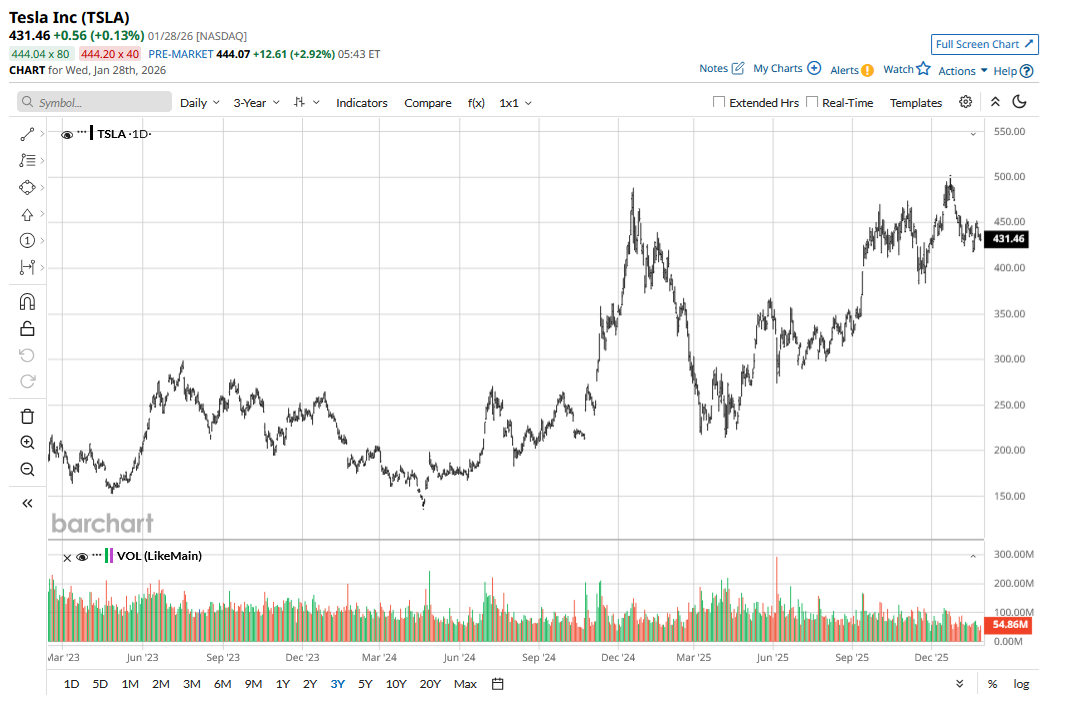
Overall, while I still believe that the automotive business remains significant for Tesla's flywheel, the stock's price action might now be influenced more by announcements on AI products rather than the EV business.
On the date of publication, Mohit Oberoi had a position in: TSLA , NFLX . All information and data in this article is solely for informational purposes. For more information please view the Barchart Disclosure Policy here.
More news from Barchart
- Nvidia Could Use Intel’s Foundry in 2028. Is It Worth Buying INTC Stock Now and Waiting?
- HSBC Says Investors Should Stay ‘Aggressively’ Risk-On. Here’s a Top-Rated Stock to Buy Now to Keep Betting on Growth.
- Meta Platforms Breaks Into Overbought Territory on Post-Earnings Rally. Is There Room for More Gains Ahead?
- As Microsoft Stock Crashes Below Key Support Levels, Should You Buy the Dip?