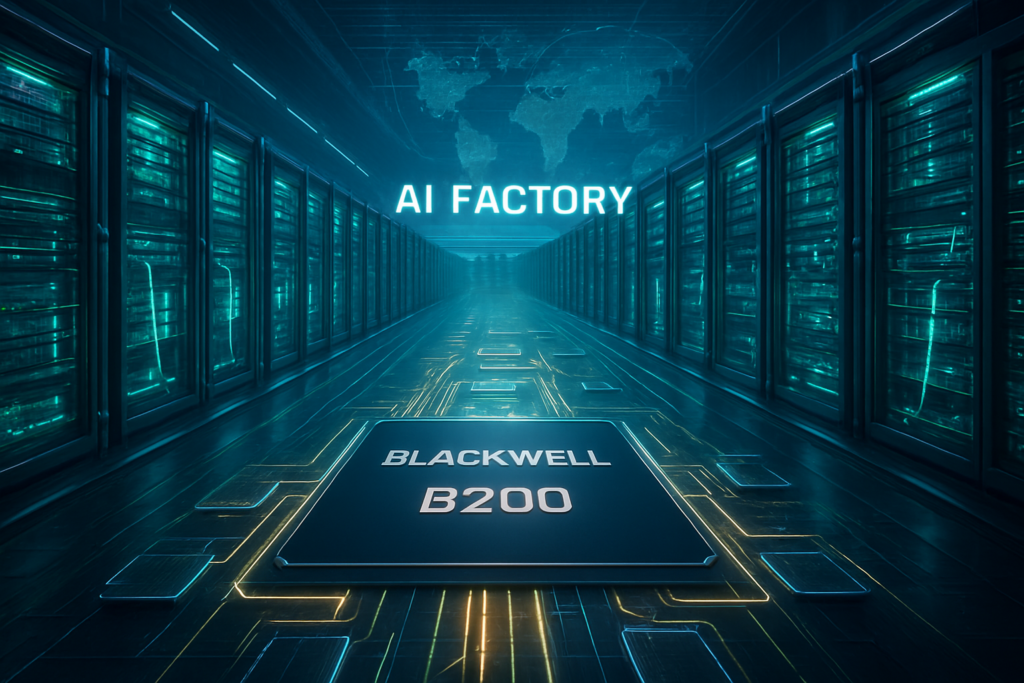
SANTA CLARA, CA — January 8, 2026 — The global landscape of artificial intelligence has reached a definitive turning point as NVIDIA (NASDAQ: NVDA) announced today that its Blackwell B200 architecture has entered full-scale volume production. This milestone marks the transition of the world’s most powerful AI chip from early-access trials to the backbone of global industrial intelligence. With supply chain bottlenecks for critical components like High Bandwidth Memory (HBM3e) and advanced packaging finally stabilizing, NVIDIA is now shipping Blackwell units in the tens of thousands per week, effectively sold out through mid-2026.
The significance of this production ramp-up was underscored by South Korean tech titan Naver (KRX:035420), which recently completed the deployment of Korea’s largest AI computing cluster. Utilizing 4,000 Blackwell B200 GPUs, the "B200 4K Cluster" is designed to propel the next generation of "omni models"—systems capable of processing text, video, and audio simultaneously. Naver’s move signals a broader shift toward "AI Sovereignty," where nations and regional giants build massive, localized infrastructure to maintain a competitive edge in the era of trillion-parameter models.
Redefining the Limits of Silicon: The Blackwell Architecture
The Blackwell B200 is not merely an incremental upgrade; it represents a fundamental architectural shift from its predecessor, the H100 (Hopper). While the H100 was a monolithic chip, the B200 utilizes a revolutionary chiplet-based design, connecting two reticle-limited dies via a 10 TB/s ultra-high-speed link. This allows the 208 billion transistors to function as a single unified processor, effectively bypassing the physical limits of traditional silicon manufacturing. The B200 boasts 192GB of HBM3e memory and 8 TB/s of bandwidth, more than doubling the capacity and speed of previous generations.
A key differentiator in the Blackwell era is the introduction of FP4 (4-bit floating point) precision. This technical leap, managed by a second-generation Transformer Engine, allows the B200 to process trillion-parameter models with 30 times the inference throughput of the H100. This capability is critical for the industry's pivot toward Mixture-of-Experts (MoE) models, where only a fraction of the model’s parameters are active at any given time, drastically reducing the energy cost per token. Initial reactions from the research community suggest that Blackwell has "reset the scaling laws," enabling real-time reasoning for models that were previously too large to serve efficiently.
The "AI Factory" Era and the Corporate Arms Race
NVIDIA CEO Jensen Huang has frequently described this transition as the birth of the "AI Factory." In this paradigm, data centers are no longer viewed as passive storage hubs but as industrial facilities where raw data is the raw material and "intelligence" is the finished product. This shift is visible in the strategic moves of hyperscalers and sovereign nations alike. While Naver is leading the charge in South Korea, global giants like Microsoft (NASDAQ: MSFT), Amazon (NASDAQ: AMZN), and Alphabet (NASDAQ: GOOGL) are integrating Blackwell into their clouds to support massive agentic systems—AI that doesn't just chat, but autonomously executes multi-step tasks.
However, NVIDIA is not without challengers. As Blackwell hits full production, AMD (NASDAQ: AMD) has countered with its MI350 and MI400 series, the latter featuring up to 432GB of HBM4 memory. Meanwhile, Google has ramped up its TPU v7 "Ironwood" chips, and Amazon’s Trainium3 is gaining traction among startups looking for a lower "Nvidia Tax." These competitors are focusing on "Total Cost of Ownership" (TCO) and energy efficiency, aiming to capture the 30-40% of internal workloads that hyperscalers are increasingly moving toward custom silicon. Despite this, NVIDIA’s software moat—CUDA—and the sheer scale of the Blackwell rollout keep it firmly in the lead.
Global Implications and the Sovereign AI Trend
The deployment of the Blackwell architecture fits into a broader trend of "Sovereign AI," where countries recognize that AI capacity is as vital as energy or food security. Naver’s 4,000-GPU cluster is a prime example of this, providing South Korea with the computational self-reliance to develop foundation models like HyperCLOVA X without total dependence on Silicon Valley. Naver CEO Choi Soo-yeon noted that training tasks that previously took 18 months can now be completed in just six weeks, a 12-fold acceleration that fundamentally changes the pace of national innovation.
Yet, this massive scaling brings significant concerns, primarily regarding energy consumption. A single GB200 NVL72 rack—a cluster of 72 Blackwell GPUs acting as one—can draw over 120kW of power, necessitating a mandatory shift toward liquid cooling solutions. The industry is now grappling with the "Energy Wall," leading to unprecedented investments in modular nuclear reactors and specialized power grids to sustain these AI factories. This has turned the AI race into a competition not just for chips, but for the very infrastructure required to keep them running.
The Horizon: From Reasoning to Agency
Looking ahead, the full production of Blackwell is expected to catalyze the move from "Reasoning AI" to "Agentic AI." Near-term developments will likely see the rise of autonomous systems capable of managing complex logistics, scientific discovery, and software development with minimal human oversight. Experts predict that the next 12 to 24 months will see the emergence of models exceeding 10 trillion parameters, powered by the Blackwell B200 and its already-announced successor, the Blackwell Ultra (B300), and the future "Rubin" (R100) architecture.
The challenges remaining are largely operational and ethical. As AI factories begin producing "intelligence" at an industrial scale, the industry must address the environmental impact of such massive compute and the societal implications of increasingly autonomous agents. However, the momentum is undeniable. OpenAI CEO Sam Altman recently remarked that there is "no scaling wall" in sight, and the massive Blackwell deployment in early 2026 appears to validate that conviction.
A New Chapter in Computing History
In summary, the transition of the NVIDIA Blackwell B200 into full production is a landmark event that formalizes the "AI Factory" as the central infrastructure of the 21st century. With Naver’s massive cluster serving as a blueprint for national AI sovereignty and the B200’s technical specs pushing the boundaries of what is computationally possible, the industry has moved beyond the experimental phase of generative AI.
As we move further into 2026, the focus will shift from the availability of chips to the efficiency of the factories they power. The coming months will be defined by how effectively companies and nations can translate this unprecedented raw compute into tangible economic and scientific breakthroughs. For now, the Blackwell era has officially begun, and the world is only starting to see the scale of the intelligence it will produce.
This content is intended for informational purposes only and represents analysis of current AI developments.
TokenRing AI delivers enterprise-grade solutions for multi-agent AI workflow orchestration, AI-powered development tools, and seamless remote collaboration platforms.
For more information, visit https://www.tokenring.ai/.