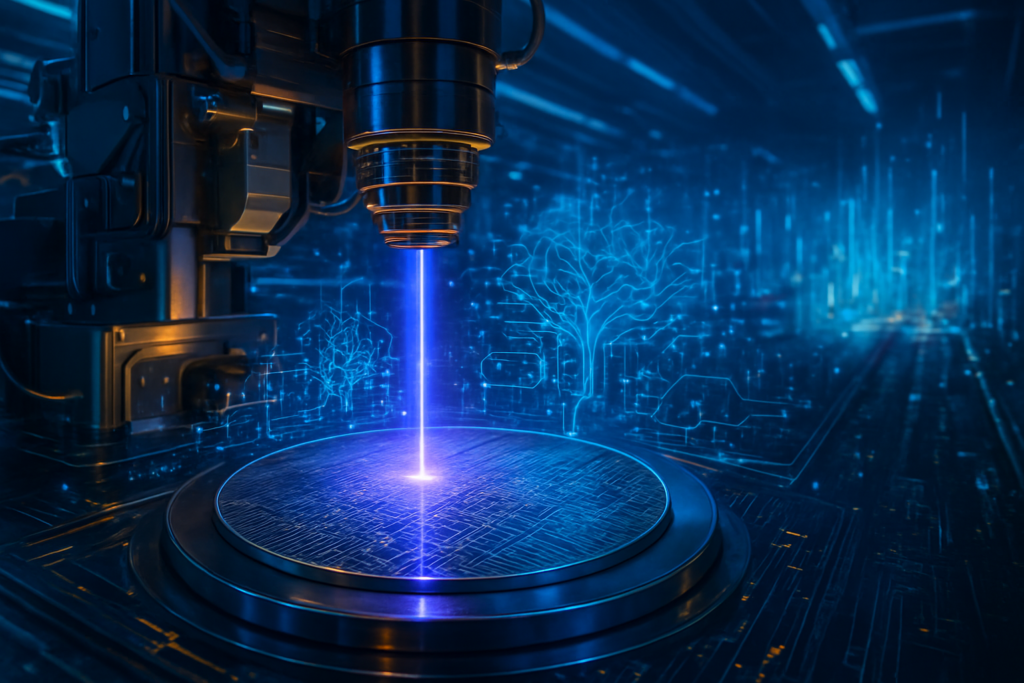
In a development that has sent shockwaves through the global semiconductor industry, reports emerging in late 2025 confirm that China has successfully breached the "technological wall" of Extreme Ultraviolet (EUV) lithography. A high-security facility in Shenzhen has reportedly validated a functional domestic EUV prototype, marking the first time a nation has independently replicated the complex light-source technology previously monopolized by the Dutch giant ASML (NASDAQ: ASML). This breakthrough signals a decisive shift in the global "chip war," suggesting that the era of Western-led containment through equipment bottlenecks is rapidly drawing to a close.
The immediate significance of this achievement cannot be overstated. For years, EUV lithography—the process of using 13.5nm wavelength light to etch microscopic circuits onto silicon—was considered the "Holy Grail" of manufacturing, accessible only to those with access to ASML's multi-billion dollar supply chain. China’s success in developing a working prototype, combined with Semiconductor Manufacturing International Corp (SMIC) (HKG:0981) reaching volume production on its 5nm-class nodes, effectively bypasses the most stringent U.S. export controls. This development ensures that China’s domestic AI and high-performance computing (HPC) sectors will have a sustainable, sovereign path toward the 2nm frontier.
Breaking the 13.5nm Barrier: The SSMB and LDP Revolution
Technically, the Chinese breakthrough deviates significantly from the architecture pioneered by ASML. While ASML utilizes Laser-Produced Plasma (LPP)—where high-power CO2 lasers vaporize tin droplets 50,000 times a second—the new Shenzhen prototype reportedly employs Laser-Induced Discharge Plasma (LDP). This method uses a combination of lasers and high-voltage discharge to generate the required plasma, a path that experts suggest is more cost-effective and simpler to maintain, even if it currently operates at a lower power output of approximately 50–100W.
Parallel to the LDP efforts, a more radical "Manhattan Project" for chips is unfolding in Xiong'an. Led by Tsinghua University, the Steady-State Micro-Bunching (SSMB) project utilizes a particle accelerator to generate a "clean" and continuous EUV beam. Unlike the pulsed light of traditional lithography, SSMB could theoretically reach power levels of 1kW or higher, potentially leapfrogging ASML’s current High-NA EUV capabilities by providing a more stable light source with fewer debris issues. This dual-track approach—LDP for immediate industrial application and SSMB for future-generation dominance—demonstrates a sophisticated R&D strategy that has outpaced Western intelligence estimates.
Furthermore, Huawei has played a pivotal role as the coordinator of a "shadow supply chain." Recent patent filings reveal that Huawei and its partner SiCarrier have perfected Self-Aligned Quadruple Patterning (SAQP) for 2nm-class features. While this "brute force" method using older Deep Ultraviolet (DUV) tools was once considered economically unviable due to low yields, the integration of domestic EUV prototypes is expected to stabilize production. Initial reactions from the international research community suggest that while China still trails in yield efficiency, the fundamental physics and engineering hurdles have been cleared.
Market Disruption: ASML’s Demand Cliff and the Rise of the "Two-Track" Supply Chain
The emergence of a viable Chinese EUV alternative poses an existential threat to the current market structure. ASML (NASDAQ: ASML), which has long enjoyed a 100% market share in EUV equipment, now faces what analysts call a "long-term demand cliff" in China—previously its most profitable region. While ASML’s 2025 revenues remained buoyed by Chinese firms stockpiling DUV spare parts, the projection for 2026 and beyond shows a sharp decline as domestic alternatives from Shanghai Micro Electronics Equipment (SMEE) and SiCarrier begin to replace Dutch and Japanese components in metrology and wafer handling.
The competitive implications extend to the world’s leading foundries. Taiwan Semiconductor Manufacturing Company (TSMC) (NYSE: TSM) and Intel (NASDAQ: INTC) are now facing a competitor in SMIC that is no longer bound by international sanctions. Although SMIC’s 5nm yields are currently estimated at 33% to 35%—far below TSMC’s ~85%—the massive $47.5 billion "Big Fund" Phase III provides the financial cushion necessary to absorb these costs. For Chinese AI giants like Baidu (NASDAQ: BIDU) and Alibaba (NYSE: BABA), this means a guaranteed supply of domestic chips for their large language models, reducing their reliance on "stripped-down" export-compliant chips from Nvidia (NASDAQ: NVDA).
Moreover, the strategic advantage is shifting toward "good enough" sovereign technology. Even if Chinese EUV machines are 50% more expensive to operate per wafer, the removal of geopolitical risk is a premium the Chinese government is willing to pay. This is forcing global tech giants to reconsider their manufacturing footprints, as the "Two-Track World"—one supply chain for the West and an entirely separate, vertically integrated one for China—becomes a permanent reality.
Geopolitical Fallout: The Export Control Paradox
The success of China’s EUV program highlights the "Export Control Paradox": the very sanctions intended to stall China’s progress served as the ultimate accelerant. By cutting off access to ASML and Lam Research (NASDAQ: LRCX) equipment, the U.S. and its allies forced Chinese firms to collaborate with domestic academia and the military-industrial complex in ways that were previously fragmented. The result is a semiconductor landscape that is more resilient and less dependent on global trade than it was in 2022.
This development fits into a broader trend of "technological sovereignty" that is defining the mid-2020s. Similar to how the launch of Sputnik galvanized the U.S. space program, the "EUV breakthrough" is being hailed in Beijing as a landmark victory for the socialist market economy. However, it also raises significant concerns regarding global security. A China that is self-sufficient in advanced silicon is a China that is less vulnerable to economic pressure, potentially altering the calculus for regional stability in the Taiwan Strait and the South China Sea.
Comparisons are already being made to the 1960s nuclear breakthroughs. Just as the world had to adjust to a multi-polar nuclear reality, the semiconductor industry must now adjust to a multi-polar advanced manufacturing reality. The era where a single company in Veldhoven, Netherlands, could act as the gatekeeper for the world’s most advanced AI applications has effectively ended.
The Road to 2nm: What Lies Ahead
Looking toward 2026 and 2027, the focus will shift from laboratory prototypes to industrial scaling. The primary challenge for China remains yield optimization. While producing a functional 5nm chip is a feat, producing millions of them at a cost that competes with TSMC is another matter entirely. Experts predict that China will focus on "advanced packaging" and "chiplet" designs to compensate for lower yields, effectively stitching together smaller, functional dies to create massive AI accelerators.
The next major milestone to watch will be the completion of the SSMB-EUV light source facility in Xiong'an. If this particle accelerator-based approach becomes operational for mass production, it could theoretically allow China to produce 2nm and 1nm chips with higher efficiency than ASML’s current High-NA systems. This would represent a complete leapfrog event, moving China from a follower to a leader in lithography physics.
However, significant challenges remain. The ultra-precision optics required for EUV—traditionally provided by Carl Zeiss for ASML—are notoriously difficult to manufacture. While the Changchun Institute of Optics has made strides, the durability and coating consistency of domestic mirrors under intense EUV radiation will be the ultimate test of the system's longevity in a 24/7 factory environment.
Conclusion: A New Era of Global Competition
The reports of China’s EUV breakthrough mark a definitive turning point in the history of technology. It proves that with sufficient capital, state-level coordination, and a clear strategic mandate, even the most complex industrial monopolies can be challenged. The key takeaways are clear: China has successfully transitioned from "brute-forcing" 7nm chips to developing the fundamental tools for sub-5nm manufacturing, and the global semiconductor supply chain has irrevocably split into two distinct spheres.
In the history of AI and computing, this moment will likely be remembered as the end of the "unipolar silicon era." The long-term impact will be a more competitive, albeit more fragmented, global market. For the tech industry, the coming months will be defined by a scramble to adapt to this new reality. Investors and policymakers should watch for the first "all-domestic" 5nm chip releases from Huawei in early 2026, which will serve as the ultimate proof of concept for this new era of Chinese semiconductor sovereignty.
This content is intended for informational purposes only and represents analysis of current AI and semiconductor developments.
TokenRing AI delivers enterprise-grade solutions for multi-agent AI workflow orchestration, AI-powered development tools, and seamless remote collaboration platforms.
For more information, visit https://www.tokenring.ai/.