As we close out 2025, the center of gravity in the artificial intelligence world has shifted. For years, the "AI experience" was synonymous with the cloud—a round-trip journey from a user's device to a massive data center and back. However, the release of the latest generation of silicon from the world’s leading chipmakers has effectively ended the era of cloud-dependency for everyday tasks. We are now witnessing the "Great Edge Migration," where the intelligence that once required a room full of servers now resides in the palm of your hand.
The significance of this development cannot be overstated. With the arrival of high-performance Neural Processing Units (NPUs) in flagship smartphones and laptops, the industry has crossed a critical threshold: the ability to run high-reasoning Large Language Models (LLMs) locally, with zero latency and total privacy. This transition marks a fundamental departure from the "chatbot" era toward "Agentic AI," where devices no longer just answer questions but proactively manage our digital lives using on-device data that never leaves the hardware.
The Silicon Arms Race: 100 TOPS and the Death of Latency
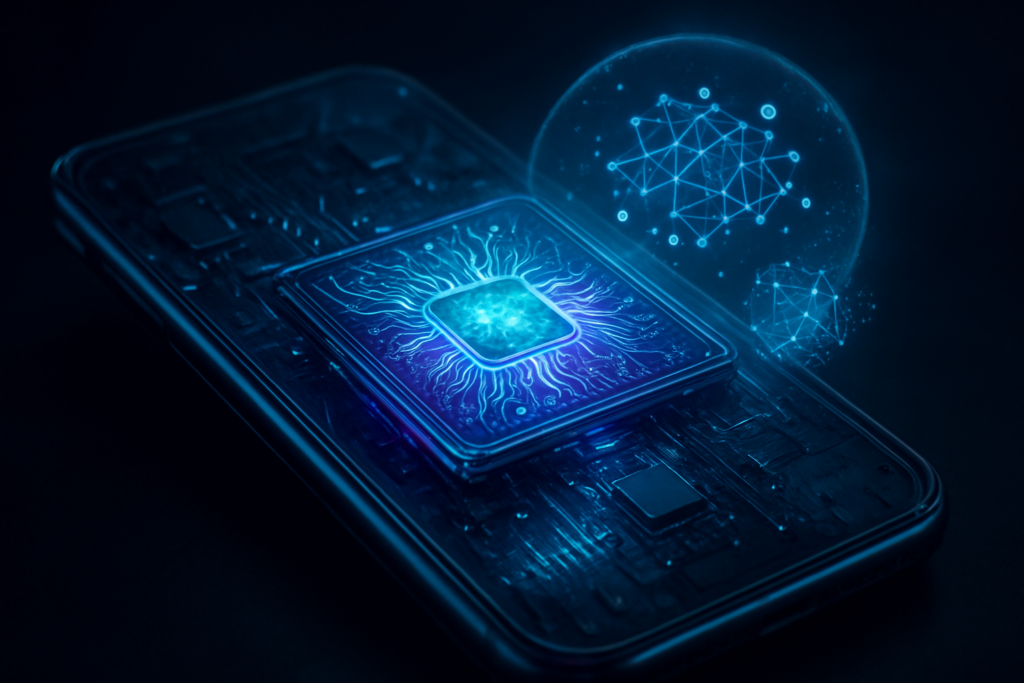
The technical backbone of this shift is a new class of "NPU-heavy" processors that prioritize AI throughput over traditional raw clock speeds. Leading the charge is Qualcomm (NASDAQ: QCOM) with its Snapdragon 8 Elite Gen 5, which features a Hexagon NPU capable of a staggering 100 Trillions of Operations Per Second (TOPS). Unlike previous generations that focused on burst performance, this new silicon is designed for "sustained inference," allowing it to run models like Llama 3.2 at over 200 tokens per second—faster than most humans can read.
Apple (NASDAQ: AAPL) has taken a different but equally potent approach with its A19 Pro and M5 chips. While Apple’s dedicated Neural Engine remains a powerhouse, the company has integrated "Neural Accelerators" directly into every GPU core, bringing total system AI performance to 133 TOPS on the base M5. Meanwhile, Intel (NASDAQ: INTC) has utilized its 18A process for the Panther Lake series, delivering 50 NPU TOPS while focusing on "Time to First Token" (TTFT) to ensure that local AI interactions feel instantaneous. AMD (NASDAQ: AMD) has targeted the high-end workstation market with its Strix Halo chips, which boast enough unified memory to run massive 70B-parameter models locally—a feat that was unthinkable for a laptop just 24 months ago.
This hardware evolution is supported by a sophisticated software layer. Microsoft (NASDAQ: MSFT) has solidified its Copilot+ PC requirements, mandating a minimum of 40 NPU TOPS and 16GB of RAM. The new Windows Copilot Runtime now provides developers with a library of over 40 local models, including Phi-4 and Whisper, which can be called natively by any application. This bypasses the need for expensive API calls to the cloud, allowing even small indie developers to integrate world-class AI into their software without the overhead of server costs.
Disruption at the Edge: The New Power Dynamics
This shift toward local inference is radically altering the competitive landscape of the tech industry. While NVIDIA (NASDAQ: NVDA) remains the undisputed king of AI training in the data center, the "Inference War" is being won at the edge by the likes of Qualcomm and Apple. As more processing moves to the device, the reliance on massive cloud clusters for everyday AI tasks is beginning to wane, potentially easing the astronomical electricity demands on hyperscalers like Amazon (NASDAQ: AMZN) and Google (NASDAQ: GOOGL).
For tech giants, the strategic advantage has moved to vertical integration. Apple’s "Private Cloud Compute" and Qualcomm’s "AI Stack 2025" are designed to create a seamless handoff between local and cloud AI, but the goal is clearly to keep as much data on-device as possible. This "local-first" strategy provides a significant moat; a company that controls the silicon, the OS, and the local models can offer a level of privacy and speed that a cloud-only competitor simply cannot match.
However, this transition has introduced a new economic reality: the "AI Tax." To support these local models, hardware manufacturers are being forced to increase base RAM specifications, with 16GB now being the absolute minimum for a functional AI PC. This has led to a surge in demand for high-speed memory from suppliers like Micron (NASDAQ: MU) and Samsung (KRX: 005930), contributing to a 5% to 10% increase in the average selling price of premium devices. HP (NYSE: HPQ) and other PC manufacturers have acknowledged that these costs are being passed to the consumer, framed as a "productivity premium" for the next generation of computing.
Privacy, Sovereignty, and the 'Inference Gap'
The wider significance of Edge AI lies in the reclamation of digital privacy. In the cloud-AI era, users were forced to trade their data for intelligence. In the Edge AI era, data sovereignty is the default. For enterprise sectors such as healthcare and finance, local AI is not just a convenience; it is a regulatory necessity. Being able to run a 10B-parameter model on a local workstation allows a doctor to analyze patient data or a lawyer to summarize sensitive contracts without ever risking a data leak to a third-party server.
Despite these gains, the industry is grappling with the "Inference Gap." While a Snapdragon 8 Gen 5 can run a 3B-parameter model with ease, it still lacks the deep reasoning capabilities of a trillion-parameter model like GPT-5. To bridge this, the industry is moving toward "Hybrid AI" architectures. In this model, the local NPU handles "fast" thinking—context-aware tasks, scheduling, and basic writing—while the cloud is reserved for "slow" thinking—complex logic, deep research, and heavy computation.
This hybrid approach mirrors the human brain's dual-process theory, and it is becoming the standard for 2026-ready operating systems. The concern among researchers, however, is "Semantic Drift," where local models may provide slightly different or less accurate answers than their cloud counterparts, leading to inconsistencies in user experience across different devices.
The Road Ahead: Agentic AI and the End of the App
Looking toward 2026, the next frontier for Edge AI is the "Agentic OS." We are moving away from a world of siloed applications and toward a world of persistent agents. Instead of opening a travel app, a banking app, and a calendar, a user will simply tell their device to "plan a weekend trip within my budget," and the local NPU will orchestrate the entire process by interacting with the underlying services on the user's behalf.
We are also seeing the emergence of new form factors. The low-power, high-output NPUs developed for phones are now finding their way into AI smart glasses. These devices use local visual NPUs to perform real-time translation and object recognition, providing an augmented reality experience that is processed entirely on the frame to preserve battery life and privacy. Experts predict that by 2027, the "AI Phone" will be less of a communication device and more of a "personal cognitive peripheral" that coordinates a fleet of wearable sensors.
A New Chapter in Computing History
The shift to Edge AI represents one of the most significant architectural changes in the history of computing, comparable to the transition from mainframes to PCs or the move from desktop to mobile. By bringing the power of large language models directly to consumer silicon, the industry has solved the twin problems of latency and privacy that have long dogged the AI revolution.
As we look toward 2026, the key metric for a device's worth is no longer its screen resolution or its camera megapixels, but its "Intelligence Density"—how much reasoning power it can pack into a pocket-sized form factor. The silent hum of billions of NPUs worldwide is the sound of a new era, where AI is no longer a destination we visit on the web, but a fundamental part of the tools we carry with us every day. In the coming months, watch for the first "AI-native" operating systems to emerge, signaling the final step in this historic migration from the cloud to the edge.
This content is intended for informational purposes only and represents analysis of current AI developments.
TokenRing AI delivers enterprise-grade solutions for multi-agent AI workflow orchestration, AI-powered development tools, and seamless remote collaboration platforms.
For more information, visit https://www.tokenring.ai/.