Under Armour’s stock price has taken a beating over the past six months, shedding 29% of its value and falling to $4.38 per share. This might have investors contemplating their next move.
Is now the time to buy Under Armour, or should you be careful about including it in your portfolio? Check out our in-depth research report to see what our analysts have to say, it’s free for active Edge members.
Why Do We Think Under Armour Will Underperform?
Even though the stock has become cheaper, we're cautious about Under Armour. Here are three reasons there are better opportunities than UAA and a stock we'd rather own.
1. Declining Constant Currency Revenue, Demand Takes a Hit
In addition to reported revenue, constant currency revenue is a useful data point for analyzing Apparel and Accessories companies. This metric excludes currency movements, which are outside of Under Armour’s control and are not indicative of underlying demand.
Over the last two years, Under Armour’s constant currency revenue averaged 7.3% year-on-year declines. This performance was underwhelming and implies there may be increasing competition or market saturation. It also suggests Under Armour might have to lower prices or invest in product improvements to accelerate growth, factors that can hinder near-term profitability. 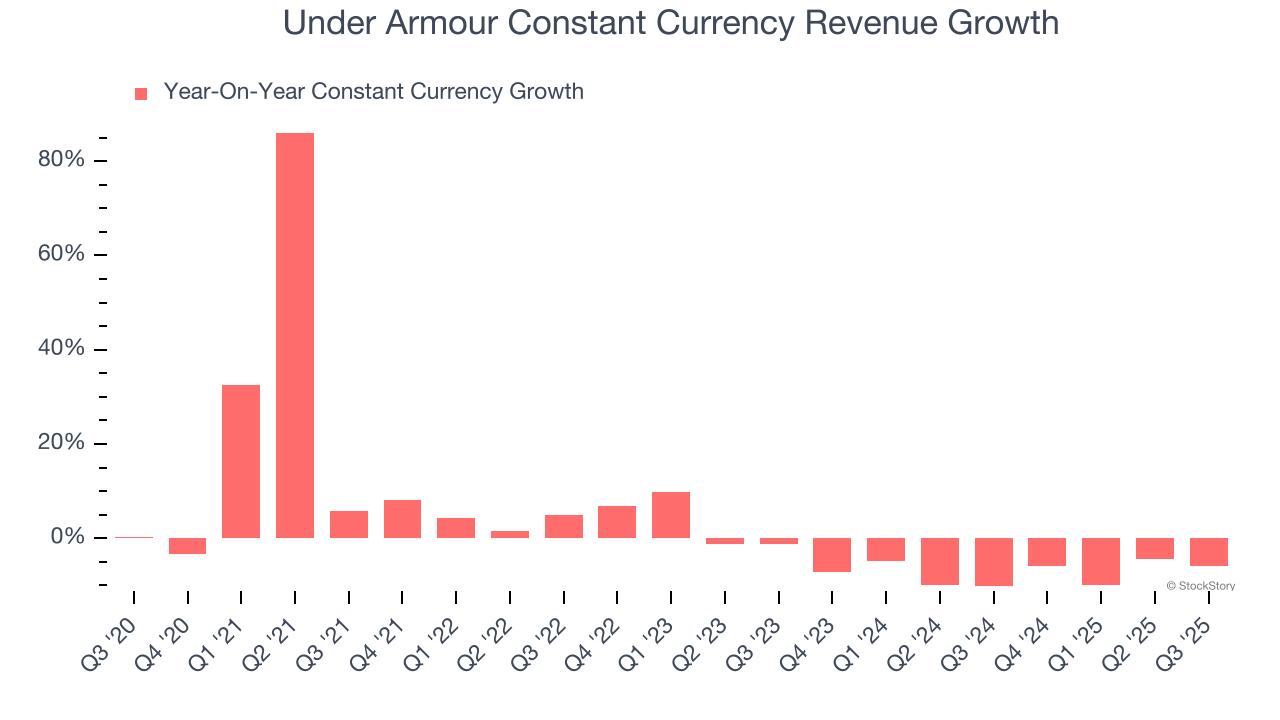
2. New Investments Fail to Bear Fruit as ROIC Declines
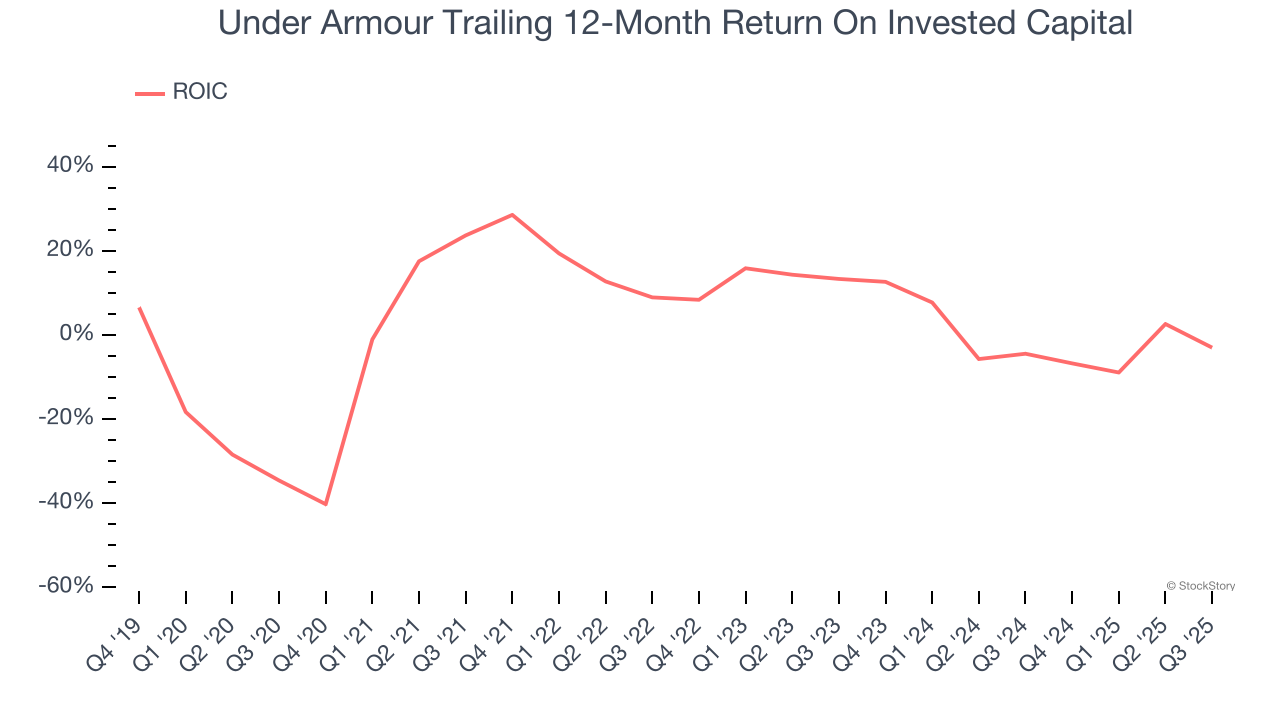
A company’s ROIC, or return on invested capital, shows how much operating profit it makes compared to the money it has raised (debt and equity).
We like to invest in businesses with high returns, but the trend in a company’s ROIC is what often surprises the market and moves the stock price. Over the last few years, Under Armour’s ROIC has unfortunately decreased significantly. Paired with its already low returns, these declines suggest its profitable growth opportunities are few and far between.
3. High Debt Levels Increase Risk
Debt is a tool that can boost company returns but presents risks if used irresponsibly. As long-term investors, we aim to avoid companies taking excessive advantage of this instrument because it could lead to insolvency.
Under Armour’s $1.9 billion of debt exceeds the $396 million of cash on its balance sheet. Furthermore, its 7× net-debt-to-EBITDA ratio (based on its EBITDA of $228.3 million over the last 12 months) shows the company is overleveraged.
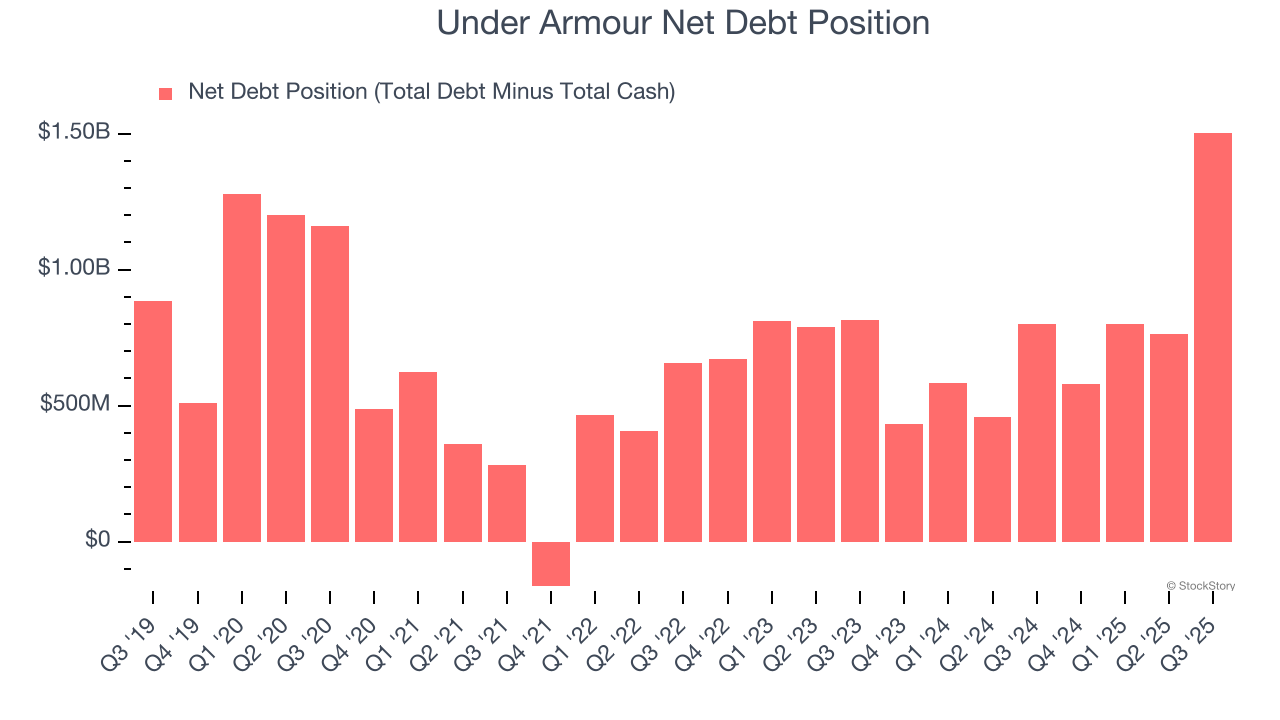
At this level of debt, incremental borrowing becomes increasingly expensive and credit agencies could downgrade the company’s rating if profitability falls. Under Armour could also be backed into a corner if the market turns unexpectedly – a situation we seek to avoid as investors in high-quality companies.
We hope Under Armour can improve its balance sheet and remain cautious until it increases its profitability or pays down its debt.
Final Judgment
We see the value of companies helping consumers, but in the case of Under Armour, we’re out. Following the recent decline, the stock trades at 35.7× forward P/E (or $4.38 per share). At this valuation, there’s a lot of good news priced in - we think there are better stocks to buy right now. We’d recommend looking at the Amazon and PayPal of Latin America.
Stocks We Like More Than Under Armour
Your portfolio can’t afford to be based on yesterday’s story. The risk in a handful of heavily crowded stocks is rising daily.
The names generating the next wave of massive growth are right here in our Top 9 Market-Beating Stocks. This is a curated list of our High Quality stocks that have generated a market-beating return of 244% over the last five years (as of June 30, 2025).
Stocks that have made our list include now familiar names such as Nvidia (+1,326% between June 2020 and June 2025) as well as under-the-radar businesses like the once-micro-cap company Tecnoglass (+1,754% five-year return). Find your next big winner with StockStory today.