San Francisco, California--(Newsfile Corp. - January 6, 2026) - Carziqo, an autonomous mobility technology company building driverless ride-hailing and fleet automation solutions, today announced an upgraded data-closed-loop ("data flywheel") architecture designed to reduce the time between real-world operations and model updates, helping fleets learn faster from on-road conditions while maintaining strict controls for safety, privacy, and compliance.
Carziqo
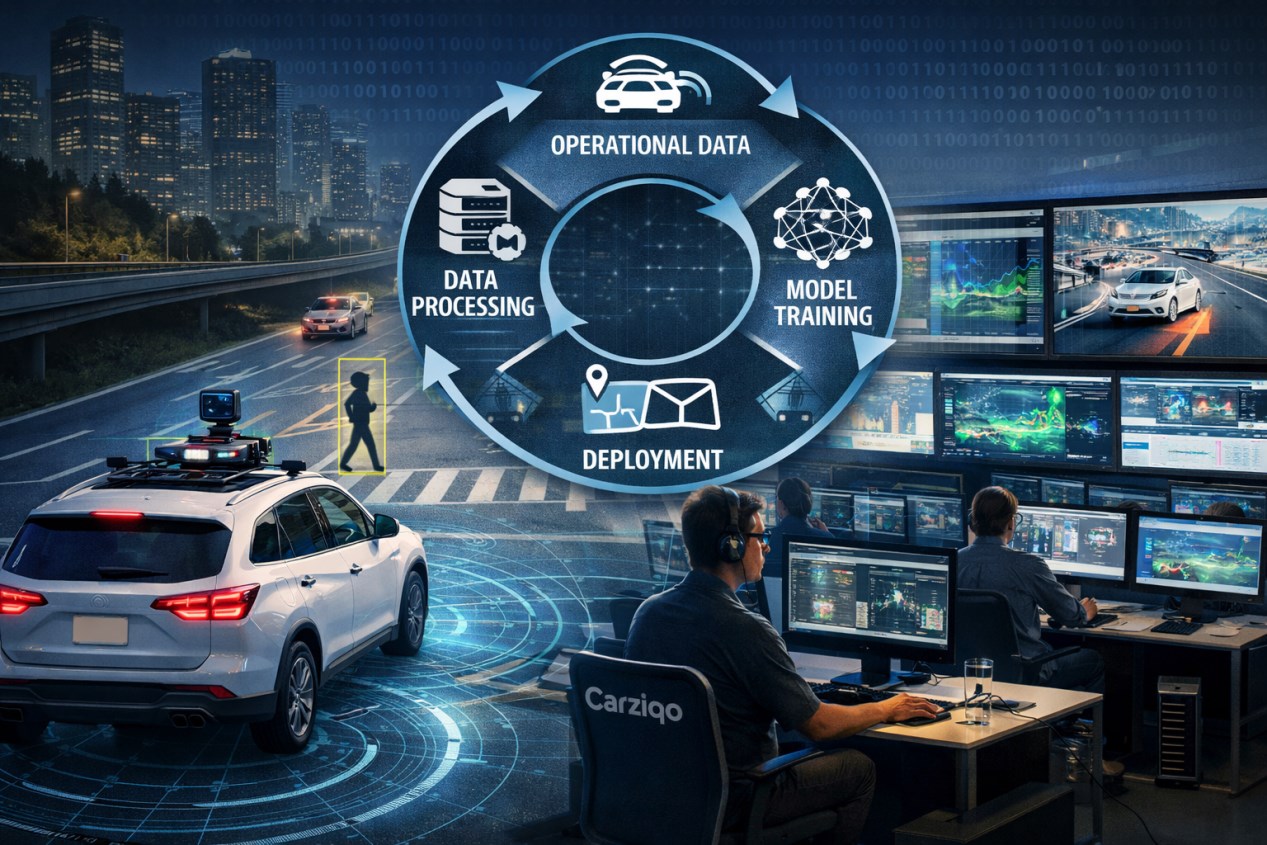
To view an enhanced version of this graphic, please visit:
https://images.newsfilecorp.com/files/12082/279578_9ccac40504c10a62_001full.jpg
Carziqo's new workflow standardizes how operational signals—ranging from perception edge cases and route-level anomalies to dispatch efficiency, rider experience indicators, and safety interventions—are transformed into curated training data, evaluated in simulation and controlled testing, and then deployed through gated release processes.
"Autonomous mobility is not just a model problem—it's an operations problem," said Zaydenn Harrington, CEO of Carziqo. "The fastest teams win by turning real-world learning into safe, repeatable improvements. Our closed-loop system shortens the path from 'what happened in the fleet' to 'what the model learned,' without compromising governance."
What Carziqo Means by "Data Closed-Loop"
In practical terms, Carziqo's closed-loop approach connects four layers into one continuous improvement cycle:
Operational Data Capture (Fleet Reality)
Vehicle telemetry and sensor diagnostics
Safety events and near-miss proxies
Perception/behavior edge cases (construction, unusual signage, rare maneuvers)
Dispatch and routing performance (wait time, cancellations, deadhead miles)
Rider experience signals (pickup accuracy, smoothness, trip reliability)
Data Curation and Labeling (Turning Signals Into Training-Grade Assets)
Automated filtering to prioritize "high-learning-value" moments
De-duplication and scenario clustering to reduce noisy repeats
Human-in-the-loop review for critical edge cases and safety-relevant sequences
Versioned datasets to enable precise comparison across model generations
Model Training, Evaluation, and Regression Testing (Proof Before Release)
Training runs tied to traceable dataset versions
Simulation and replay-based validation against real fleet scenarios
Regression checks to ensure improvements do not introduce new failure modes
Policy-based gating: models advance only when predefined safety and reliability thresholds are met
Deployment and Monitoring (Controlled Rollout With Feedback)
Staged releases (shadow mode → limited geofence → broader availability)
Continuous monitoring for drift, rare-event recurrence, and operational impacts
Automated triggers to re-queue new data for the next iteration cycle
Why Cycle Time Matters
In autonomous driving and fleet automation, performance is shaped by long-tail events and operational complexity—factors that do not appear evenly in static datasets. A shorter iteration cycle helps teams respond to:
Changes in road geometry and construction patterns
Weather-driven and seasonal variability
Local driving behaviors and city-specific rules
Hardware variations and sensor aging
Dispatch demand shifts and supply constraints
Carziqo stated that its internal rollout of the closed-loop workflow has reduced friction across engineering, operations, and safety teams by standardizing what gets captured, what gets labeled, what gets trained, and what gets released-under a single governance framework.
Safety, Governance, and Privacy by Design
Carziqo emphasized that the upgraded system is built to support safety review and responsible data handling, including:
Minimization principles: collecting only what is necessary for system improvement
Access controls and auditability for sensitive datasets and labeling pipelines
Clear separation between operational logs and training datasets
Release gating tied to measurable evaluation criteria and regression tests
Monitoring and rollback readiness for production deployments
"Iteration speed without governance is not progress," Zaydenn Harrington added. "Our goal is disciplined velocity—faster learning with stronger controls."
What's Next
Carziqo plans to expand closed-loop coverage across additional operational domains, including:
Enhanced scenario mining for rare edge cases
Improved simulation fidelity tied to fleet observations
More granular model versioning to isolate which data changes drive performance
Operational optimization loops that connect autonomy performance to dispatch efficiency and customer experience metrics
About Carziqo
Carziqo is an autonomous mobility technology company developing driverless ride-hailing and fleet automation systems. The company focuses on building scalable operations, safety-centered engineering processes, and data-driven AI iteration that supports reliable autonomous services across diverse real-world environments.
Media Contact
Carziqo Office
Arielleth Thalren
Email: info@carziqo.com
Website: carziqo.com
To view the source version of this press release, please visit https://www.newsfilecorp.com/release/279578