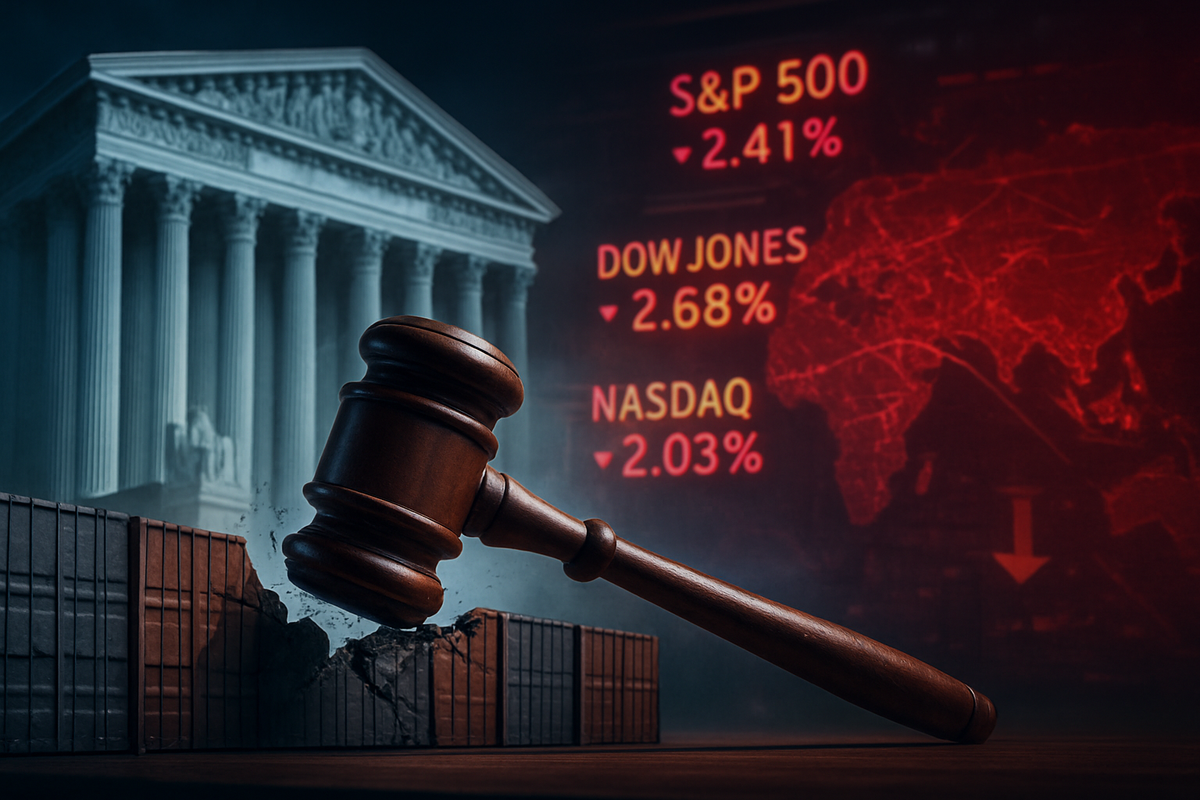
The global financial landscape was thrown into a state of high-octane volatility this morning, February 23, 2026, as investors grappled with the fallout of a monumental Supreme Court ruling that has effectively dismantled the cornerstone of President Trump’s "Trade 2.0" agenda. In a 6-3 decision handed down late Friday, the high court ruled that the administration overstepped its constitutional authority by using emergency powers to bypass Congress and impose universal baseline tariffs.
While the ruling initially triggered a brief relief rally on Friday afternoon, the mood has turned decidedly sour in pre-market trading this morning. S&P 500 futures have slid 0.8%, with Nasdaq 100 futures leading the decline at 1.0%, as the White House signaled an immediate pivot to alternative legal statutes to keep its protectionist wall intact. The sudden legal void has injected a fresh "unpredictability premium" into global equities, leaving multi-national corporations and trade partners in a high-stakes limbo over the future of American trade policy.
The Verdict that Shook the Trade Wall
The Supreme Court’s ruling in the consolidated case Learning Resources, Inc. v. Trump centers on the administration's use of the International Emergency Economic Powers Act (IEEPA) of 1977. Since early 2025, the President has utilized IEEPA to justify a 10% universal reciprocal tariff and more aggressive levies on Mexico and Canada, citing "national emergencies" related to trade deficits and border security. However, Chief Justice John Roberts, writing for the majority, delivered a stinging rebuke of this executive overreach, stating that the power to tax—which includes the imposition of tariffs—is a power "exclusive to the halls of Congress" under Article I of the Constitution.
The legal timeline leading to this moment has been a year-long collision course between the Executive Branch and the judiciary. Following the administration’s "Liberation Day" proclamation in April 2025, which saw the first wave of broad-based tariffs, dozens of retail and manufacturing trade groups filed suit. Lower courts were initially divided, but the Supreme Court’s definitive stance has now rendered the bulk of the IEEPA-based tariff regime legally dead.
The immediate market reaction has been one of whiplash. On Friday, the S&P 500 (NYSEARCA:SPY) closed up 0.7% on the news, with tech stocks initially cheering what looked like a return to a more traditional trade environment. However, over the weekend, the administration’s response—announced via social media and official executive orders—showed no signs of backing down. By Saturday evening, the President announced a pivot to Section 122 of the Trade Act of 1974, which allows for a 15% tariff for a 150-day window to address balance-of-payments deficits. This "legal musical chairs" has left analysts at firms like Deutsche Bank and Allianz warning that the era of policy stability is officially over.
Corporate America: A Divided Battlefield
The ruling creates a complex map of winners and losers, though "uncertainty" remains the dominant theme for all. Technology giants like Apple Inc. (NASDAQ: AAPL) have been among the most vocal critics of the tariff regime, having faced an estimated $20 billion in annual exposure. While the SCOTUS ruling theoretically removes the 60% baseline tariff on some Chinese imports, the administration’s insistence on using Section 301 and Section 232 (National Security) authorities means Apple’s accelerated shift of production to India and Vietnam is unlikely to slow down.
Retailers like Walmart Inc. (NYSE: WMT), which have had to pass roughly 50% of tariff costs onto consumers through higher prices on general merchandise, are currently in a "wait-and-see" mode. The 150-day reprieve offered by the Section 122 limit provides some breathing room, but the threat of a "fiscal cliff" in mid-September 2026—when those powers expire—prevents any long-term downward adjustment in pricing.
The automotive sector remains perhaps the most battered by the news. Ford Motor Company (NYSE: F) and General Motors Company (NYSE: NYSE:GM) both saw their 2025 earnings heavily impacted by the 25% duties on imported parts. While the IEEPA ruling nullifies some of those specific costs, the administration’s continued use of Section 232 investigations into automotive national security keeps a cloud of potential 25% tariffs hanging over the industry. On the flip side, gold and precious metal miners like Newmont Corporation (NYSE: NEM) have seen a surge in interest, as spot gold hit a historic $5,160 per ounce this morning, acting as a "policy hedge" for investors fleeing the volatility of the dollar.
A Systemic Shift in Global Trade Norms
Beyond the immediate tickers, this ruling represents a fundamental challenge to the "Protectionist Era" that has dominated the mid-2020s. By reasserting Congressional control over trade, the Supreme Court has effectively forced the administration to play a more tactical, rather than total, trade war. However, the ripple effects are already being felt across the Atlantic and Pacific. In Europe, the DAX in Germany fell 0.7% early Monday, as investors fear the U.S. will now lean more heavily on Section 232 "National Security" justifications for car tariffs, which were not invalidated by Friday's ruling.
In Asia, the reaction was more nuanced. The Hang Seng Index in Hong Kong actually surged 2.5%, as the market bets that the shift from a 20-40% IEEPA regime to a 15% Section 122 cap may actually lower the effective tax rate on high-value electronics in the short term. This highlights a growing trend of "regulatory arbitrage," where global companies are constantly recalculating their supply chains based on which specific U.S. legal statute is currently in favor at the White House.
The historical precedent here is significant, drawing comparisons to the 1930s when judicial and legislative pushback against executive trade power led to a period of intense domestic political friction. We are now entering a phase of "fragmented trade," where the executive branch uses a patchwork of narrower authorities to achieve the same protectionist goals previously reached through broad emergency declarations.
The Road Ahead: September’s Fiscal Cliff
What comes next is a period of intense legal and administrative chaos. The most immediate concern for the Treasury Department is the "refund nightmare." An estimated $150 billion to $200 billion in IEEPA-based tariffs has already been collected over the past year. With the Supreme Court declaring the authority for those collections void, a deluge of class-action lawsuits from importers seeking refunds is expected to hit the Court of International Trade as early as this afternoon.
In the short term, the market will focus on the 150-day countdown for the Section 122 "Balance of Payments" tariffs. This creates a hard deadline in mid-September 2026. Unless the administration can strike a deal with a deeply divided Congress to codify these tariffs into law, the U.S. could face a sudden "tariff holiday" followed by a renewed trade skirmish. Strategic pivots are already underway; many firms are likely to hold off on major Capital Expenditure (CapEx) projects until the legal dust settles, potentially slowing GDP growth in the second half of the year.
For investors, the primary challenge is navigating the "unpredictability premium." The move from a predictable (if aggressive) tariff wall to a shifting landscape of 150-day windows and national security investigations makes it nearly impossible to value long-term supply chain investments.
Market Wrap-Up and Investor Outlook
The Supreme Court’s ruling has successfully clipped the wings of the Executive Branch’s trade powers, but it has not ended the trade war. Instead, it has transformed it into a more complex, more litigious, and significantly more volatile beast. The key takeaway for the market today is that the "Trump Trade" is no longer a monolith; it is now a series of tactical legal battles that will be fought agency by agency, statute by statute.
Moving forward, the S&P 500 is likely to remain range-bound as it digests the transition to the Section 122 regime. Investors should watch for three major signals over the coming months:
- The success (or failure) of the administration in fast-tracking Section 232 "National Security" reports to replace the invalidated IEEPA duties.
- The rhetoric from Congressional leaders on whether they will move to "re-authorize" the President's tariff powers.
- The progress of the massive refund litigation, which could have significant fiscal implications for the federal budget.
While the "Tariff Train" has switched tracks, it remains at full speed. Investors are advised to maintain high levels of liquidity and look toward "safe-haven" sectors as the constitutional tug-of-war between the White House and the Judiciary continues to play out on the global stage.
This content is intended for informational purposes only and is not financial advice.