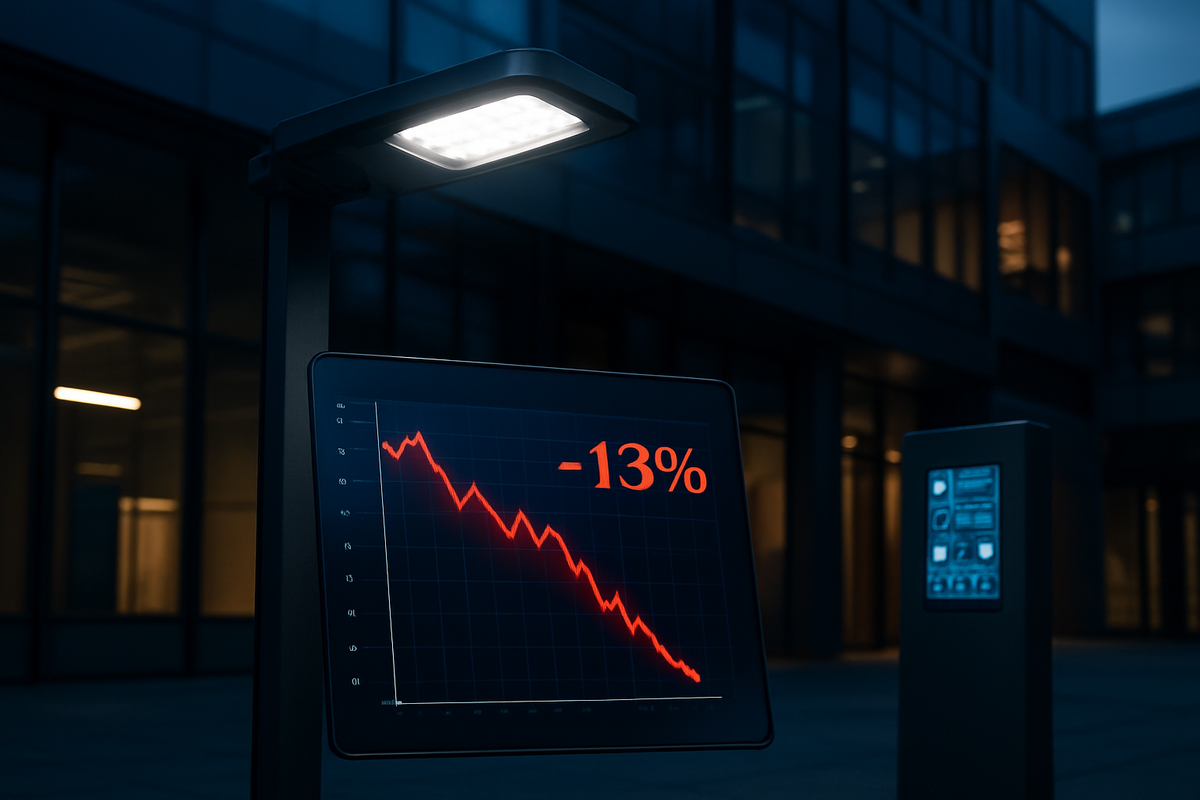
The industrial lighting and building automation giant Acuity Brands (NYSE: AYI) saw its stock price crater by more than 13% on January 8, 2026, following the release of its latest quarterly earnings report. Despite posting earnings per share that exceeded analyst expectations, the company’s inability to raise its full-year guidance and a perceived stagnation in revenue growth triggered a massive "sell the news" reaction among investors who had pushed the stock to record highs in the weeks leading up to the announcement.
The sharp decline reflects a growing sensitivity in the market toward high-valuation industrial tech stocks. As the broader Nasdaq Composite struggled with its own triple-digit losses on the same day, Acuity Brands became a focal point for concerns regarding the sustainability of the post-pandemic infrastructure boom and the potential for a "seasonality shift" that could dampen performance in the coming months.
High Expectations Meet "Priced for Perfection" Realities
On the morning of January 8, 2026, Acuity Brands reported its fiscal results for the period ending November 30, 2025. The company announced an adjusted earnings per share (EPS) of $4.69, comfortably surpassing the consensus analyst estimate of $4.45. This represented an 18% increase year-over-year, showcasing the company’s continued ability to extract efficiency from its operations. However, the top-line figures told a different story. Net sales reached $1.14 billion, a 20% increase year-over-year largely driven by the integration of the QSC acquisition, but this figure barely met the high-end expectations of a market hungry for more aggressive growth.
The timeline leading up to this sell-off is critical for understanding the magnitude of the drop. Between April 2024 and early January 2026, Acuity Brands’ stock had rallied over 30%, reaching an all-time high of approximately $380 per share just days before the report. This rally was fueled by optimism surrounding the company’s "Intelligent Spaces" segment and its pivot toward industrial technology. When management merely reaffirmed its full-year 2026 guidance—projecting net sales between $4.7 billion and $4.9 billion—rather than raising it, investors who had "priced the stock for perfection" immediately moved to lock in profits, leading to a gap-down at the opening bell.
During the earnings call, CEO Neil Ashe and CFO Karen Holcom highlighted that a "tariff-related backlog pull-forward" had favorably impacted the previous two quarters. They warned of "altered seasonality" for the upcoming second fiscal quarter, suggesting that the volume of orders might normalize or even dip as the backlog is cleared. This specific warning about the Q2 outlook acted as a catalyst for the 13.08% intraday plunge, as traders grew wary of a potential slowdown in the core Acuity Brands Lighting (ABL) segment.
Winners and Losers in the Lighting and Automation Space
The immediate loser of the day was undoubtedly the Acuity Brands shareholder base, which saw billions in market capitalization evaporate in a single session. However, the ripple effects were felt across the sector. Hubbell Incorporated (NYSE: HUBB), a direct competitor in the industrial and utility lighting space, managed to remain relatively flat, closing down only 0.01%. Hubbell’s resilience suggests that investors may be rotating out of high-multiple "tech-adjacent" names like Acuity and into more traditional, stable industrial plays that have shown consistent momentum without the same level of valuation risk.
Eaton Corporation (NYSE: ETN), another major player in power management and building automation, saw its shares decline by 1.24%. While Eaton is also navigating a high-valuation environment, its broader diversification across the "physical backbone" of the AI economy has provided it with a more robust defensive profile than Acuity. Meanwhile, European rival Signify (AMS: LIGHT) fell 1.46% on the Amsterdam exchange. Signify continues to struggle with its transition to high-margin software services, and Acuity’s warning about "backlog normalization" may signal that the entire lighting industry is entering a period of cooling demand.
On the winning side, opportunistic institutional investors may see this 13% drop as a favorable entry point for a company that is still fundamentally growing its "Intelligent Spaces" (AIS) segment at a double-digit clip. The AIS segment, which includes the Distech and QSC brands, remains a bright spot, and competitors who lack a similar software-led strategy may find themselves losing market share to Acuity in the long run, even if Acuity's stock is currently suffering from a short-term valuation correction.
Broader Industry Trends and the "Supply Shock" Factor
The sell-off in Acuity Brands fits into a broader trend of market skepticism toward companies that have benefited from "pull-forward" demand. Much like the tech sector’s correction in previous years, the industrial tech space is now grappling with the normalization of supply chains. The "tariff-related backlog" mentioned by management refers to a strategic move by many distributors to stock up on components and fixtures ahead of anticipated trade policy changes. As these inventories are worked through, the artificial boost to revenue disappears, leaving a gap that organic growth must fill.
Historically, Acuity Brands has been a bellwether for the North American construction and renovation market. A 13% drop following a profit beat is reminiscent of the company’s April 2023 performance, where a revenue miss overshadowed strong earnings. This pattern suggests that the market is no longer satisfied with margin expansion alone; it requires evidence of sustainable, top-line volume growth. Furthermore, the "Industrial Tech" transformation that Acuity is undergoing—moving from a fixture manufacturer to a software and controls provider—is a capital-intensive journey that often results in "choppy" quarterly results that frustrate short-term traders.
Regulatory and policy implications also loom large. The mention of tariffs during the earnings call underscores the vulnerability of the lighting industry to global trade tensions. With many components still sourced internationally, any supply shock or pricing adjustment required to maintain margins can lead to the "uncertainty in the marketplace" that management cited as a headwind. This event serves as a warning to other industrial companies that rely on global supply chains: even a strong balance sheet cannot fully insulate a stock from the volatility of geopolitical trade shifts.
The Path Forward: Strategic Pivots and Market Opportunities
In the short term, Acuity Brands will likely focus on stabilizing its share price by demonstrating that the "seasonality shift" is a temporary hurdle rather than a permanent decline. The company is expected to lean heavily into its "Acuity Intelligent Spaces" segment to offset any softness in traditional lighting. If the company can prove that its software and IoT integrations are becoming "sticky" enough to generate recurring revenue, it may regain the trust of growth-oriented investors. However, the next two quarters will be a "show-me" period for management.
Strategic adaptations may include a more aggressive push into the data center and infrastructure markets, where power management and intelligent lighting are in high demand. As Eaton and Hubbell have shown, being tied to the "AI infrastructure" trade is a powerful tailwind. Acuity has the technology through its Distech Controls brand to compete in this space, but it must execute flawlessly to convince the market that it belongs in the same conversation as the top-tier power management giants.
Long-term, the 13% sell-off may be viewed as a necessary "reset" for a stock that had run too far, too fast. The fundamental transition of the company remains intact, and the acquisition of QSC provides a significant platform for growth in the audio-visual and control space. Investors should watch for whether the company uses its strong cash flow to initiate share buybacks at these lower levels, which would signal management's confidence that the market has overreacted to the Q1 report and the Q2 outlook.
Summary and Investor Watchpoints
The 13% plunge in Acuity Brands (NYSE: AYI) serves as a stark reminder that in a high-valuation market, "good" is no longer "good enough." While the company delivered a solid earnings beat, the combination of stagnant revenue, a lack of guidance upgrades, and warnings of a cooling backlog proved too much for the stock to bear. The event highlights the delicate balance industrial tech companies must strike between managing short-term supply chain "noise" and long-term strategic transformation.
Moving forward, investors should keep a close eye on the following:
- Revenue Growth in ABL: Whether the core lighting segment can return to volume growth as the backlog normalizes.
- AIS Margin Expansion: Whether the software-heavy Intelligent Spaces segment can continue to scale and provide the high-margin cushion the company needs.
- Macro Indicators: Trends in non-residential construction and any further updates on tariff policies that could impact pricing.
While the immediate impact of the January 8 sell-off is painful for shareholders, the long-term significance lies in Acuity’s ability to navigate the transition from a traditional manufacturer to a modern industrial technology leader. The coming months will determine if this drop was a minor setback or a sign of a deeper structural shift in the lighting and building automation industry.
This content is intended for informational purposes only and is not financial advice.