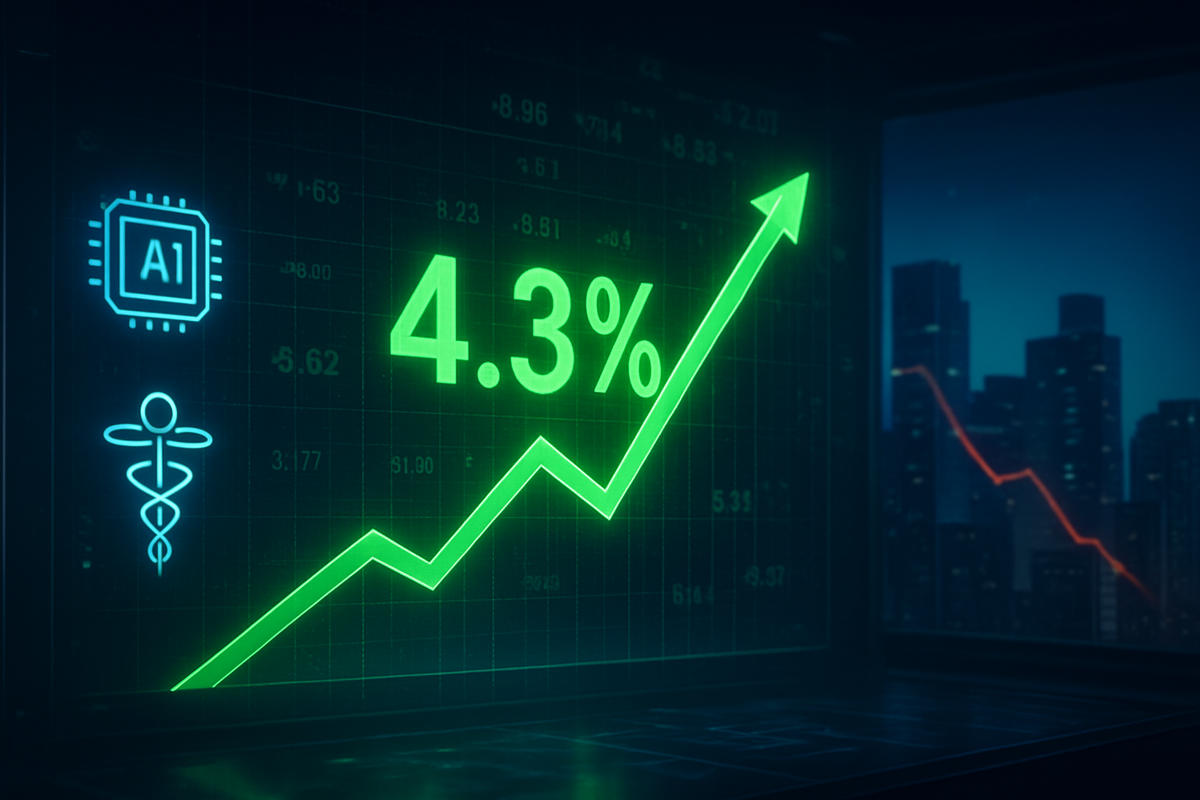
The United States economy defied gravity in the third quarter of 2025, posting a staggering 4.3% annualized growth rate that has sent shockwaves through global financial markets. Released on December 23, 2025—following a two-month delay caused by a late-autumn federal government shutdown—the Bureau of Economic Analysis (BEA) report revealed an economy that is not just avoiding a recession, but actively accelerating. This "blowout" performance significantly outpaced the consensus forecast of 3.3%, painting a picture of a "hot" economy driven by a resilient labor market and a final, frantic surge in consumer spending.
While the headline growth figure is a testament to American economic vitality, its immediate implications for Wall Street are complex. The report has effectively dismantled hopes for a series of aggressive interest rate cuts by the Federal Reserve in early 2026. With the Core Personal Consumption Expenditures (PCE) price index—the Fed's preferred inflation gauge—ticking up to 2.9%, investors are now grappling with a "no-landing" scenario. This realization triggered a volatile session where high-growth tech and defensive staples diverged sharply, as the market repriced the reality of "higher-for-longer" interest rates persisting well into the new year.
The Anatomy of an Economic Surprise: Behind the 4.3% Surge
The path to this Q3 blowout began in the summer of 2025, characterized by a unique confluence of factors that blindsided most macroeconomists. Leading the charge was personal consumption, which grew at a 3.5% annual pace. A significant portion of this growth was concentrated in the services sector, particularly healthcare, which added nearly a full percentage point to the total GDP. Additionally, a "buying ahead" phenomenon emerged as businesses and consumers accelerated purchases of durable goods and information processing equipment to front-run anticipated trade tariffs scheduled for 2026.
The timeline of this report’s release added to the market's dramatic reaction. Originally slated for late October, the data remained under lock and key during the three-week government shutdown in November. When the "blackout" finally ended, the pent-up demand for economic clarity resulted in a massive data dump on December 23. Key stakeholders, including Treasury Secretary Janet Yellen and Federal Reserve Chair Jerome Powell, had previously hinted at "pockets of strength," but few anticipated a growth rate exceeding 4%. Initial industry reactions were polarized: retail associations celebrated the consumer's strength, while bond traders immediately sent the 10-year Treasury yield climbing toward 4.2%.
The Corporate Divide: Winners and Losers in a High-Growth, High-Rate Era
In this environment of robust growth and sticky inflation, the market has become a "stock-picker's paradise," rewarding companies with immense pricing power and punishing those sensitive to the cost of capital. Eli Lilly and Company (NYSE: LLY) emerged as a primary beneficiary, reporting a 54% year-over-year revenue surge in its own Q3 filings as demand for its GLP-1 weight-loss and diabetes treatments reached a fever pitch. Similarly, NVIDIA Corporation (NASDAQ: NVDA) continued its historic run, with data center revenue soaring 66% as the "Blackwell" chip architecture became the backbone of the global AI infrastructure build-out.
On the retail front, Walmart Inc. (NYSE: WMT) demonstrated its dominance by capturing market share from higher-income households seeking value amidst 2.9% inflation. Its 5.8% revenue growth stood in stark contrast to more discretionary-focused peers. Conversely, the real estate and housing sectors bore the brunt of the "higher-for-longer" fallout. American Tower Corporation (NYSE: AMT) saw its shares languish near 52-week lows as investors fretted over its capital-intensive model and the rising cost of refinancing debt. Lennar Corporation (NYSE: LEN) also felt the squeeze, reporting a 46% plunge in net income as it was forced to offer aggressive mortgage rate buydowns to lure buyers into a 6.5%+ interest rate environment.
The Wider Significance: A 'No-Landing' Reality for 2026
The Q3 2025 GDP report is more than just a data point; it represents a fundamental shift in the post-pandemic economic narrative. For the past two years, the market has fluctuated between fears of a "hard landing" (recession) and hopes for a "soft landing" (inflation cooling without growth collapsing). This latest data suggests a third path: the "no-landing," where growth remains above trend and inflation refuses to settle at the Fed's 2% target. This mirrors the "blowout" Q3 of 2023, where a 4.9% growth rate forced a similar re-evaluation of Fed policy, though the 2025 version is complicated by a much tighter labor market.
The ripple effects are already being felt across the regulatory landscape. The Federal Reserve is now under immense pressure to maintain restrictive policy, even as some sectors of the economy—like commercial real estate—show signs of structural strain. Furthermore, the "buying ahead" of tariffs suggests that the 4.3% growth rate might be a "sugar high" that could lead to a significant inventory correction in early 2026. Historically, such periods of overheated growth followed by policy tightening have often preceded periods of heightened market volatility and sector rotation.
The Road Ahead: Strategic Pivots and 2026 Outlook
As we move into the final days of 2025, the short-term outlook for the market is one of cautious optimism tempered by valuation concerns. The "Santa Claus rally" has been bifurcated; while the S&P 500 remains near all-time highs, the breadth of the rally is narrowing. Investors should expect a strategic pivot toward "fortress balance sheets"—companies like UnitedHealth Group Incorporated (NYSE: UNH) that can generate consistent cash flow regardless of the interest rate environment. The potential for a "maturity wall" in corporate debt in 2026 means that companies with high leverage will face significant headwinds.
Looking toward the first half of 2026, the primary challenge will be the transition from a growth-driven market to an earnings-driven one. If the 4.3% GDP growth was indeed fueled by a temporary pull-forward of demand, the "payback" period in Q1 2026 could be jarring. Market opportunities may emerge in "late-cycle" winners, such as energy and specialized industrials, while the tech sector must continue to prove that its AI-driven revenue growth can outpace the rising cost of capital.
Final Assessment: A Resilient Economy Facing a Policy Crossroads
The blowout Q3 GDP report has solidified 2025 as a year of unprecedented economic resilience. The U.S. consumer has proven to be the ultimate backstop, and the integration of AI into the corporate fabric has provided a productivity boost that few saw coming. However, the "victory lap" for the bulls is being cut short by the realization that a hot economy comes with the price of persistent inflation and restrictive monetary policy. The market's "no-landing" scenario is a double-edged sword: it offers growth today at the risk of a more painful correction tomorrow.
As we look toward the coming months, investors should keep a close eye on the "Core PCE" revisions and the January jobs report. The key takeaway from this event is that the U.S. economy remains the global engine of growth, but the era of "easy money" is firmly in the rearview mirror. Moving forward, the focus will shift from the sheer pace of growth to the quality and sustainability of that growth in a world where capital finally has a significant cost.
This content is intended for informational purposes only and is not financial advice.