As the 2025 calendar year draws to a close, the global cocoa market is once again defying expectations of a return to normalcy. While industry analysts had initially predicted a robust supply recovery following the historic deficits of 2024, a wave of downward revisions in December 2025 has sent shockwaves through the commodities pits. The anticipated "supply glut" that was supposed to provide relief to confectioners and consumers alike is rapidly evaporating, replaced by a shrinking surplus forecast for the 2025-2026 season that is driving persistent and aggressive market volatility.
As of December 19, 2025, cocoa futures on the Intercontinental Exchange (NYSE: ICE) are trading near $6,050 per metric tonne in New York. While this is a significant retreat from the eye-watering peaks of $12,000 seen in early 2024, the recent 17% price surge over the last month signals that the "cocoa crisis" is far from over. The tightening supply outlook, coupled with the imminent inclusion of cocoa in major commodity indices, has left financial institutions and chocolate manufacturers bracing for a volatile start to 2026.
A Fragile Recovery Stalls in West Africa
The narrative of 2025 was supposed to be one of healing. After a disastrous 2023-2024 crop year that saw a deficit of nearly 500,000 tonnes, the 2024-2025 season showed signs of improvement. However, as the 2025-2026 season officially commenced in October, the optimism began to sour. Major financial institutions have spent the first half of December slashing their surplus estimates. Citigroup (NYSE: C) recently cut its 2025-2026 surplus forecast to just 79,000 metric tonnes, down from an earlier estimate of 134,000. Rabobank followed suit on December 10, lowering its projection to 250,000 tonnes, citing a "structural malaise" in West African production that weather alone cannot fix.
The timeline of this tightening began in late autumn when the Harmattan—the dry, dust-laden winds from the Sahara—arrived earlier and more intensely than usual, stunting pod development in the Ivory Coast and Ghana. These two nations, which account for over 60% of global supply, are battling more than just weather. Reports from the International Cocoa Organization (ICCO) indicate that Cacao Swollen Shoot Virus Disease (CSSVD) has now infected nearly 50% of the acreage in certain Ghanaian regions. Furthermore, with 70% of the tree stock in the region now over 25 years old, the biological capacity for a massive production rebound is fundamentally capped.
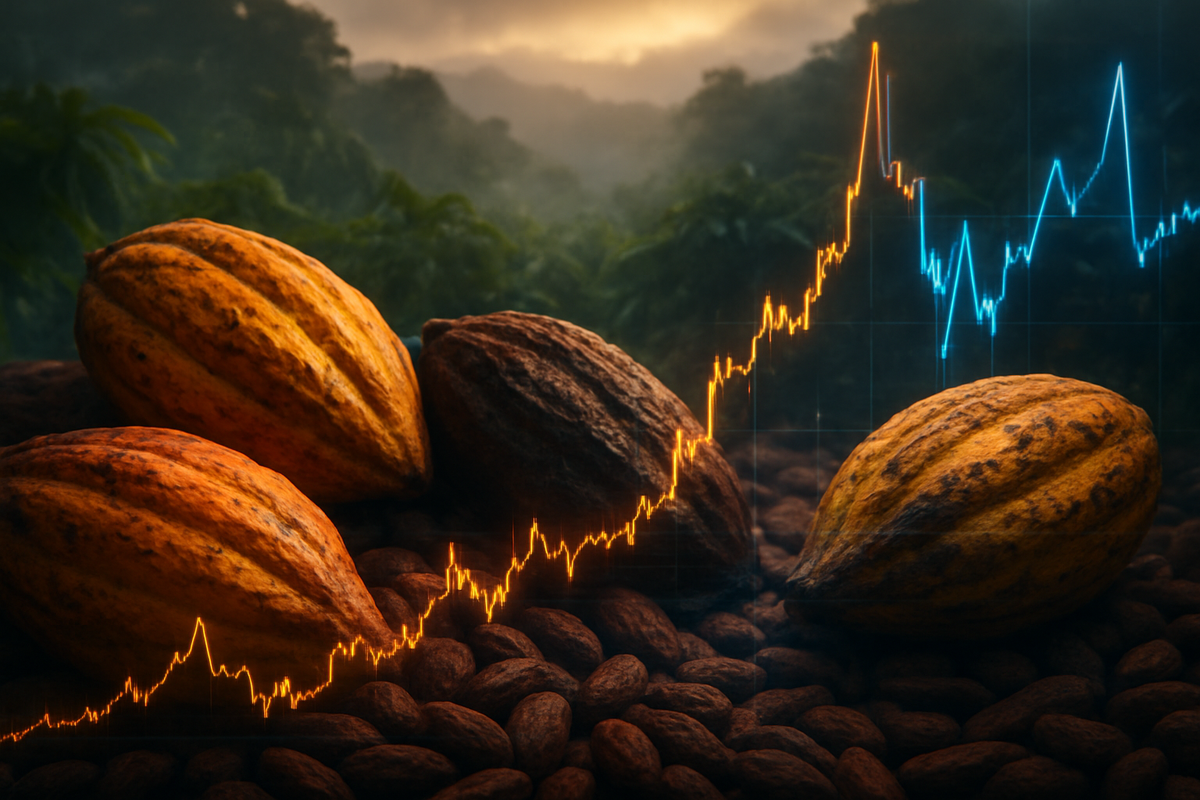
Initial market reactions to these shrinking forecasts have been characterized by a "sawtooth" volatility pattern. Traders who had bet on a massive surplus are now rushing to cover short positions, while the inclusion of New York cocoa futures in the Bloomberg Commodity Index (BCOM) starting January 2026 is expected to trigger up to $2 billion in passive buying. This looming "wall of money" has created a floor for prices, preventing the correction that many retail chocolate brands had hoped for.
Winners and Losers in the Chocolate Aisles
The persistent high cost of cocoa has created a stark divide among the industry's major players. The Hershey Company (NYSE: HSY) has emerged as one of the most visible casualties of the prolonged price elevation. In its most recent guidance, Hershey projected adjusted earnings per share (EPS) for 2025 significantly below analyst consensus, as the company struggles to pass on costs to price-sensitive American consumers. Hershey’s heavy reliance on the North American market and its high cocoa-to-revenue ratio have made it particularly vulnerable to margin compression and "shrinkflation" backlash.
Conversely, Lindt & Sprüngli (SWX: LISN) has demonstrated remarkable resilience, proving that premiumization can be a potent hedge against inflation. By catering to affluent consumers less sensitive to price hikes, Lindt raised its 2025 organic growth guidance to 9–11%. The company has successfully implemented double-digit price increases while maintaining volume growth, a feat its mid-market competitors have failed to replicate. Similarly, Mondelez International (NASDAQ: MDLZ), the maker of Cadbury and Oreo, has used its vast geographic diversification to weather the storm, though it still anticipates a 10% drop in adjusted earnings for the current fiscal year.
For the world’s largest cocoa processor, Barry Callebaut (SWX: BARN), the environment is one of strategic pivoting. While the company has seen mid-single-digit volume declines as manufacturers seek out cocoa substitutes, it has managed to protect its bottom line through aggressive cost-pass-through mechanisms and efficiency programs. However, the shrinking surplus means Barry Callebaut must continue to navigate a "two-tier" market where the cost of sourcing compliant, high-quality beans remains prohibitively high.
Regulatory Shocks and Financialization
The wider significance of the current cocoa market turmoil is deeply tied to the European Union Deforestation Regulation (EUDR). In a dramatic turn of events on December 17, 2025, the European Parliament officially adopted a one-year delay for the regulation’s enforcement. Large companies now have until December 30, 2026, to ensure their supply chains are deforestation-free. While this provided a temporary "relief valve" for prices by removing the immediate threat of a de-facto embargo on West African beans, it has not erased the long-term structural costs.
This event fits into a broader trend of "green premiums" in the commodities market. Despite the delay, the infrastructure for EUDR—including geospatial mapping and polygon boundaries for every farm—is already being built. This has created a bifurcated market where "EUDR-compliant" beans command a significant premium over standard beans. Financial institutions are now treating cocoa not just as a commodity, but as a complex ESG-linked asset, adding layers of regulatory risk that did not exist five years ago.
The financialization of the market has also played a role in the current volatility. High maintenance margins, which soared to nearly $26,000 per contract during the 2024 peak, forced many traditional hedge funds out of the market. High-profile managers like Pierre Andurand of Andurand Capital saw significant drawdowns before scaling back. The resulting lack of liquidity has left the market in the hands of "systematic" algorithmic funds and short-term traders, whose rapid-fire moves can cause price swings of $500 in a single afternoon, regardless of physical supply fundamentals.
The Road Ahead: 2026 and Beyond
Looking forward, the cocoa market faces a period of intense transition. In the short term, the January 2026 rebalancing of the BCOM index will be the primary catalyst for price action. Investors should expect a "January effect" where passive inflows could push prices back toward the $7,000 mark, even if physical supply remains stable. Long-term, the focus will shift to whether the Ivory Coast and Ghana can successfully implement their "Cocoa African Economic Zone" initiatives to increase domestic processing and capture more value, a move that could further restrict the export of raw beans to Western markets.
Strategic pivots are already underway. Major food conglomerates are investing heavily in "cocoa-free" chocolate alternatives and reformulating recipes to use more basics and fillers, reducing their dependence on the bean. However, these adaptations take time and face regulatory hurdles regarding labeling. The potential for a "triple-top" in prices remains a distinct possibility if the 2026 Harmattan proves to be as severe as current meteorological models suggest.
Market opportunities may emerge in South America, particularly in Ecuador and Brazil, where production is expanding rapidly without the same degree of disease and aging-tree pressure seen in Africa. However, these regions are still several years away from being able to fill the massive gap left by a potential structural decline in West African output.
Conclusion: A New Era of Scarcity
The shrinking surplus forecasts for the 2025-2026 season confirm that the cocoa market has entered a new era of scarcity and high-stakes volatility. The "cheap chocolate" era, fueled by decades of overproduction and low labor costs in West Africa, appears to be at an end. As we move into 2026, the market will be defined by a delicate balance between recovering yields and the mounting pressures of climate change and environmental regulation.
For investors, the key takeaway is that the "correction" from 2024's highs was a reset, not a return to the old status quo. The market remains highly sensitive to even minor supply disruptions. Moving forward, the industry will be watching for the final 2025 crop figures from the ICCO and the impact of the BCOM inclusion in early January. In a world where a chocolate bar is increasingly viewed as a luxury item rather than a commodity staple, the companies that can master their supply chains and maintain brand loyalty will be the only ones to emerge from this bittersweet cycle intact.
This content is intended for informational purposes only and is not financial advice.