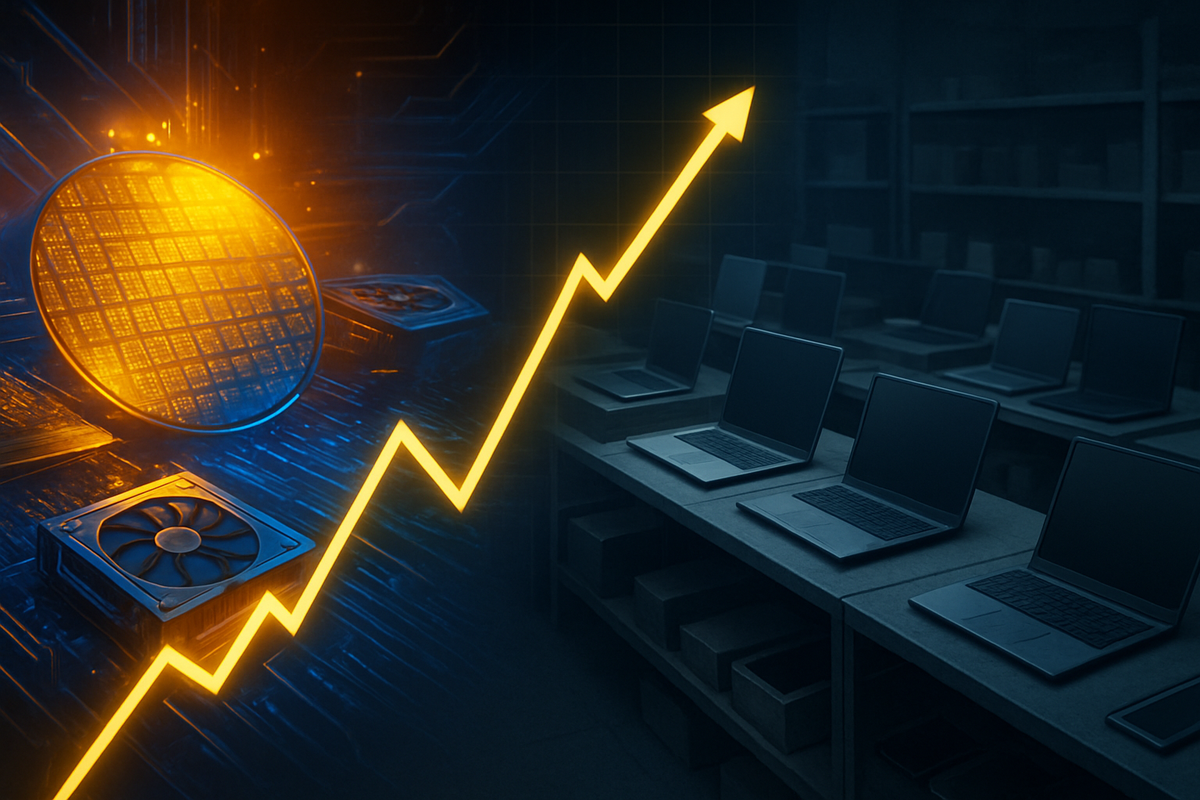
The technology sector has entered a period of historic structural divergence as of late 2025. While the broader market indices suggest a steady climb, a closer look reveals a "two-speed" economy within the tech world. On one side, the architects of the artificial intelligence revolution—specifically semiconductor powerhouses—are reporting record-shattering profits and backlogs that stretch into 2027. On the other, the traditional titans of consumer electronics are grappling with a "perfect storm" of market saturation, a lack of breakthrough innovation, and a punishing supply-chain crisis that has sent component costs through the roof.
This divergence was brought into sharp focus this week as the final earnings reports of the calendar year filtered through Wall Street. The contrast is stark: firms that manufacture the "brains" of the AI era are seeing their valuations reach unprecedented heights, while the companies that put those chips into the hands of consumers are facing workforce reductions and shrinking margins. As of December 18, 2025, the gap between the "builders" and the "vendors" has never been wider, signaling a fundamental shift in where the market’s value is being captured.
The AI Infrastructure "Giga-Cycle" vs. The Consumer Lull
The narrative of 2025 has been dominated by the relentless build-out of global AI data centers. Leading the charge, Nvidia (NASDAQ: NVDA) recently reported Q3 revenue of $57.0 billion, a staggering 62% increase from the previous year. The company’s "Blackwell" GPU architecture has become the most sought-after commodity in the global economy, with CEO Jensen Huang confirming that supply is effectively "sold out" for the foreseeable future. This insatiable demand for compute power has created a "giga-cycle" that shows no signs of cooling, even as interest rates remain stubbornly high.
Simultaneously, the memory market has entered a period of extreme volatility. Micron Technology (NASDAQ: MU) stunned analysts on December 17, 2025, with a quarterly revenue of $13.64 billion. The driver behind this surge is High Bandwidth Memory (HBM), the specialized silicon required to feed data to Nvidia’s GPUs. Micron’s management confirmed that their entire HBM production capacity is committed through the end of 2026. However, this success for the chipmakers has come at a direct cost to the electronics sector. To meet AI demand, manufacturers have diverted silicon wafers away from standard DRAM used in laptops and smartphones, triggering a "RAM Crisis" that has seen retail memory prices surge by 500% over the last twelve months.
Winners and Losers in the Silicon Shift
The primary beneficiaries of this divergence are undoubtedly the semiconductor firms with high exposure to AI infrastructure. Nvidia (NASDAQ: NVDA) has solidified its position as a $4.3 trillion behemoth, with its data center division now accounting for nearly 90% of its total sales. Micron (NASDAQ: MU) has similarly transitioned from a cyclical commodity player to a high-margin strategic partner, with its stock price hitting a record high of $264.75 this month. These companies are operating in an environment of chronic under-supply, allowing them to dictate pricing and maintain gross margins above 75%.
Conversely, the "losers" in this current cycle are the legacy hardware giants. HP Inc. (NYSE: HPQ) recently announced a massive restructuring plan that includes laying off up to 6,000 employees, citing "macroeconomic headwinds" and a tepid recovery in the PC market. While Dell Technologies (NYSE: DELL) has seen success in its AI server business, its consumer PC revenue has dropped 7% year-over-year, illustrating the internal tension between high-growth enterprise AI and stagnant consumer demand. Even Apple (NASDAQ: AAPL) has not been immune; while its services division continues to grow, its hardware categories like the iPad and Wearables have shown flat or declining revenue as consumers hold onto their devices longer, waiting for a compelling reason to upgrade.
Wider Significance and the Shift to Infrastructure-Led Growth
This event marks a significant departure from the historical trend where consumer electronics—driven by the smartphone and PC booms—were the primary engines of tech growth. We are now witnessing a transition to an "infrastructure-led" tech economy. The current "RAM Crisis" of 2025 mirrors the memory shortages of 2017 but on a far more aggressive scale. By prioritizing AI-grade silicon, chipmakers are effectively "taxing" the consumer electronics sector, forcing device makers to either absorb higher costs or pass them on to an already price-sensitive public.
Furthermore, the slower-than-expected adoption of "AI PCs" has complicated the recovery for firms like HP and Dell. While industry analysts predicted that 2025 would be the year of the AI-integrated laptop, actual adoption has lagged at 31% of the market. Consumers have proven hesitant to pay a premium for AI features that lack a "killer app" in the consumer space. Additionally, new trade tariffs of up to 25% on certain electronic components have further squeezed margins for firms that rely on global assembly lines, whereas the highly specialized nature of AI chips has largely insulated them from these specific trade pressures due to their critical strategic importance.
The Road Ahead: 2026 and Beyond
In the short term, the divergence is expected to persist. Semiconductor giants will likely continue to report record earnings as long as the "Stargate" and "Llama 4" class AI models require massive hardware clusters for training and inference. For electronics firms, the primary challenge will be navigating the supply-side constraints of the RAM crisis. We may see strategic pivots where companies like Apple (NASDAQ: AAPL) and Dell (NYSE: DELL) begin designing more of their own specialized silicon to bypass the volatility of the open merchant market, though this is a long-term play that requires years of R&D.
The long-term outlook for consumer electronics hinges on the development of software that makes AI hardware a "must-have" rather than a "nice-to-have." If a breakthrough consumer AI application emerges in 2026, it could trigger the massive replacement cycle that hardware vendors are desperately waiting for. Until then, the market will likely continue to reward the "picks and shovels" of the AI era while remaining cautious on the firms that sell the finished products.
Summary and Investor Outlook
The tech sector at the end of 2025 is a landscape of extremes. The "Great Tech Decoupling" has separated the industry into those who provide the foundational infrastructure for artificial intelligence and those who are struggling to find their footing in a saturated consumer market. The key takeaways for the year are the absolute dominance of Nvidia (NASDAQ: NVDA) and Micron (NASDAQ: MU), the ongoing struggle of traditional PC makers like HP Inc. (NYSE: HPQ), and the emergence of a systemic supply-chain imbalance caused by the prioritization of AI silicon.
Moving forward, investors should keep a close eye on HBM supply levels and the potential for a "cooling off" in data center CapEx. However, for the next several months, the momentum remains firmly with the chipmakers. The "RAM Crisis" will be the defining hurdle for the consumer electronics sector in early 2026, and any sign of easing in component prices could be the first signal of a broader recovery for the struggling device giants. For now, the silicon kings reign supreme.
This content is intended for informational purposes only and is not financial advice.