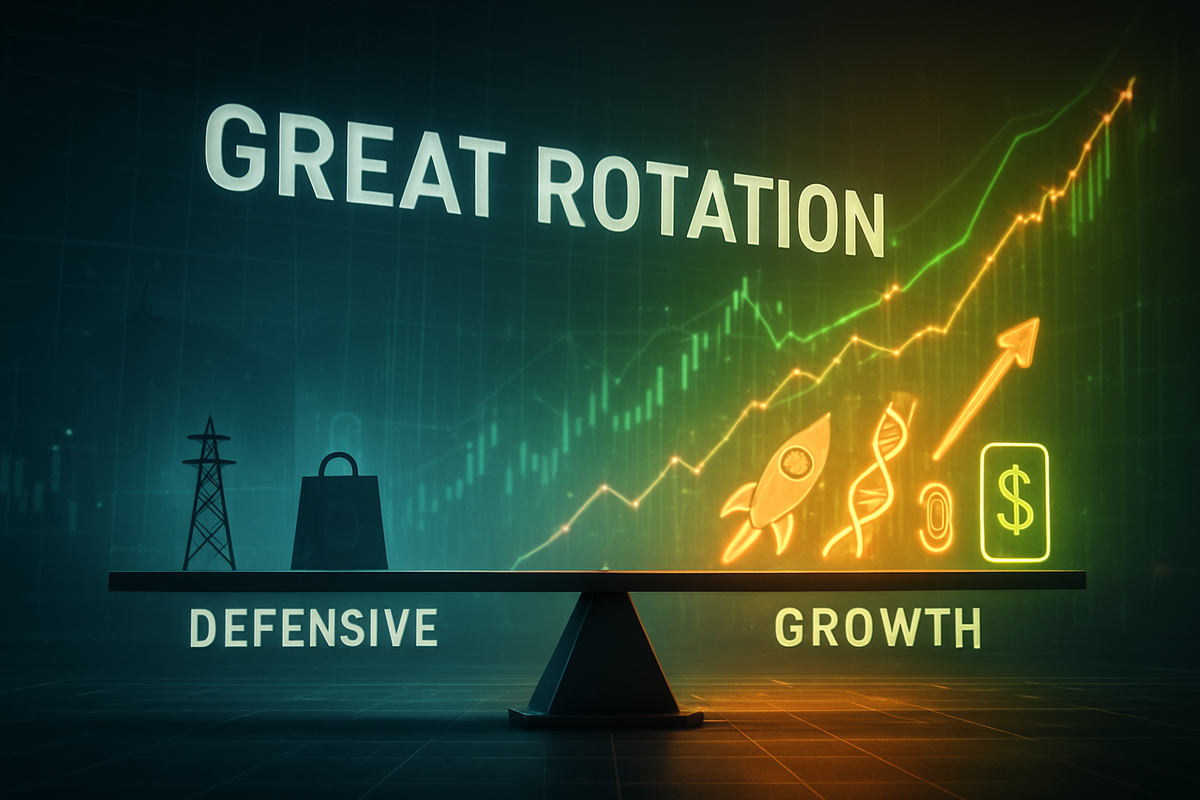
The financial markets are witnessing a historic "Great Rotation" this December, as the era of defensive posturing and mega-cap concentration appears to be giving way to a broad-based growth rally. Following the Federal Reserve’s third consecutive interest rate cut on December 10, 2025, institutional capital has begun a rapid exodus from traditional "safe-haven" sectors like Utilities and Consumer Staples. In their place, investors are piling into high-beta growth names, particularly in the biotech and fintech sectors, signaling a renewed appetite for risk as the year draws to a close.
This shift marks a significant departure from the market narrative of early 2024 and 2025, which was dominated by a "flight to quality" and the defensive stability of dividend-paying giants. With the federal funds rate now sitting in the 3.50%–3.75% range, the "higher for longer" mantra has been officially retired, providing the necessary oxygen for interest-rate-sensitive small and mid-cap companies to outperform. The immediate implication is a widening of market participation, a trend that many analysts believe could define the equity landscape well into 2026.
The Fed Catalyst and the Breakout of the Russell 2000
The pivot point for this rotation occurred on December 10, 2025, when the Federal Open Market Committee (FOMC) delivered a 25-basis-point rate cut. While the cut was widely anticipated, the accompanying economic projections suggested a "soft landing" was not just a possibility, but the current reality. This sparked an immediate reaction in the Russell 2000 index, which tracks small-cap stocks. Between December 1 and December 18, the index surged to multiple all-time highs, closing at a record 2,590.61. This "Small-Cap Summer in Winter" has seen the index outperform the tech-heavy Nasdaq-100, which has struggled under the weight of an "AI hangover" and valuation concerns among its largest constituents.
The timeline leading to this moment began in late October, when cooling inflation data first hinted that the Fed could afford to be more aggressive with its easing cycle. Throughout November, market leaders like NVIDIA (NASDAQ: NVDA) and Broadcom (NASDAQ: AVGO) began to see profit-taking as investors looked for "catch-up" trades in undervalued sectors. By the time the December 10 meeting arrived, the stage was set for a massive reallocation of capital. Key stakeholders, including major hedge funds and retail-driven ETFs, have been the primary drivers, moving billions out of stagnant defensive positions and into high-growth opportunities.
Winners and Losers: From Stagnant Staples to High-Flying Growth
The most visible winners of this rotation are found in the biotechnology and fintech sectors. Structure Therapeutics (NASDAQ: GPCR) emerged as a poster child for this movement, seeing its stock price more than double in early December following breakthrough Phase 2 data for its oral obesity drug. Similarly, Abivax (NASDAQ: ABVX) saw a surge to a 52-week high of $138.49 immediately following the Fed's announcement. These clinical-stage companies, which rely heavily on future cash flows, are the primary beneficiaries of a lower discount rate environment.
In the fintech space, Affirm Holdings (NASDAQ: AFRM) and Sezzle (NASDAQ: SEZL) have seen double-digit gains in the last two weeks. Affirm jumped 11.8% on December 16 alone, as lower rates are expected to boost consumer spending power and lower the cost of credit for "Buy Now, Pay Later" providers. Mid-cap growth staple Roku, Inc. (NASDAQ: ROKU) also joined the rally, gaining 16% since the start of the month as analysts upgraded the stock on improving advertising fundamentals and a more favorable macro backdrop.
Conversely, the "losers" in this environment are the defensive darlings of the past year. Procter & Gamble (NYSE: PG) and NextEra Energy (NYSE: NEE) have seen significant outflows as their "bond proxy" status loses appeal in a falling-rate environment. Similarly, mega-cap tech giants like Oracle (NYSE: ORCL) have faced selling pressure as investors rotate into smaller, more nimble growth plays that offer higher potential alpha. Even PepsiCo (NASDAQ: PEP) has lagged the broader market, as the "safety" of consumer staples is no longer worth the premium in a "risk-on" world.
Broader Significance and the End of Concentration
This rotation is more than just a seasonal "Santa Claus rally"; it represents a fundamental shift in market structure. For much of 2023 and 2024, the market was characterized by extreme concentration in the "Magnificent Seven." The current movement suggests a "normalization" where the rest of the market is finally catching up. This broadening is a healthy sign for the long-term sustainability of the bull market, as it reduces the systemic risk associated with a few mega-cap stocks carrying the entire index.
Historically, this event mirrors the market dynamics of the mid-1990s, where a Fed pivot led to a sustained period of small-cap outperformance. However, the current environment is unique due to the integration of AI across all sectors. While hardware providers like NVIDIA are seeing a pause, software and service-oriented growth companies like Salesforce (NYSE: CRM) and Netflix (NASDAQ: NFLX) are being re-evaluated as "AI monetizers." This shift is also forcing a regulatory rethink, as a broader market may face less scrutiny than one dominated by a handful of trillion-dollar monopolies.
What Lies Ahead: Navigating the 2026 Outlook
As we approach 2026, the primary question for investors is whether this rotation has staying power. In the short term, the market is likely to see continued volatility as institutional players finish rebalancing their portfolios for year-end reporting. However, the long-term outlook remains bullish for growth, provided that inflation remains within the Fed's "comfort zone" of 2.5% to 3.0%. A potential strategic pivot for investors will be moving away from "growth at any price" and toward "quality growth"—companies with proven paths to profitability and strong balance sheets that can thrive in a 3.5% rate environment.
Scenarios for the coming months include a "melt-up" in small-caps if the January Effect takes hold, or a temporary pullback if the Fed signals a "hawkish pause" in early 2026. Investors should also keep a close eye on the labor market; if unemployment continues to creep toward 5%, the Fed may be forced to cut rates even further, which would provide another leg up for the growth trade but might raise concerns about a potential recession.
Summary and Final Thoughts
The rotation from defensive sectors to growth stocks in December 2025 marks a definitive turning point in the post-pandemic economic cycle. The key takeaways are clear: the Fed's easing cycle has successfully shifted investor focus from capital preservation to capital appreciation. The breakout of the Russell 2000 and the resurgence of biotech and fintech indicate that the "risk-on" spirit is alive and well.
Moving forward, the market appears more balanced and resilient than it has been in years. While the mega-cap tech dominance may be fading, the emergence of a broader growth narrative provides ample opportunity for savvy stock-pickers. Investors should watch for upcoming CPI data and the Fed’s first meeting of 2026 to gauge the velocity of future rate cuts. For now, the "Great Rotation" is the dominant theme on Wall Street, and those who adapted early to this growth-oriented environment are reaping the rewards.
This content is intended for informational purposes only and is not financial advice