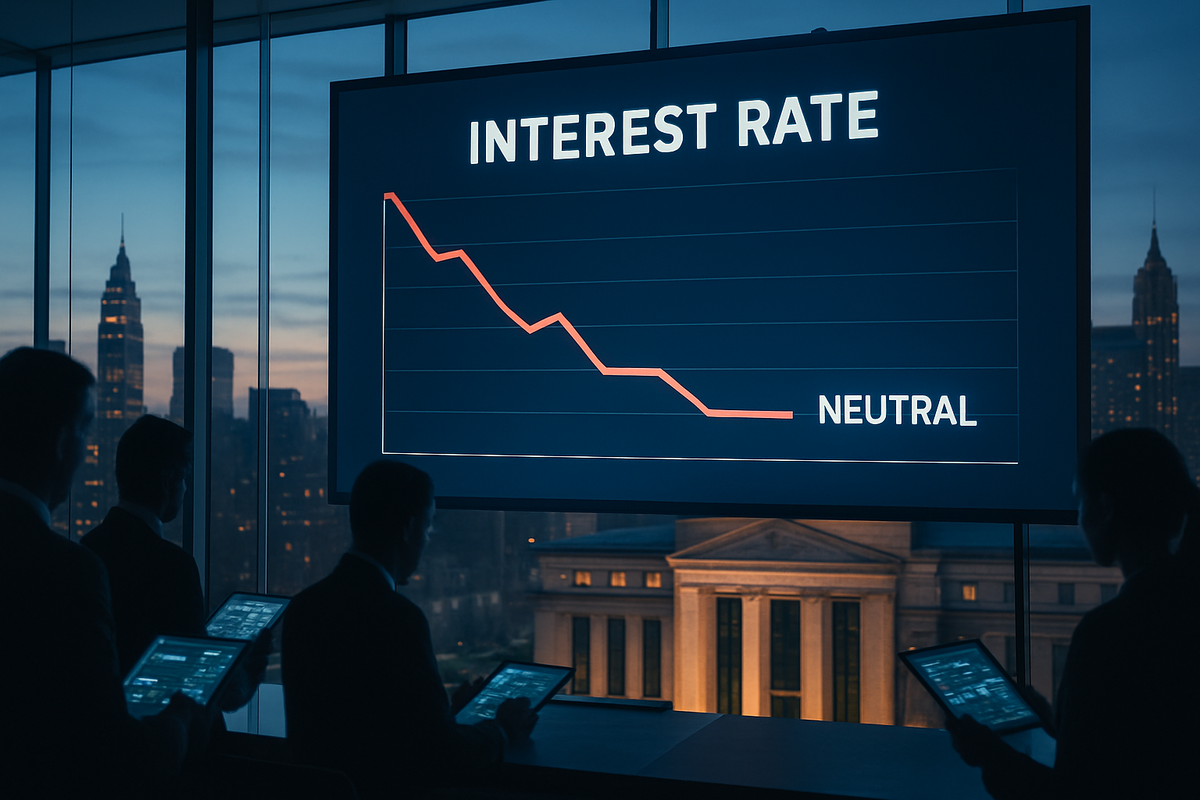
As the dust settles on the Federal Open Market Committee’s final meeting of the year, the American banking sector is entering 2026 in a state of cautious transition. On December 10, 2025, the Federal Reserve delivered its third consecutive 25-basis-point interest rate cut, lowering the federal funds target range to 3.50% – 3.75%. This move officially signaled the end of the "restrictive" era and a pivot to what Fed Chair Jerome Powell described as the "upper end of neutral." For the nation’s largest financial institutions, the shift marks a critical turning point: the tailwinds of high interest rates are fading, replaced by a complex landscape of stabilizing margins, a rebound in capital markets, and a labor market that is beginning to show cracks.
The immediate implications for the market are twofold. First, the "higher-for-longer" narrative that dominated the post-pandemic recovery has been decisively retired. Second, the banking industry is now forced to pivot from a strategy focused on maximizing net interest income (NII) to one that prioritizes loan growth and fee-based services. With the unemployment rate edging up to 4.5% and annual CPI inflation lingering at a "sticky" 2.7%, the Fed’s move is a delicate balancing act—attempting to support a cooling economy without reigniting the inflationary pressures that have plagued the last three years.
A Contentious Path to Neutrality
The road to the December rate cut was anything but smooth. The 2025 calendar year was defined by "stagflation-lite"—a period of modest GDP growth (projected at 1.7% for the year) and persistent service-sector inflation. The Fed’s decision to cut rates in September, October, and finally December was driven by a growing concern over "downside risks to employment." However, the December meeting revealed a rare internal rift within the FOMC. Three members dissented from the decision—the highest number of dissents since 2019—with two preferring to hold rates steady due to inflation concerns and one pushing for a more aggressive 50-basis-point cut to preempt a recession.
Compounding the uncertainty was a 43-day government shutdown in late 2024 and early 2025, which paralyzed economic data collection and left policymakers "flying blind" for a significant portion of the year. This data vacuum contributed to the Fed’s cautious, 25-bps-at-a-time approach. As the banking sector looks toward the first quarter of 2026, the "dot plot" indicates a likely pause in rate movements. The median projection now shows only one additional 25-basis-point cut for the entirety of 2026, suggesting that the central bank is ready to let the current rates percolate through the economy before making further moves.
Winners and Losers in the New Rate Environment
The transition to a neutral rate environment is creating a clear divide between the "haves" and "have-nots" of the financial world. JPMorgan Chase & Co. (NYSE: JPM) continues to lead the pack, despite seeing its NII (excluding market activities) fall by approximately 2% sequentially in the fourth quarter. The bank has successfully offset margin pressure by raising its full-year NII forecast to $92.5 billion, driven by a surge in credit card activity and a $10 billion investment in "critical industries" like artificial intelligence and defense. Similarly, Bank of America Corp. (NYSE: BAC) is expected to report record NII for 2025, reaching upwards of $15.6 billion in Q4, thanks to a robust commercial lending pipeline.
On the other hand, Wells Fargo & Co. (NYSE: WFC) has faced a more stagnant outlook, with its net interest margin (NIM) falling to 2.68% as its floating-rate assets felt the immediate impact of the Fed's cuts. However, a major silver lining for the bank was the lifting of its $1.95 trillion asset cap in mid-2025, providing a long-term catalyst for growth that its peers lack. Meanwhile, Citigroup Inc. (NYSE: C) has found stability in its "Services" division, reporting a NIM of 2.14% and robust 5% year-over-year loan growth, particularly in its international corporate lending and branded card segments.
In the fintech space, the "neutral" shift has been a boon for deposit-rich players like SoFi Technologies, Inc. (NASDAQ: SOFI). With its bank charter and $32.9 billion deposit base, SoFi has been a primary winner in 2025, using low-cost funding to reignite its student loan and personal loan businesses. Conversely, wholesale-funding dependent firms like Upstart Holdings, Inc. (NASDAQ: UPST) have struggled. Without a stable deposit base, these firms remain at the mercy of institutional investors who have grown skittish amid 2025's tariff-related economic volatility and recession fears.
Regulatory Relief and the Rebound of Investment Banking
The broader significance of the current environment extends beyond interest rates. One of the most impactful developments of 2025 was the significant softening of the "Basel III Endgame" regulations. After intense industry lobbying and a major re-proposal, the Federal Reserve slashed the proposed capital requirement increase for Global Systemically Important Banks (G-SIBs) from 16% to approximately 9%. More importantly for regional players like PNC Financial Services Group, Inc. (NYSE: PNC) and Truist Financial Corp. (NYSE: TFC), banks with assets between $100 billion and $250 billion were largely exempted from the most stringent new rules.
This regulatory relief, combined with a stabilization of the yield curve, has sparked a "C-shaped" recovery in the industry. While lower rates reduce the interest banks earn on loans, they also allow institutions to lower the rates they pay to depositors. Furthermore, the "neutral" rate environment has reignited the IPO and M&A markets. Investment banking fees, which were in the doldrums during the hiking cycle, saw a massive rebound in late 2025. JPMorgan, for instance, reported a nearly 50% jump in investment banking fees earlier in the year, a trend that is expected to continue as corporate America gains more certainty regarding the cost of capital.
The 2026 Outlook: A Strategic Pivot Required
Looking ahead, the banking sector must navigate a period of "wait-and-see." In the short term, the primary challenge will be managing the "lag effect" of the 2025 rate cuts. While the Fed is expected to pause in early 2026, the full impact of lower rates on loan yields will continue to manifest in quarterly earnings reports throughout the first half of the year. Banks will need to pivot their strategies toward volume-driven growth—aggressively pursuing new loan originations to compensate for thinner margins.
The labor market remains the ultimate wild card. If the unemployment rate continues its climb toward 5%, credit quality will become the dominant story of 2026. While large banks currently remain over-capitalized with Common Equity Tier 1 (CET1) ratios above 13%, a significant uptick in defaults could force a shift from share buybacks and dividend increases toward higher loan-loss provisions. The emergence of AI-driven credit scoring models will be a key area of competition, as banks seek to better price risk in an economy that is growing at a slower, more deliberate pace.
A Resilient Sector in a Stabilizing Market
In summary, the banking sector is emerging from the volatility of the mid-2020s in a position of relative strength. The Fed’s pivot to neutral has removed the "tail risk" of a policy-induced recession, even if it has simultaneously capped the explosive NII growth seen in 2023 and 2024. The key takeaways for the market are the dominance of the Big Four, the survival and recovery of regional banks under a friendlier regulatory regime, and the clear advantage held by fintechs with bank charters.
As we move into 2026, investors should keep a close watch on two metrics: loan growth and credit quality. The era of "easy" profits from rising rates is over; the era of "operational excellence" has begun. Banks that can successfully transition to fee-based income and capture market share in a stabilizing economy will be the long-term winners. While the Fed may be hitting the pause button, the evolution of the American financial landscape is only accelerating.
This content is intended for informational purposes only and is not financial advice.