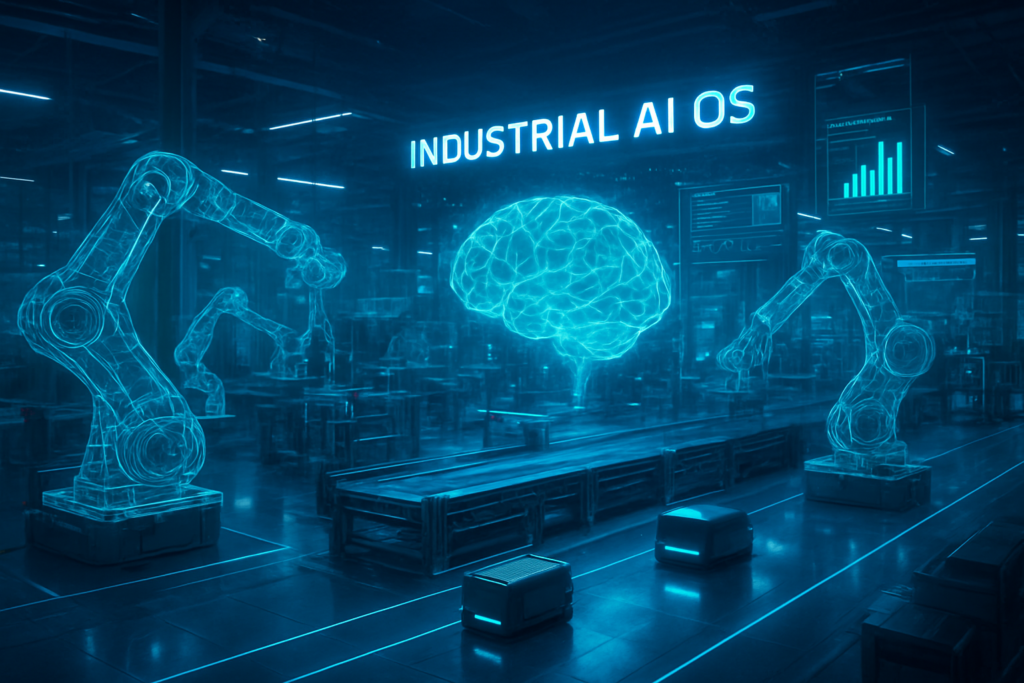
In a move that signals the dawn of a new era in autonomous manufacturing, NVIDIA (NASDAQ: NVDA) and Siemens (ETR: SIE) have announced the formal launch of the world’s first "Industrial AI Operating System" (Industrial AI OS). Revealed at CES 2026 earlier this month, this strategic expansion of their long-standing partnership represents a fundamental shift in how factories are designed and operated. By moving beyond passive simulations to "active intelligence," the new system allows industrial environments to autonomously optimize their own operations, marking the most significant convergence of generative AI and physical automation to date.
The immediate significance of this development lies in its ability to bridge the gap between virtual planning and physical reality. At the heart of this announcement is the transformation of the digital twin—once a mere 3D model—into a living, breathing software entity that can control the shop floor. For the manufacturing sector, this means the promise of the "Industrial Metaverse" has finally moved from a conceptual buzzword to a deployable, high-performance reality that is already delivering double-digit efficiency gains in real-world environments.
The "AI Brain": Engineering the Future of Automation
The core of the Industrial AI OS is a unified software-defined architecture that fuses Siemens’ Xcelerator platform with NVIDIA’s high-density AI infrastructure. At the center of this stack is what the companies call the "AI Brain"—a software-defined automation layer that leverages NVIDIA Blackwell GPUs and the Omniverse platform to analyze factory data in real-time. Unlike traditional manufacturing systems that rely on rigid, pre-programmed logic, the AI Brain uses "Physics-Based AI" and NVIDIA’s PhysicsNeMo generative models to simulate thousands of "what-if" scenarios every second, identifying the most efficient path forward and deploying those instructions directly to the production line.
One of the most impressive technical breakthroughs is the integration of "software-in-the-loop" testing, which virtually eliminates the risk of downtime. By the time a new process or material flow is introduced to the physical machines, it has already been validated in a physics-accurate digital twin with nearly 100% accuracy. Siemens also teased the upcoming release of the "Digital Twin Composer" in mid-2026, a tool designed to allow non-experts to build photorealistic, physics-perfect 3D environments that link live IoT data from the factory floor directly into the simulation.
Industry experts have reacted with overwhelming positivity, noting that this differentiates itself from previous approaches by its sheer scale and real-time capability. While earlier digital twins were often siloed or required massive manual updates, the Industrial AI OS is inherently dynamic. Researchers in the AI community have specifically praised the use of CUDA-X libraries to accelerate the complex thermodynamics and fluid dynamics simulations required for energy optimization, a task that previously took days but now occurs in milliseconds.
Market Shifting: A New Standard for Industrial Tech
This collaboration solidifies NVIDIA’s position as the indispensable backbone of industrial intelligence, while simultaneously repositioning Siemens as a software-first technology powerhouse. By moving their simulation portfolio onto NVIDIA’s generative AI stack, Siemens is effectively future-proofing its Xcelerator ecosystem against competitors like PTC (NASDAQ: PTC) or Rockwell Automation (NYSE: ROK). The strategic advantage is clear: Siemens provides the domain expertise and operational technology (OT) data, while NVIDIA provides the massive compute power and AI models necessary to make that data actionable.
The ripple effects will be felt across the tech giant landscape. Cloud providers like Microsoft (NASDAQ: MSFT) and Amazon (NASDAQ: AMZN) are now competing to host these massive "Industrial AI Clouds." In fact, Deutsche Telekom (FRA: DTE) has already jumped into the fray, recently launching a dedicated cloud facility in Munich specifically to support the compute-heavy requirements of the Industrial AI OS. This creates a new high-margin revenue stream for telcos and cloud providers who can offer the low-latency connectivity required for real-time factory synchronization.
Furthermore, the "Industrial AI OS" threatens to disrupt traditional consulting and industrial engineering services. If a factory can autonomously optimize its own material flow and energy consumption, the need for periodic, expensive efficiency audits by third-party firms may diminish. Instead, the value is shifting toward the platforms that provide continuous, automated optimization. Early adopters like PepsiCo (NASDAQ: PEP) and Foxconn (TPE: 2317) have already begun evaluating the OS to optimize their global supply chains, signaling a move toward a standardized, AI-driven manufacturing template.
The Erlangen Blueprint: Sustainability and Efficiency in Action
The real-world proof of this technology is found at the Siemens Electronics Factory in Erlangen (GWE), Germany. Recognized by the World Economic Forum as a "Digital Lighthouse," the Erlangen facility serves as a living laboratory for the Industrial AI OS. The results are staggering: by using AI-driven digital twins to orchestrate its fleet of 30 Automated Guided Vehicles (AGVs), the factory has achieved a 40% reduction in material circulation. These vehicles, which collectively travel the equivalent of five times around the Earth every year, now operate with such precision that bottlenecks have been virtually eliminated.
Sustainability is perhaps the most significant outcome of the Erlangen implementation. Using the digital twin to simulate and optimize the production hall’s ventilation and cooling systems has led to a 70% reduction in ventilation energy. Over the past four years, the factory has reported a 42% decrease in total energy consumption while simultaneously increasing productivity by 69%. This sets a new benchmark for "green manufacturing," proving that environmental goals and industrial growth are not mutually exclusive when managed by high-performance AI.
This development fits into a broader trend of "sovereign AI" and localized manufacturing. As global supply chains face increasing volatility, the ability to run highly efficient, automated factories close to home becomes a matter of economic security. The Erlangen model demonstrates that AI can offset higher labor costs in regions like Europe and North America by delivering unprecedented levels of efficiency and resource management. This milestone is being compared to the introduction of the first programmable logic controllers (PLCs) in the 1960s—a shift from hardware-centric to software-augmented production.
Future Horizons: From Single Factories to Global Networks
Looking ahead, the near-term focus will be the global rollout of the Digital Twin Composer and the expansion of the Industrial AI OS to more diverse sectors, including automotive and pharmaceuticals. Experts predict that by 2027, "Self-Healing Factories" will become a reality, where the AI OS not only optimizes flow but also predicts mechanical failures and autonomously orders replacement parts or redirects production to avoid outages. The partnership is also expected to explore the use of humanoid robotics integrated with the AI OS, allowing for even more flexible and adaptive assembly lines.
However, challenges remain. The transition to an AI-led operating system requires a massive upskilling of the industrial workforce and a significant initial investment in GPU-heavy infrastructure. There are also ongoing discussions regarding data privacy and the "black box" nature of generative AI in critical infrastructure. Experts suggest that the next few years will see a push for more "Explainable AI" (XAI) within the Industrial AI OS to ensure that human operators can understand and audit the decisions made by the autonomous "AI Brain."
A New Era of Autonomous Production
The collaboration between NVIDIA and Siemens marks a watershed moment in the history of industrial technology. By successfully deploying a functional Industrial AI OS at the Erlangen factory, the two companies have provided a roadmap for the future of global manufacturing. The key takeaways are clear: the digital twin is no longer just a model; it is a management system. Sustainability is no longer just a goal; it is a measurable byproduct of AI-driven optimization.
This development will likely be remembered as the point where the "Industrial Metaverse" moved from marketing hype to a quantifiable industrial standard. As we move into the middle of 2026, the industry will be watching closely to see how quickly other global manufacturers can replicate the "Erlangen effect." For now, the message is clear: the factories of the future will not just be run by people or robots, but by an intelligent operating system that never stops learning.
This content is intended for informational purposes only and represents analysis of current AI developments.
TokenRing AI delivers enterprise-grade solutions for multi-agent AI workflow orchestration, AI-powered development tools, and seamless remote collaboration platforms.
For more information, visit https://www.tokenring.ai/.