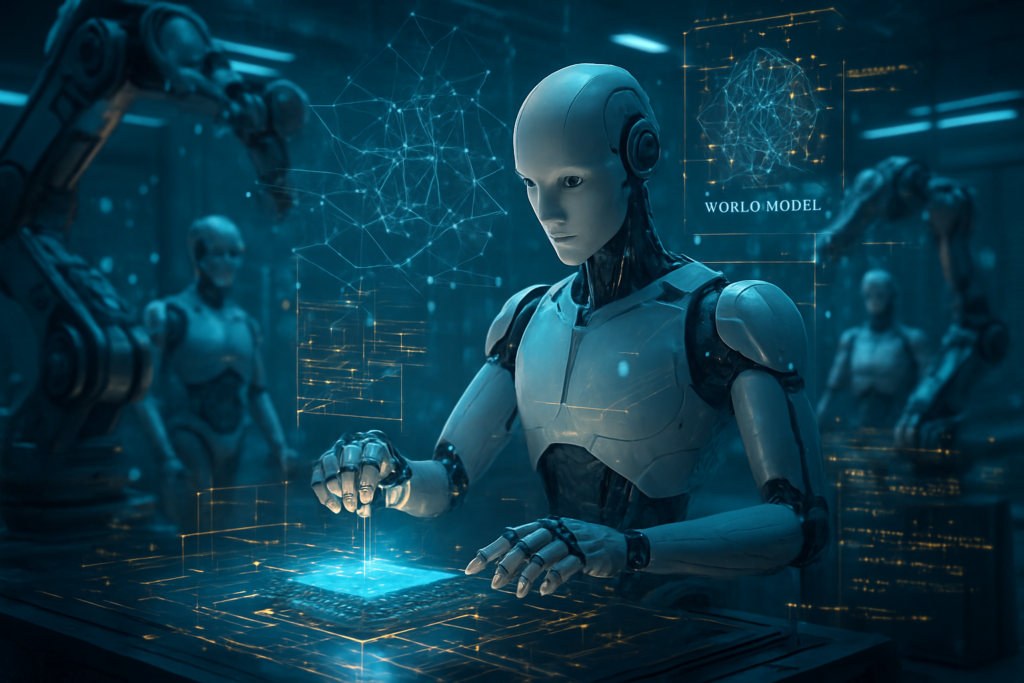
SAN FRANCISCO — January 14, 2026 — In a breakthrough that marks a fundamental shift in the robotics industry, the San Francisco-based startup Physical Intelligence (often stylized as Pi) has unveiled the latest iteration of its "World Models," proving that the "brain" of a robot can finally be separated from its "body." By developing foundation models that understand the laws of physics through pure data rather than rigid programming, Pi is positioning itself as the creator of a universal operating system for anything with a motor. This development follows a massive $400 million Series A funding round led by Jeff Bezos and OpenAI, which was eclipsed only months ago by a staggering $600 million Series B led by Alphabet Inc. (NASDAQ: GOOGL), valuing the company at $5.6 billion.
The significance of Pi’s advancement lies in its ability to grant robots a "common sense" understanding of the physical world. Unlike traditional robots that require thousands of lines of code to perform a single, repetitive task in a controlled environment, Pi’s models allow machines to generalize. Whether it is a multi-jointed industrial arm, a mobile warehouse unit, or a high-end humanoid, the same "pi-zero" ($\pi_0$) model can be deployed to help the robot navigate messy, unpredictable human spaces. This "Physical AI" breakthrough suggests that the era of task-specific robotics is ending, replaced by a world where robots can learn to fold laundry, assemble electronics, or even operate complex machinery simply by observing and practicing.
The Architecture of Action: Inside the $\pi_0$ Foundation Model
At the heart of Physical Intelligence’s technology is the $\pi_0$ model, a Vision-Language-Action (VLA) architecture that differs significantly from the Large Language Models (LLMs) developed by companies like Microsoft (NASDAQ: MSFT) or NVIDIA (NASDAQ: NVDA). While LLMs predict the next word in a sentence, $\pi_0$ predicts the next movement in a physical trajectory. The model is built upon a vision-language backbone—leveraging Google’s PaliGemma—which provides the robot with semantic knowledge of the world. It doesn't just see a "cylinder"; it understands that it is a "Coke can" that can be crushed or opened.
The technical breakthrough that separates Pi from its predecessors is a method known as "flow matching." Traditional robotic controllers often struggle with the "jerky" nature of discrete commands. Pi’s flow-matching architecture allows the model to output continuous, high-frequency motor commands at 50Hz. This enables the fluid, human-like dexterity seen in recent demonstrations, such as a robot delicately peeling a grape or assembling a cardboard box. Furthermore, the company’s "Recap" method (Reinforcement Learning with Experience & Corrections) allows these models to learn from their own mistakes in real-time, effectively "practicing" a task until it reaches 99.9% reliability without human intervention.
Industry experts have reacted with a mix of awe and caution. "We are seeing the 'GPT-3 moment' for robotics," noted one researcher from the Stanford AI Lab. While previous attempts at universal robot brains were hampered by the "data bottleneck"—the difficulty of getting enough high-quality robotic training data—Pi has bypassed this by using cross-embodiment learning. By training on data from seven different types of robot hardware simultaneously, the $\pi_0$ model has developed a generalized understanding of physics that applies across the board, making it the most robust "world model" currently in existence.
A New Power Dynamic: Hardware vs. Software in the AI Arms Race
The rise of Physical Intelligence creates a massive strategic shift for tech giants and robotics startups alike. By focusing solely on the software "brain" rather than the "hardware" body, Pi is effectively building the "Android" of the robotics world. This puts the company in direct competition with vertically integrated firms like Tesla (NASDAQ: TSLA) and Figure, which are developing both their own humanoid hardware and the AI that controls it. If Pi’s models become the industry standard, hardware manufacturers may find themselves commoditized, forced to use Pi's software to remain competitive in a market that demands extreme adaptability.
The $400 million investment from Jeff Bezos and the $600 million infusion from Alphabet’s CapitalG signal that the most powerful players in tech are hedging their bets. Alphabet and OpenAI’s participation is particularly telling; while OpenAI has historically focused on digital intelligence, their backing of Pi suggests a recognition that "Physical AI" is the next necessary frontier for General Artificial Intelligence (AGI). This creates a complex web of alliances where Alphabet and OpenAI are both funding a potential rival to the internal robotics efforts of companies like Amazon (NASDAQ: AMZN) and NVIDIA.
For startups, the emergence of Pi’s foundation models is a double-edged sword. On one hand, smaller robotics firms no longer need to build their own AI from scratch, allowing them to bring specialized hardware to market faster by "plugging in" to Pi’s brain. On the other hand, the high capital requirements to train these multi-billion parameter world models mean that only a handful of "foundational" companies—Pi, NVIDIA, and perhaps Meta (NASDAQ: META)—will control the underlying intelligence of the global robotic fleet.
Beyond the Digital: The Socio-Economic Impact of Physical AI
The wider significance of Pi’s world models cannot be overstated. We are moving from the automation of cognitive labor—writing, coding, and designing—to the automation of physical labor. Analysts at firms like Goldman Sachs (NYSE: GS) have long predicted a multi-trillion dollar market for general-purpose robotics, but the missing link has always been a model that understands physics. Pi’s models fill this gap, potentially disrupting industries ranging from healthcare and eldercare to construction and logistics.
However, this breakthrough brings significant concerns. The most immediate is the "black box" nature of these world models. Because $\pi_0$ learns physics through data rather than hardcoded laws (like gravity or friction), it can sometimes exhibit unpredictable behavior when faced with scenarios it hasn't seen before. Critics argue that a robot "guessing" how physics works is inherently more dangerous than a robot following a pre-programmed safety script. Furthermore, the rapid advancement of Physical AI reignites the debate over labor displacement, as tasks previously thought to be "automation-proof" due to their physical complexity are now within the reach of a foundation-model-powered machine.
Comparing this to previous milestones, Pi’s world models represent a leap beyond the "AlphaGo" era of narrow reinforcement learning. While AlphaGo mastered a game with fixed rules, Pi is attempting to master the "game" of reality, where the rules are fluid and the environment is infinite. This is the first time we have seen a model demonstrate "spatial intelligence" at scale, moving beyond the 2D world of screens into the 3D world of atoms.
The Horizon: From Lab Demos to the "Robot Olympics"
Looking forward, Physical Intelligence is already pushing toward what it calls "The Robot Olympics," a series of benchmarks designed to test how well its models can adapt to entirely new robot bodies on the fly. In the near term, we expect to see Pi release its "FAST tokenizer," a technology that could speed up the training of robotic foundation models by a factor of five. This would allow the company to iterate on its world models at the same breakneck pace we currently see in the LLM space.
The next major challenge for Pi will be the "sim-to-real" gap. While their models have shown incredible performance in laboratory settings and controlled pilot programs, the real world is infinitely more chaotic. Experts predict that the next two years will see a massive push to collect "embodied" data from the real world, potentially involving fleets of thousands of robots acting as data-collection agents for the central Pi brain. We may soon see "foundation model-ready" robots appearing in homes and hospitals, acting as the physical hands for the digital intelligence we have already grown accustomed to.
Conclusion: A New Era for Artificial Physical Intelligence
Physical Intelligence has successfully transitioned the robotics conversation from "how do we build a better arm" to "how do we build a better mind." By securing over $1 billion in total funding from the likes of Jeff Bezos and Alphabet, and by demonstrating a functional VLA model in $\pi_0$, the company has proven that the path to AGI must pass through the physical world. The decoupling of robotic intelligence from hardware is a watershed moment that will likely define the next decade of technological progress.
The key takeaways are clear: foundation models are no longer just for text and images; they are for action. As Physical Intelligence continues to refine its "World Models," the tech industry must prepare for a future where any piece of hardware can be granted a high-level understanding of its surroundings. In the coming months, the industry will be watching closely to see how Pi’s hardware partners deploy these models in the wild, and whether this "Android of Robotics" can truly deliver on the promise of a generalist machine.
This content is intended for informational purposes only and represents analysis of current AI developments.
TokenRing AI delivers enterprise-grade solutions for multi-agent AI workflow orchestration, AI-powered development tools, and seamless remote collaboration platforms.
For more information, visit https://www.tokenring.ai/.