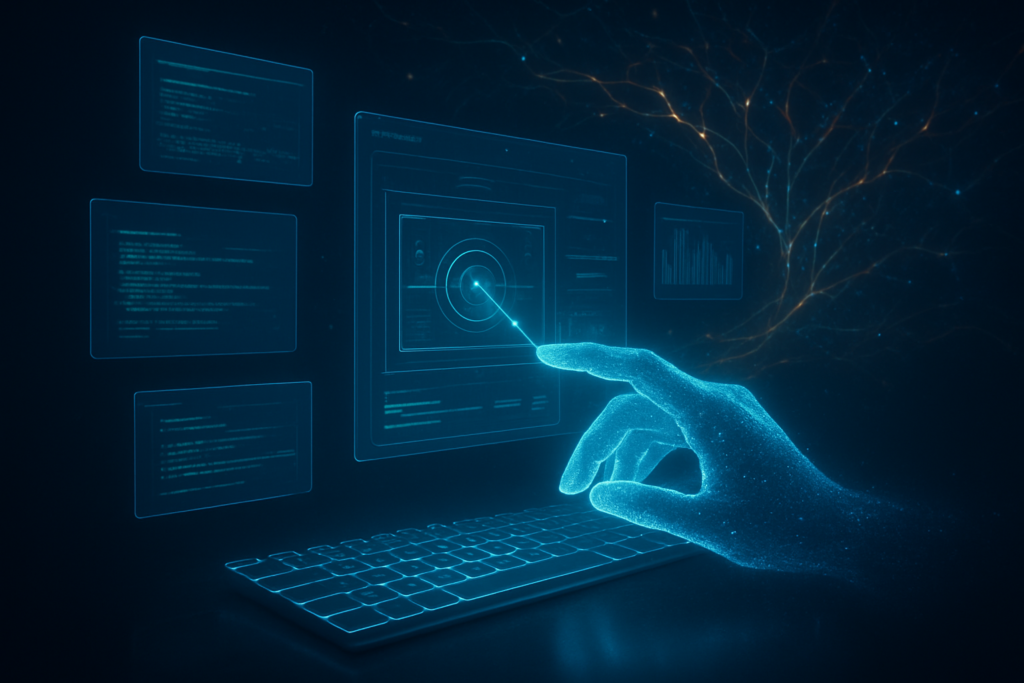
The era of the passive chatbot is officially over. As of early 2026, the artificial intelligence landscape has transitioned from models that merely talk to models that act. At the center of this revolution is Anthropic’s "Computer Use" capability, a breakthrough that allows AI to navigate a desktop interface with the same visual and tactile precision as a human being. By interpreting screenshots, moving cursors, and typing text across any application, Anthropic has effectively given its Claude models a "body" to operate within the digital world, marking the most significant shift in AI agency since the debut of large language models.
This development has fundamentally altered how enterprises approach productivity. No longer confined to the "walled gardens" of specific software integrations or brittle APIs, Claude can now bridge the gap between legacy systems and modern workflows. Whether it’s navigating a decades-old ERP system or orchestrating complex data transfers between disparate creative tools, the "Computer Use" feature has turned the personal computer into a playground for autonomous agents, sparking a high-stakes arms race among tech giants to control the "Agentic OS" of the future.
The technical architecture of Anthropic’s Computer Use capability represents a radical departure from traditional automation. Unlike Robotic Process Automation (RPA), which relies on pre-defined scripts and rigid UI selectors, Claude operates through a continuous "Vision-Action Loop." The model captures a screenshot of the user's environment, analyzes the pixels to identify buttons and text fields, and then calculates the exact (x, y) coordinates needed to move the mouse or execute a click. This pixel-based approach allows the AI to interact with any software—from specialized scientific tools to standard office suites—without requiring custom backend integration.
Since its initial beta release in late 2024, the technology has seen massive refinements. The current Claude 4.5 iteration, released in late 2025, introduced a "Thinking" layer that allows the agent to pause and reason through multi-step plans before execution. This "Hybrid Reasoning" has drastically reduced the "hallucinated clicks" that plagued earlier versions. Furthermore, a new "Zoom" capability allows the model to request high-resolution crops of specific screen regions, enabling it to read fine print or interact with dense spreadsheets that were previously illegible at standard resolutions.
Initial reactions from the AI research community were a mix of awe and apprehension. While experts praised the move toward "Generalist Agents," many pointed out the inherent fragility of visual-only navigation. Early benchmarks, such as OSWorld, showed Claude’s success rate jumping from a modest 14.9% at launch to over 61% by 2026. This leap was largely attributed to Anthropic’s Model Context Protocol (MCP), an open standard that allows the AI to securely pull data from local files and databases, providing the necessary context to make sense of what it "sees" on the screen.
The market impact of this "agency explosion" has been nothing short of disruptive. Anthropic’s strategic lead in desktop control has forced competitors to accelerate their own agentic roadmaps. OpenAI (Private) recently responded with "Operator," a browser-centric agent optimized for consumer tasks, while Google (NASDAQ: GOOGL) launched "Jarvis" to turn the Chrome browser into an autonomous action engine. However, Anthropic’s focus on full-desktop control has given it a distinct advantage in the B2B sector, where legacy software often lacks the web-based APIs that Google and OpenAI rely upon.
Traditional RPA leaders like UiPath (NYSE: PATH) and Automation Anywhere (Private) have been forced to pivot or risk obsolescence. Once the kings of "scripted" automation, these companies are now repositioning themselves as "Agentic Orchestrators." For instance, UiPath recently launched its Maestro platform, which coordinates Anthropic agents alongside traditional robots, acknowledging that while AI can "reason," traditional RPA is still more cost-effective for high-volume, repetitive data entry. This hybrid approach is becoming the standard for enterprise-grade automation.
The primary beneficiaries of this shift have been the cloud providers hosting these compute-heavy agents. Amazon (NASDAQ: AMZN), through its AWS Bedrock platform, has become the de facto home for Claude-powered agents, offering the "air-gapped" virtual machines required for secure desktop use. Meanwhile, Microsoft (NASDAQ: MSFT) has performed a surprising strategic maneuver by integrating Anthropic models into Office 365 alongside its OpenAI-based Copilots. By offering a choice of models, Microsoft ensures that its enterprise customers have access to the "pixel-perfect" navigation of Claude when OpenAI’s browser-based agents fall short.
Beyond the corporate balance sheets, the wider significance of Computer Use touches on the very nature of human-computer interaction. We are witnessing a transition from the "Search and Click" era to the "Delegate and Approve" era. This fits into the broader trend of "Agentic AI," where the value of a model is measured by its utility rather than its chatty personality. Much like AlphaGo proved AI could master strategic systems and GPT-4 proved it could master language, Computer Use proves that AI can master the tools of modern civilization.
However, this newfound agency brings harrowing security concerns. Security researchers have warned of "Indirect Prompt Injection," where a malicious website or document could contain hidden instructions that trick an AI agent into exfiltrating sensitive data or deleting files. Because the agent has the same permissions as the logged-in user, it can act as a "Confused Deputy," performing harmful actions under the guise of a legitimate task. Anthropic has countered this with specialized "Guardrail Agents" that monitor the main model’s actions in real-time, but the battle between autonomous agents and adversarial actors is only beginning.
Ethically, the move toward autonomous computer use has reignited fears of white-collar job displacement. As agents become capable of handling 30–70% of routine office tasks—such as filing expenses, generating reports, and managing calendars—the "entry-level" cognitive role is under threat. The societal challenge of 2026 is no longer just about retraining workers for "AI tools," but about managing the "skill atrophy" that occurs when humans stop performing the foundational tasks that build expertise, delegating them instead to a silicon-based teammate.
Looking toward the horizon, the next logical step is the "Agentic OS." Industry experts predict that by 2028, the traditional desktop metaphor—files, folders, and icons—will be replaced by a goal-oriented sandbox. In this future, users won't "open" applications; they will simply state a goal, and the operating system will orchestrate a fleet of background agents to achieve it. This "Zero-Click UI" will prioritize "Invisible Intelligence," where the interface only appears when the AI requires human confirmation or a high-level decision.
The rise of the "Agent-to-Agent" (A2A) economy is another imminent development. Using protocols like MCP, an agent representing a buyer will negotiate in milliseconds with an agent representing a supplier, settling transactions via blockchain-based micropayments. While the technical hurdles—such as latency and "context window" management—remain significant, the potential for an autonomous B2B economy is a multi-trillion-dollar opportunity. The challenge for developers in the coming months will be perfecting the "handoff"—the moment an AI realizes it has reached the limit of its reasoning and must ask a human for help.
In summary, Anthropic’s Computer Use capability is more than just a feature; it is a milestone in the history of artificial intelligence. It marks the moment AI stopped being a digital librarian and started being a digital worker. The shift from "talking" to "doing" has fundamentally changed the competitive dynamics of the tech industry, disrupted the multi-billion-dollar automation market, and forced a global conversation about the security and ethics of autonomous agency.
As we move further into 2026, the success of this technology will depend on trust. Can enterprises secure their desktops against agent-based attacks? Can workers adapt to a world where their primary job is "Agent Management"? The answers to these questions will determine the long-term impact of the Agentic Revolution. For now, the world is watching as the cursor moves on its own, signaling the start of a new chapter in the human-machine partnership.
This content is intended for informational purposes only and represents analysis of current AI developments.
TokenRing AI delivers enterprise-grade solutions for multi-agent AI workflow orchestration, AI-powered development tools, and seamless remote collaboration platforms.
For more information, visit https://www.tokenring.ai/.