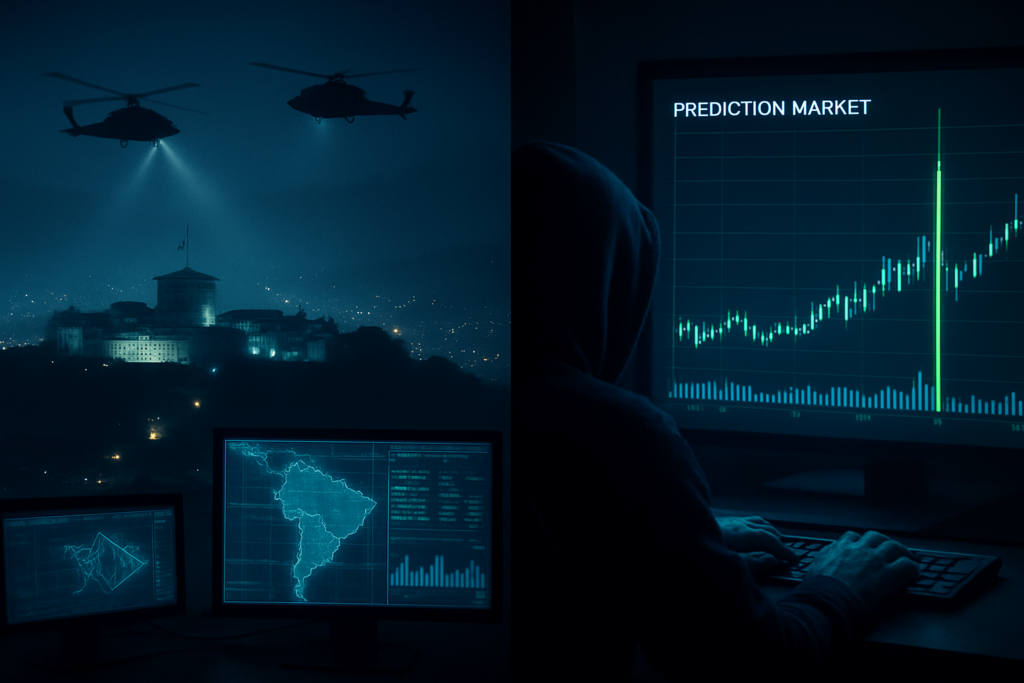
The early morning of January 3, 2026, will be remembered as one of the most significant geopolitical shifts of the decade. As U.S. Army Delta Force commandos descended upon the Fort Tiuna military complex in Caracas to capture Nicolás Maduro, a parallel drama was unfolding in the digital corridors of decentralized finance. While the world slept, a series of high-stakes trades on Polymarket signaled the impending raid hours before the first explosion echoed through the Venezuelan capital.
The successful capture of Maduro—now awaiting trial on narco-terrorism charges in New York—triggered a massive payout on one of the most controversial prediction contracts in history. With nearly half a million dollars flowing to a single anonymous trader who appeared to know the "unknowable," the event has ignited a firestorm of debate over the integrity of prediction markets, the potential for state-level insider trading, and the urgent need for new regulatory guardrails.
The Market: What’s Being Predicted
The focal point of the controversy was a Polymarket contract titled: "Will Nicolás Maduro be out of office by January 31, 2026?" For much of the latter half of 2025, this market was a quiet corner of the platform, with shares trading between $0.05 and $0.08. This pricing indicated that the broad market assigned less than an 8% probability to Maduro being removed from power, as geopolitical analysts viewed a direct military extraction as a "tail risk" that could destabilize the region.
The resolution criteria for the contract were specific: Maduro had to be resigned, physically removed, captured by a foreign power, or otherwise rendered unable to exercise the powers of the presidency. Following the announcement of "Operation Absolute Resolve" by President Trump at 4:21 a.m. EST on January 3, the market quickly moved toward a $1.00 valuation. By the time Maduro was confirmed to be in custody aboard the USS Iwo Jima, the total trading volume for Maduro-related ouster markets across platforms had surged past $64 million.
On the night of the raid, between 9:58 p.m. and 2:58 a.m. EST, the market witnessed an unprecedented anomaly. An anonymous user under the pseudonym "Burdensome-Mix" began aggressively buying "Yes" shares. This trader wagered approximately $32,537 on the low-probability outcome just hours before the Delta Force helicopters crossed the Venezuelan border. When the market resolved, the trader walked away with a staggering profit of $436,759.61—a return of more than 1,242%.
Why Traders Are Betting
The timing of the "Burdensome-Mix" trades has led many to believe that the bet was not based on public sentiment, but on classified military intelligence. The bulk of the positions were entered after the final strike authorization was reportedly signed but before the public—or even the Venezuelan military—was aware of the operation. This "pitch-perfect" conviction on a low-probability event has led to widespread allegations of "dark information" usage.
While some traditional geopolitical analysts were caught off guard, the prediction markets were reacting in real-time. Proponents of these platforms argue that this is exactly how they are supposed to work: by aggregating all available information, including that held by people "in the know," to produce the most accurate forecast possible. Critics, however, argue that when the "information" is a top-secret military operation, the market ceases to be a forecasting tool and becomes a vehicle for laundering government secrets into personal profit.
Furthermore, a secondary conflict erupted over an "invasion" market. While the ouster market paid out, a separate contract asking if the U.S. would "invade" Venezuela was ruled as "No" by the UMA oracle. The oracle determined that a "snatch-and-extract" mission by special forces did not meet the definition of an invasion, which typically requires a large-scale occupation of territory. This distinction left many "Yes" bettors frustrated, claiming the oracle manipulated the outcome to favor the house or high-volume liquidity providers.
Broader Context and Implications
The fallout from the "Maduro Bet" has reached the halls of Congress. Representative Ritchie Torres (D-N.Y.) recently introduced the Public Integrity in Financial Prediction Markets Act of 2026. The bill aims to close what Torres calls the "geopolitical loophole" by prohibiting federal elected officials, political appointees, and executive branch staff from trading on prediction markets if they possess material nonpublic information related to their official duties.
The event has also highlighted the operational role of defense contractors in modern conflicts. During the raid, high-tech assets from companies like Lockheed Martin (NYSE: LMT), including F-35 stealth fighters used to suppress Venezuelan air defenses, were critical to the mission's success. The intersection of military hardware and digital betting software has created a new paradigm where the success of a $100 million aircraft can directly determine the winner of a $400,000 bet.
This incident marks a turning point for the credibility of decentralized prediction markets. On one hand, Polymarket correctly "predicted" the event through its pricing mechanism, proving its utility as a leading indicator. On the other hand, the suspicion of insider trading and the semantic disputes over oracle resolutions have provided ammunition for regulators who wish to see these platforms brought under stricter oversight by the Commodity Futures Trading Commission (CFTC).
What to Watch Next
In the coming weeks, the focus will shift from the betting floor to the courtroom. The U.S. Department of Justice is reportedly investigating the "Burdensome-Mix" account to determine if the individual behind it has ties to the Department of Defense or the National Security Council. Any evidence linking the trades to a government employee could lead to the first major criminal prosecution for "prediction market insider trading."
Additionally, the passage of Rep. Torres's bill remains a key milestone. If enacted, it would force platforms like Polymarket and Kalshi to implement more rigorous Know Your Customer (KYC) protocols to identify and block government employees from specific markets. The debate over whether an "extraction" counts as an "invasion" will also likely lead to a standardizing of contract language across the industry to avoid future "oracle disputes."
Finally, eyes are on the upcoming legal proceedings for Maduro in the Southern District of New York. Markets are already forming around the length of his trial and the eventual verdict. Traders are closely watching for any signs of a plea deal, which could once again send shockwaves through the political prediction markets.
Bottom Line
The $400,000 Maduro payout is a watershed moment for prediction markets. It has demonstrated their uncanny ability to capture the "wisdom of the crowds" (or the knowledge of the few) with surgical precision. However, it has also exposed the significant ethical and legal risks inherent in betting on global security events.
As we move further into 2026, the "Maduro Bet" will serve as the primary case study for the tension between transparency and security. While these markets provide invaluable data to the public, the risk of incentivizing the leak of classified information remains a daunting challenge for lawmakers and platform operators alike. For now, the "Burdensome-Mix" trader remains a symbol of the high stakes—and high suspicions—of the new era of geopolitical forecasting.
This article is for informational purposes only and does not constitute financial or betting advice. Prediction market participation may be subject to legal restrictions in your jurisdiction.
PredictStreet focuses on covering the latest developments in prediction markets.
Visit the PredictStreet website at https://www.predictstreet.ai/.