As of December 24, 2025, the global geopolitical landscape has shifted focus toward a "Maritime Century," placing Huntington Ingalls Industries (NYSE: HII) at the epicenter of national security strategy. As America’s largest military shipbuilder, HII is more than a defense contractor; it is the industrial foundation upon which the U.S. Navy’s strategy of "distributed lethality" and Indo-Pacific deterrence is built.
In late 2025, HII has found itself in a unique spotlight. Following a volatile 2024 marked by labor shortages and supply chain disruptions, the company has staged a remarkable recovery. Driven by the landmark FY2026 National Defense Authorization Act (NDAA) and the accelerating momentum of the AUKUS (Australia-UK-US) trilateral partnership, HII has transitioned from a legacy industrial giant to a high-tech naval architect. This deep-dive examines how HII is navigating new defense spending policies to secure its dominance in the next decade of maritime warfare.
Historical Background
HII’s lineage is a tapestry of American industrial history. The company was formally established as an independent, publicly traded entity in 2011 after being spun off from Northrop Grumman. However, its roots extend back to 1886, when Collis Potter Huntington founded the Newport News Shipbuilding and Dry Dock Company in Virginia. Over nearly 140 years, Newport News has built more than 800 ships, including every nuclear-powered aircraft carrier in the U.S. fleet.
The second pillar, Ingalls Shipbuilding in Pascagoula, Mississippi, was founded in 1938 and became a pioneer in all-welded shipbuilding. Together, these yards have seen the U.S. through World War II, the Cold War, and the Global War on Terror. In 2021, the company rebranded its technical services division as Mission Technologies, reflecting a strategic pivot toward cyber, artificial intelligence (AI), and unmanned systems, moving beyond "bending steel" to master the digital domain.
Business Model
HII’s business model is built on three distinct but symbiotic segments:
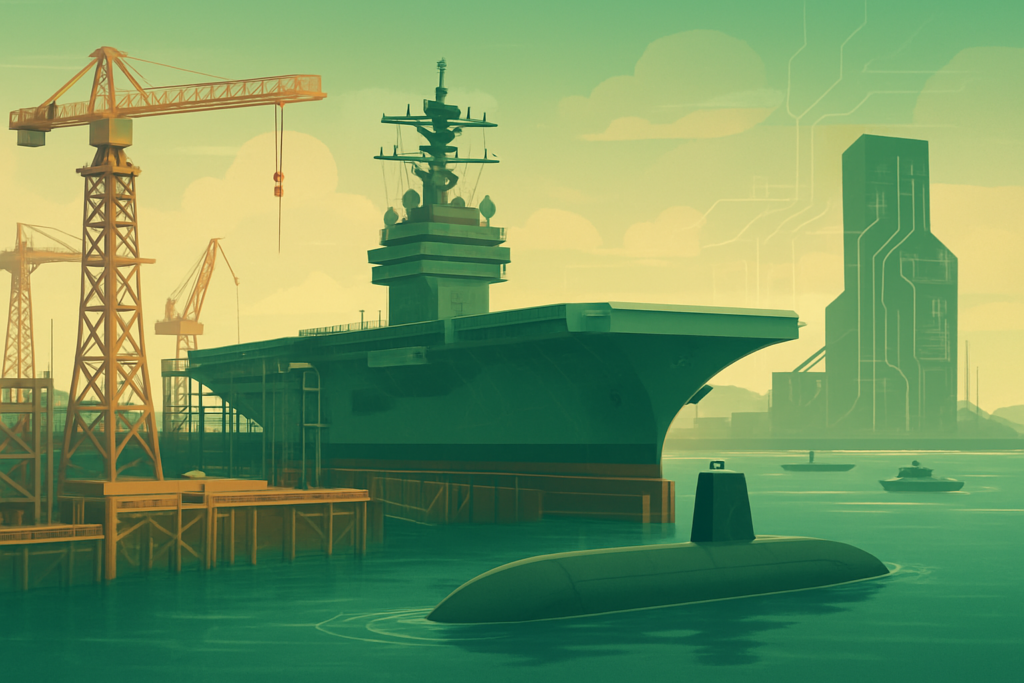
- Newport News Shipbuilding (NNS): The sole designer and builder of nuclear-powered aircraft carriers and one of only two builders of nuclear submarines. This segment generates the majority of revenue and is characterized by long-term, multi-billion dollar contracts with the U.S. Navy.
- Ingalls Shipbuilding: Specializes in non-nuclear surface combatants, including Arleigh Burke-class destroyers, amphibious assault ships, and the National Security Cutter for the Coast Guard. Ingalls provides the "volume" for the fleet’s surface presence.
- Mission Technologies: The company’s high-growth engine. It provides all-domain solutions including C5ISR, AI-driven analytics, and uncrewed underwater and surface vehicles. This segment seeks to capture the higher margins associated with software and advanced technology services.
Stock Performance Overview
HII has delivered a historic performance throughout 2025. After a difficult 2024 where the stock lagged the broader defense sector due to margin compression, the stock has rallied aggressively.
- 1-Year Performance (2025): The stock has surged approximately 90%, recovering from a 52-week low of $158.88 in February 2025 to trade above $350 in late December. This surge followed the 2024 election and subsequent "Peace Through Strength" naval budget proposals.
- 5-Year Performance: HII has provided a total return of approximately 101%, outperforming many of its peer aerospace and defense counterparts during the same period.
- 10-Year Performance: A steady compounder, the stock has returned nearly 178%, supported by consistent dividend growth and share repurchases.
Financial Performance
Financial results for the 2025 fiscal year indicate a company that has finally successfully navigated its post-pandemic labor hurdles.
- Revenue: In Q3 2025, HII reported record quarterly revenue of $3.2 billion, a 16.1% increase year-over-year. Full-year 2025 guidance for shipbuilding revenue is set at approximately $9.1 billion.
- Margins: While 2024 operating margins dipped to 4.6% due to legacy contract adjustments, they have recovered toward the 6.0% range in late 2025. Management’s long-term target remains 7-8% as digital manufacturing efficiencies take hold.
- Backlog: The company’s total backlog reached a record $56 billion in late 2025, providing nearly five years of revenue visibility. This backlog is anchored by the multi-ship buy of Ford-class carriers and Virginia-class submarines.
Leadership and Management
Christopher D. Kastner, who became President and CEO in 2022, has been the architect of the company’s recent transformation. Kastner’s strategy, often termed "Deckplate Discipline," focuses on operational execution over aggressive M&A.
In 2025, the leadership team was refreshed with the appointment of Brian Blanchette as President of Ingalls Shipbuilding, while Kari Wilkinson continues to lead Newport News. Under Kastner, HII has embraced a more collaborative relationship with the Navy and its peer competitor General Dynamics, focusing on joint submarine production to meet the aggressive requirements of the AUKUS pact.
Products, Services, and Innovations
Innovation at HII is no longer just about hull design; it is about the integration of "Ship OS."
- Ford-Class Carriers: The Gerald R. Ford (CVN 78) class represents the most advanced warship ever built, featuring electromagnetic aircraft launch systems (EMALS) and significantly reduced manning requirements.
- Unmanned Systems: Mission Technologies launched the ROMULUS line of unmanned surface vessels (USVs) in 2025, designed for long-range surveillance and electronic warfare.
- Digital Shipbuilding: HII has partnered with Palantir and C3 AI to deploy a "Shipbuilding Operating System" that uses digital twins to identify production bottlenecks in real-time. This technology was credited with reducing construction hours on the Virginia-class Block V submarines by 12% in 2025.
Competitive Landscape
HII exists in a "co-opetitive" duopoly with General Dynamics (NYSE: GD), particularly the latter's Electric Boat division. While they compete for surface ship contracts, they are legally mandated partners in the production of nuclear submarines.
Compared to GD, HII is more purely a maritime player. While GD has a diversified portfolio including Gulfstream jets and land systems, HII’s focus is almost exclusively on the Navy. This makes HII more sensitive to shipbuilding budget cycles but also a more direct play for investors looking to capitalize on naval expansion. In late 2025, HII gained a competitive edge by winning the contract for the Navy's new small surface combatant (FF(X)), a move that diversifies its portfolio away from purely "mega-ships."
Industry and Market Trends
Three major trends are currently driving the naval shipbuilding industry:
- AUKUS Pillar I: The agreement to provide Australia with nuclear-powered submarines has created a massive demand tailwind. HII’s joint venture, H&B Defence, is already qualifying Australian suppliers, effectively expanding the industrial base.
- Distributed Maritime Operations (DMO): The Navy is shifting from a few large targets to many smaller, networked platforms. This has led to increased funding for destroyers and unmanned systems, both HII strengths.
- Industrial Base Modernization: The Navy’s $25 billion Shipyard Infrastructure Optimization Program (SIOP) is finally trickling down to private yards, funding the dry-dock upgrades necessary for 21st-century maintenance.
Risks and Challenges
Despite the record backlog, HII faces persistent headwinds:
- Labor Scarcity: The lack of skilled welders, pipefitters, and nuclear technicians remains the primary constraint on growth. While HII raised wages in 2025, the aging workforce is a long-term demographic challenge.
- Supply Chain Fragility: Delays in the delivery of long-lead nuclear components have occasionally pushed sub-delivery schedules out by months.
- Fixed-Price Contracts: Inflationary pressures can erode margins on multi-year, fixed-price contracts. HII has worked with the Pentagon to include "Economic Price Adjustment" (EPA) clauses in new contracts, but older contracts remain a risk.
Opportunities and Catalysts
- Carrier Block Buys: The FY2026 NDAA authorizes the "block buy" of CVN-82 and CVN-83. Purchasing two carriers at once saves the government money but provides HII with unprecedented workforce stability and purchasing power.
- Unmanned Proliferation: As the Navy aims for a "500-ship fleet" (including 150 unmanned vessels), Mission Technologies is poised to capture a significant portion of this emerging market.
- Increased Defense Spending: Geopolitical tensions in the Red Sea and the Taiwan Strait have shifted the budgetary momentum toward naval readiness, a trend unlikely to reverse in the current political climate.
Investor Sentiment and Analyst Coverage
Wall Street sentiment on HII has turned overwhelmingly bullish in the fourth quarter of 2025. Major houses like Goldman Sachs and J.P. Morgan upgraded the stock following the passage of the $900 billion defense policy bill. Analysts highlight HII’s "valuation floor," provided by its massive backlog, and its potential for "margin catch-up" as production efficiencies finally manifest. Hedge fund activity in the defense sector has increased, with institutional ownership of HII currently sitting at approximately 88%.
Regulatory, Policy, and Geopolitical Factors
The legislative environment is the most critical driver for HII. The FY2026 National Defense Authorization Act not only authorized record spending but also signaled a shift in policy toward "multi-year procurement" for major programs. This allows HII to buy materials in bulk and stabilize its workforce. Furthermore, the "Peace Through Strength" initiatives from the current administration emphasize a 355-ship Navy, a goal that necessitates HII’s yards to run at maximum capacity for the foreseeable future.
Conclusion
Huntington Ingalls Industries enters 2026 as a pivotal player in the defense of the Western world. By successfully bridging the gap between heavy industrial manufacturing and cutting-edge digital integration, the company has transformed its value proposition. While labor and margin risks remain, the combination of a record $56 billion backlog, a favorable legislative environment, and a clear leadership vision under Chris Kastner makes HII a foundational asset for defense-focused investors.
Investors should watch for Q1 2026 earnings for confirmation that shipbuilding margins are maintaining their upward trajectory and monitor the progress of the AUKUS supplier qualification as a leading indicator of long-term international growth.
This content is intended for informational purposes only and is not financial advice.