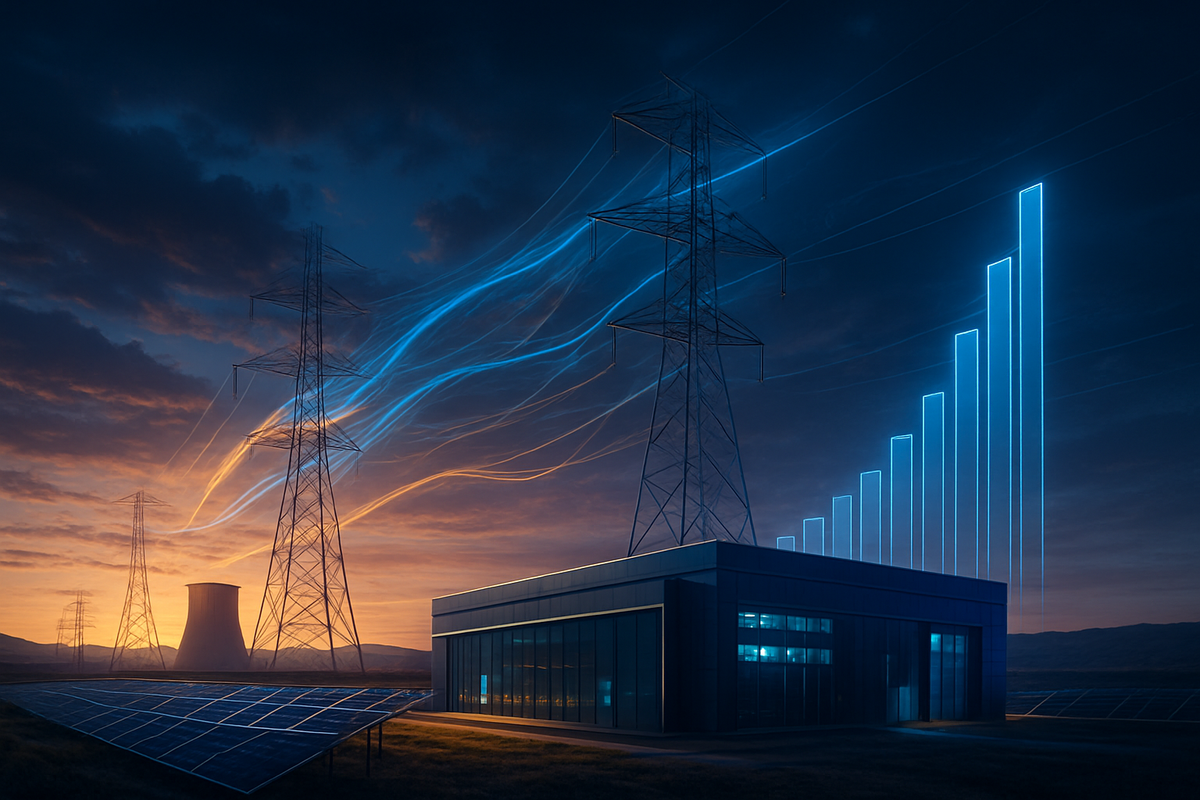
The global energy landscape has undergone a seismic shift, culminating in a staggering 98% year-over-year surge in deal value for the Power and Utilities (P&U) sector as of early 2026. According to the latest market data from January 2026, the sector has transitioned from a traditional defensive haven into a high-octane growth engine. This massive infusion of capital is being driven by a "perfect storm": the insatiable energy appetite of artificial intelligence (AI) data centers and the strict regulatory pressure to meet 2030 and 2050 decarbonization mandates.
As of February 6, 2026, the implications of this investment boom are reverberating across Wall Street. While the total number of transactions in the P&U space remained relatively stable throughout 2025, the scale of these deals has ballooned. We are no longer seeing small, tactical acquisitions; instead, the market is being dominated by "mega-deals" and multi-billion-dollar infrastructure plays as private equity giants and utility titans race to secure the generation capacity and grid connections necessary to power the next decade of digital expansion.
The Era of the Mega-Deal: Decoding the 98% Surge
The dramatic rise in deal value was crystallized in the January 2026 report by EY, which analyzed M&A activity through the end of December 2025. The data revealed that the aggregate deal value nearly doubled, a phenomenon attributed to the extreme scarcity of "shovel-ready" power infrastructure. Throughout 2025, the industry witnessed a pivot away from fragmented renewable projects toward integrated energy systems capable of providing 24/7 "dispatchable" clean power. This shift was largely necessitated by the realization that intermittent solar and wind alone cannot satisfy the constant, high-density load required by AI reasoning models, which often demand upwards of 100 megawatts (MW) for a single facility.
The timeline leading to this surge began in mid-2024 when the projected U.S. data center grid demand for 2025 was revised upward to 61.8 gigawatts (GW). By late 2025, it became clear that this demand was likely to double by 2030. In response, key players like BlackRock (NYSE: BLK) and Blackstone (NYSE: BX) began aggressively acquiring both digital and physical infrastructure. A pivotal moment occurred in late 2025 when BlackRock received final regulatory approval for its $6.2 billion acquisition of ALLETE Inc. (NYSE: ALE), the parent of Minnesota Power, signaling a new era of private equity taking public utilities private to accelerate capital-intensive upgrades.
Winners and Losers in the Race for Megawatts
The primary beneficiaries of this capital influx are large-scale integrated utilities with significant "landbanks" and existing grid connections. NextEra Energy (NYSE: NEE) has emerged as a clear frontrunner, leveraging its scale to ink massive partnerships. In 2025, NextEra secured a "gigawatt-scale" agreement with Alphabet Inc. (NASDAQ: GOOGL) to build data center campuses featuring co-located generation and storage. Furthermore, NextEra’s decision to restart the Duane Arnold nuclear plant specifically to power data centers has set a new precedent for the "nuclear-to-data center" nexus, driving their valuation to record highs.
Conversely, the rapid escalation in deal values and the resulting "mega-projects" have put smaller municipal utilities and capital-constrained firms at a disadvantage. These entities often lack the balance sheets to compete for high-priced renewable portfolios or the regulatory leverage to fast-track grid upgrades. For investors, Dominion Energy (NYSE: D) has also shown resilience; by increasing its five-year capital plan to $50.1 billion to handle the surge in Northern Virginia—the world’s data center capital—the company has solidified its role as an essential infrastructure provider. However, the risk remains for the general public: as utilities spend billions on upgrades, there is mounting concern over "rate shock" for residential consumers who may end up subsidizing the infrastructure needed for Big Tech.
Re-Electrification and the Policy Shift
The broader significance of this trend cannot be overstated. We are witnessing what industry analysts call the "Great Re-Electrification," a period comparable only to the initial build-out of the electrical grid in the early 20th century. For the first time in decades, electricity demand is decoupling from GDP growth, with power needs rising significantly faster than the general economy. This has forced a strategic pivot in decarbonization policy. While Net Zero 2050 remains the long-term goal, the immediate need for reliability has led companies like Southern Company (NYSE: SO) to delay the retirement of certain fossil fuel assets to ensure grid stability for AI hubs.
Regulatory bodies are also adapting. In late 2025, we saw the emergence of "Bring Your Own Power" (BYOP) models, where hyperscalers like Meta Platforms (NASDAQ: META) finance the construction of their own dedicated power plants. This shift reduces the immediate burden on the public grid but creates a complex regulatory environment regarding who owns and operates these "islands" of power. Furthermore, the "Gas-to-AI" nexus has repositioned natural gas as a critical transition fuel, with companies like PPL Corp (NYSE: PPL) entering joint ventures to build high-efficiency gas stations specifically for data center clients.
The Road Ahead: Scarcity and Consolidation
As we look toward the remainder of 2026 and into 2027, the primary challenge will be the "infrastructure bottleneck." Despite the 98% jump in investment, the physical supply chain—particularly for large power transformers and high-voltage transmission lines—remains under severe strain. Lead times for some critical grid components have stretched to over three years. This scarcity will likely drive even further consolidation, as only the largest firms will have the procurement power to secure the necessary hardware.
One major event to watch in the coming months is the rumored $38 billion acquisition of AES Corp (NYSE: AES) by BlackRock. If this deal proceeds, it would mark the largest utility acquisition in history and confirm that the sector's valuation is now being driven by its role as the backbone of the global AI economy. Strategic pivots toward small modular reactors (SMRs) and advanced geothermal energy are also expected to accelerate as companies seek new ways to provide carbon-free, 24/7 power in land-constrained areas.
Final Assessment for the 2026 Market
The 98% surge in Power and Utilities deal value is more than just a statistical anomaly; it is the beginning of a multi-decade investment cycle. The convergence of AI and decarbonization has transformed the sector from a low-growth, dividend-focused industry into a high-stakes arena for technological and capital competition. For investors, the takeaway is clear: the most valuable assets in the current economy are no longer just the algorithms themselves, but the physical infrastructure required to run them.
Moving forward, the market will be defined by the "haves" and "have-nots" of energy access. Investors should closely monitor the regulatory environment, specifically focusing on rate-case decisions and grid connection queues. As we navigate 2026, the ability of a utility to balance the relentless demand from tech giants with the political sensitivity of residential power prices will be the ultimate determinant of long-term value. The "Great Power Grab" is far from over; it is simply entering its most intensive phase.
This content is intended for informational purposes only and is not financial advice.