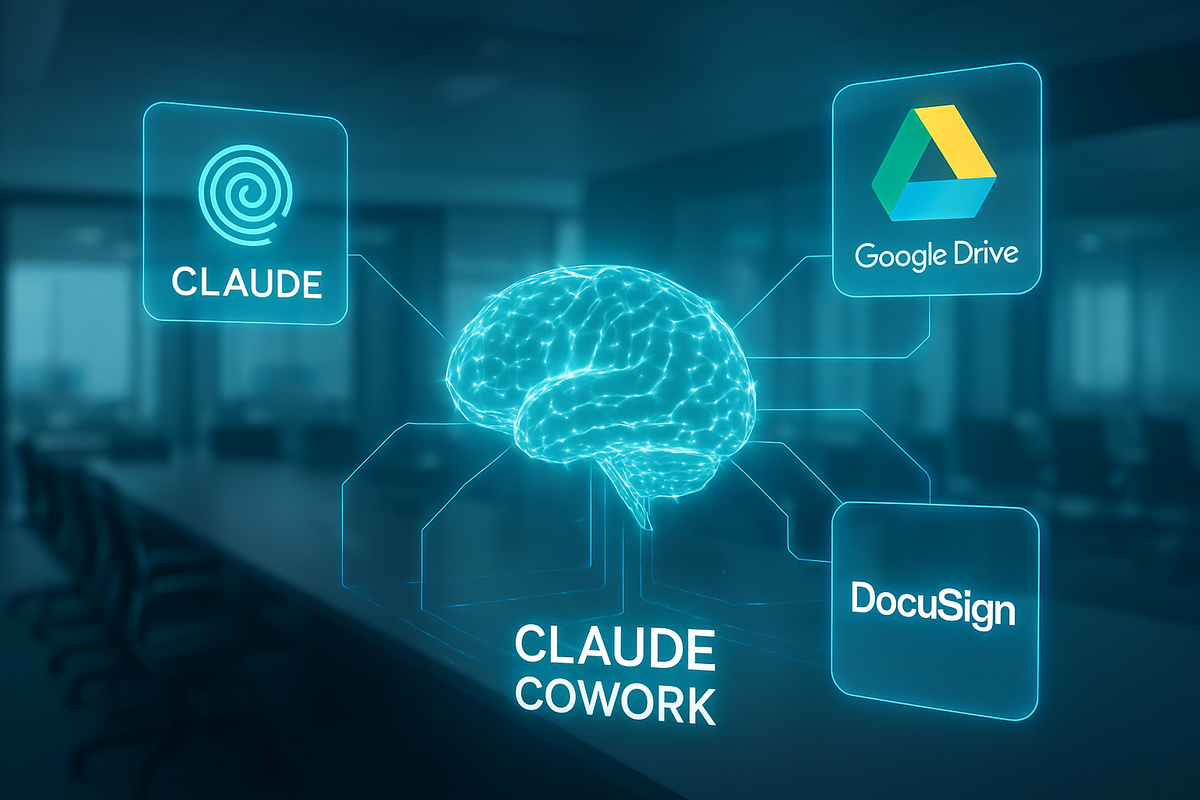
The enterprise software landscape underwent a seismic shift this week as Anthropic unveiled "Claude Cowork," a revolutionary persistent workplace platform designed to transform AI from a conversational assistant into an autonomous digital colleague. By launching deep, native integrations with Google Drive, Gmail, and DocuSign (NASDAQ: DOCU), alongside a suite of department-specific "agentic" plugins, Anthropic has moved beyond the "chatbot" era. This expansion signals a direct challenge to the traditional per-seat licensing models that have defined the software-as-a-service (SaaS) industry for two decades.
The immediate market reaction has been nothing short of historic. Following the February 24, 2026, announcement, the S&P 500 Software Index saw its most volatile week in years, as investors began to price in the "agentic cannibalization" of legacy software. As Claude gains the ability to autonomously manage document workflows, draft and send complex legal correspondence via Alphabet Inc. (NASDAQ: GOOGL) tools, and execute contract lifecycles, the necessity for specialized, high-cost mid-tier SaaS tools is being questioned by IT departments globally.
The Dawn of Claude Cowork: A Timeline of Integration
The launch of Claude Cowork on February 24, 2026, was the culmination of a high-velocity month for Anthropic. The rollout began on February 5 with the debut of Claude Opus 4.6, featuring a staggering 1-million-token context window, allowing the model to "remember" and process entire corporate libraries in a single session. This was followed by the February 20 release of "Claude Code Security," a tool that uses reasoning-based scanning to identify zero-day vulnerabilities. These technical milestones set the stage for the Cowork platform, which utilizes the open-source Model Context Protocol (MCP) to "read and write" across a company’s existing tech stack.
The centerpieces of this expansion are the "Deep Connectors" for Google Workspace and DocuSign. Unlike previous iterations that required manual copy-pasting, Claude can now autonomously navigate a user’s Google Drive to synthesize project data, draft emails in Gmail based on that data, and even flag contradictory clauses in DocuSign agreements before they are sent for signature. Furthermore, Anthropic introduced ten pre-built departmental plugins tailored for Finance, HR, and Engineering. The Finance plugin, for instance, can pull real-time data from FactSet Research Systems Inc. (NYSE: FDS) to update complex Excel models and simultaneously generate a corresponding PowerPoint deck for executive review.
Winners, Losers, and the Pricing Pivot
The primary beneficiary of this shift appears to be the "infrastructure layer." Companies providing the backbone for these AI agents, such as Alphabet Inc. (NASDAQ: GOOGL) and Amazon.com, Inc. (NASDAQ: AMZN)—both major backers of Anthropic—stand to gain as compute demand surges. Microsoft Corp. (NASDAQ: MSFT) has also taken a pragmatic approach, integrating Claude Opus 4.6 into its Azure "Foundry" to cater to enterprise clients who prefer Anthropic’s reasoning capabilities over OpenAI’s GPT-5. Meanwhile, professional services giant Accenture (NYSE: ACN) has solidified its lead by deploying its "Anthropic Business Group," a 30,000-person task force dedicated to implementing these agentic workflows for Fortune 500 clients.
On the losing side of the "SaaSpocalypse" are traditional "per-seat" productivity tools that offer limited AI integration. ServiceNow, Inc. (NYSE: NOW) and LegalZoom.com, Inc. (NASDAQ: LZ) saw their shares pressured earlier this month as analysts warned that autonomous agents could automate the very tasks these platforms charge humans to perform. To combat this, Salesforce, Inc. (NYSE: CRM) has aggressively accelerated its "Agentforce" platform, announcing a pivot toward "consumption-based pricing." By charging per "successful agent action" rather than per user login, Salesforce is attempting to evolve alongside the technology, though the transition remains a high-stakes gamble for its quarterly revenue consistency.
From Copilots to Autonomous Agents: A Broader Industry Shift
This event marks a definitive transition from "AI as a Copilot"—where the human does the work and the AI assists—to "AI as an Agent," where the AI executes the work and the human provides oversight. This trend mirrors the historical shift from manual bookkeeping to automated ERP systems in the 1990s, but at a vastly accelerated pace. The use of the Model Context Protocol (MCP) as an industry standard is particularly significant; it suggests that the future of enterprise software is not a "walled garden" but an interconnected ecosystem where the most intelligent model wins by being the best orchestrator.
The regulatory implications of this shift are already coming into focus. As Claude gains the ability to send emails and sign off on workflows, the "Human-in-the-Loop" (HITL) requirement is becoming a central theme for policy discussions in Washington and Brussels. Regulators are increasingly concerned with "algorithmic accountability"—who is responsible when an autonomous agent incorrectly interprets a DocuSign contract or leaks sensitive information via a Gmail plugin? Anthropic has addressed this with its "Customize" admin dashboard, giving IT leaders granular control over what agents can and cannot do, but the legal framework for autonomous corporate actions remains in its infancy.
The Road Ahead: 2026 and Beyond
In the short term, expect a wave of "me-too" integrations from competitors as they scramble to match Anthropic’s agentic capabilities. The focus will likely shift from model size to "agentic reliability"—how often an AI can complete a multi-step workflow without human intervention. Long-term, the very concept of a "software application" may dissolve, replaced by "task-specific interfaces" that appear when needed and disappear once the AI agent has completed the job. For companies like Salesforce and Microsoft, the challenge will be managing the "cannibalization" of their legacy revenue streams while trying to capture the new, high-margin market of autonomous agent orchestration.
Market opportunities are emerging for "AI Audit" firms—companies that specialize in verifying that these autonomous workflows are compliant and secure. As Claude and its peers take over more administrative and analytical tasks, the demand for human expertise will likely shift toward high-level strategy and "prompt engineering" at the architectural level. The "SaaSpocalypse" may not be the death of software, but it is certainly the end of software as we knew it in the 2010s.
Summary and Investor Outlook
Anthropic’s launch of Claude Cowork and its deep enterprise integrations represents a watershed moment for the technology sector. By bridging the gap between high-level reasoning and functional execution through Google and DocuSign, Anthropic has set a new standard for what enterprise AI must look like in 2026. The move has forced a reckoning for SaaS providers, leading to a fundamental rethink of pricing models and user engagement.
For investors, the coming months will be defined by "execution risk." Watch for how quickly legacy players like Salesforce (NYSE: CRM) can transition to consumption-based revenue and how Alphabet Inc. (NASDAQ: GOOGL) manages its dual role as an Anthropic partner and a competitor via its own Gemini models. The "SaaSpocalypse" has introduced a era of volatility, but for those positioned at the intersection of agentic orchestration and infrastructure, the growth potential is unprecedented. The key takeaway is clear: the most valuable "seat" in the office may no longer belong to a human, but to a model.
This content is intended for informational purposes only and is not financial advice