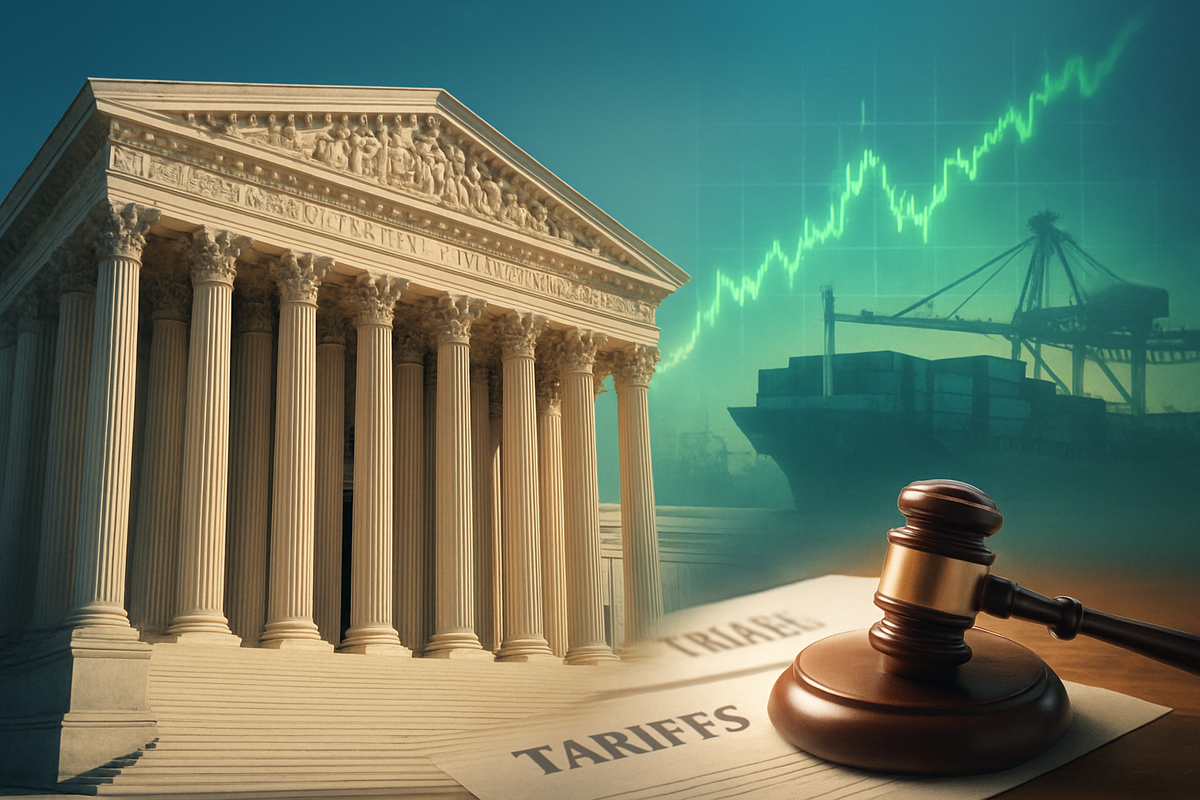
In a landmark decision that has sent shockwaves through Washington and jubilant rallies across global financial markets, the United States Supreme Court ruled 6-3 today that President Donald Trump exceeded his legal authority in imposing sweeping "reciprocal tariffs" under the International Emergency Economic Powers Act (IEEPA). The ruling in Learning Resources v. Trump effectively guts the centerpiece of the administration’s "Liberation Day" trade policy enacted in April 2025, which had placed a universal 10% baseline tariff on nearly all imports and duties as high as 125% on specific goods from trade rivals.
The Court’s decision marks a significant turning point for the U.S. economy, potentially triggering a massive $175 billion refund process for American businesses that have been grappling with skyrocketing input costs for nearly a year. While the White House immediately slammed the decision as a "disgrace" to the American worker, investors responded with a decisive "buy" signal, as major indices surged on the prospect of eased inflationary pressures and restored profit margins for multi-national corporations.
A Decisive Blow to Executive Trade Authority
The core of the Supreme Court’s ruling rested on the "Major Questions Doctrine," a legal principle that requires Congress to provide explicit authorization when delegating powers of "vast economic and political significance" to the executive branch. Chief Justice John Roberts, writing for the majority, argued that while the IEEPA grants the President broad powers to regulate international commerce during national emergencies, it does not provide a "blank check" to levy taxes—a power the Constitution reserves strictly for Congress under Article I, Section 8. The majority was joined by the Court’s three liberal justices, along with Trump appointees Neil Gorsuch and Amy Coney Barrett, signaling a rare cross-ideological consensus against executive overreach in fiscal matters.
The timeline leading to this moment began on April 2, 2025, a date President Trump declared "Liberation Day." Following a period of legislative gridlock where the "Reciprocal Trade Act" failed to pass the Senate, the President declared a national emergency regarding the U.S. trade deficit. Using Executive Order 14257, he bypassed Congress to implement a tiered tariff system. Small businesses and massive retailers alike were caught in the crossfire. Learning Resources, an educational toy maker, and V.O.S. Selections, a wine importer, led the legal charge, arguing that the IEEPA was never intended to be a tool for permanent protectionist tax policy.
Reaction from the executive branch was swift and vitriolic. Speaking at a breakfast with U.S. governors shortly after the news broke, President Trump labeled the ruling a "disgrace" and a "judicial surrender to foreign interests." He maintained that the tariffs were the only leverage the U.S. had to force fair trade deals with China and the European Union. However, for the three dissenting justices—Clarence Thomas, Samuel Alito, and Brett Kavanaugh—the argument was simpler: they believed the broad language of the 1977 statute historically granted the President enough discretion to manage economic threats through duties.
Retail and Manufacturing Giants Set to Recoup Billions
The financial implications of the ruling are staggering. Analysts estimate that between $133 billion and $175 billion in collected duties may now be subject to refund claims. Among the largest potential beneficiaries is Costco Wholesale Corp (NASDAQ: COST), a primary plaintiff in the broader legal challenge. Costco had previously warned shareholders that the tariffs were forcing unprecedented price hikes on consumer staples; today, its stock rose 4.2% as investors anticipated both a return to lower pricing and a substantial administrative refund.
The automotive and industrial sectors also saw immediate relief. Toyota Motor Corp (NYSE: TM) and The Goodyear Tire & Rubber Co (NASDAQ: GT), both of which rely on complex global supply chains for parts and raw materials, saw their shares climb as the threat of 100% "reciprocal" duties on certain components vanished. Alcoa Corp (NYSE: AA), which had faced volatile market conditions due to the shifting trade landscape, also saw a positive bump. These companies had spent the last ten months filing "protective" lawsuits to prevent U.S. Customs and Border Protection from finalizing their tariff payments, a strategic move that now clears the way for a more streamlined recovery of their funds.
On the luxury side, the ruling sparked a rally in European ADRs. LVMH Moet Hennessy Louis Vuitton SE (OTC: LVMUY) jumped over 5% on the news, as the threat of punitive duties on French wines and leathers was lifted. Similarly, sportswear giant Under Armour Inc (NYSE: UA), which had been forced to aggressively restructure its sourcing away from high-tariff regions in 2025, now faces a much more favorable cost environment. While the "losers" of this ruling are primarily the federal budget—which had been using tariff revenue to offset domestic tax cuts—the private sector's gain is viewed by most economists as a net positive for market stability.
The Major Questions Doctrine and the Future of Trade Policy
The wider significance of this ruling cannot be overstated, as it creates a permanent legal hurdle for any future administration seeking to use "emergency" statutes for broad economic engineering. By invoking the Major Questions Doctrine, the Court has essentially put a "lock and key" on the nation’s purse strings, reminding the executive branch that the power to tax is not a discretionary tool for foreign policy. This fits into a broader trend of the Roberts Court reining in the "administrative state," a shift that has significant implications for everything from environmental regulations to labor laws.
Historically, this case draws comparisons to the 1952 case Youngstown Sheet & Tube Co. v. Sawyer, where the Supreme Court struck down President Truman’s attempt to seize steel mills during a national emergency. Today’s ruling reinforces the principle that even in a perceived crisis, the President cannot manufacture legislative power where none exists. For U.S. trading partners, the ruling is seen as a restoration of the "rules-based order," potentially heading off a cascading series of retaliatory tariffs that had threatened to plunge the global economy into a 1930s-style protectionist spiral.
However, the regulatory ripple effects may be complex. While the IEEPA-based tariffs are gone, the administration still holds other tools. Authorities such as Section 301 of the Trade Act of 1974 or Section 232 (National Security) remain on the books. While these are narrower in scope, they have survived legal challenges in the past. Competitors in domestic industries that benefited from the protection—such as certain U.S.-based steel and textile manufacturers—may now find themselves exposed to lower-priced foreign competition, potentially leading to a renewed push for formal legislation in a still-divided Congress.
Navigating the Refund Maze and the 'Backup Plan'
In the short term, the primary challenge for corporations will be the "refund maze." While the Supreme Court has declared the tariffs illegal, the actual mechanism for returning the money remains in the hands of the Treasury Department and U.S. Customs and Border Protection. Legal experts warn that this could be a years-long administrative battle. Large corporations like Toyota and Costco have the legal teams to navigate the "liquidation" process, but smaller importers who did not file protective protests may find it significantly harder to recoup their losses.
The Trump administration has also hinted at a "backup plan." During his remarks today, the President suggested he would look at "alternative legal authorities" to keep the tariffs in place. This could mean a pivot to Section 122 of the Trade Act of 1974, which allows for temporary duties to deal with "serious balance-of-payments" deficits. However, after today's stinging defeat, any such move would likely face an immediate injunction from the same lower courts that originally stayed the IEEPA duties, as the Supreme Court has now signaled its lack of appetite for executive trade adventurism.
Looking forward, the market will likely see a period of "re-shoring" reversal. Many companies that were planning to move manufacturing to the U.S. at great expense to avoid the 2025 tariffs may now pause those capital expenditures. This creates a "strategic pivot" for boards of directors: do they trust the current legal stability, or do they prepare for a potential legislative version of the Reciprocal Trade Act should the political winds shift in the 2026 midterm elections?
Market Resilience in the Face of Trade Uncertainty
In summary, the Supreme Court’s decision to strike down the IEEPA tariffs is a historic win for the principle of separation of powers and a massive relief for the global supply chain. The key takeaways for investors are clear: the "tariff tax" that moved markets throughout 2025 is largely a thing of the past, and a massive liquidity injection in the form of corporate refunds is on the horizon. The market’s positive reaction today reflects a belief that the "worst-case scenario" of a global trade war has been averted by the judiciary.
Moving forward, the market will likely remain sensitive to inflation data, as the removal of these duties should theoretically help cool the Consumer Price Index (CPI) in the coming quarters. Investors should watch for the Treasury Department’s guidance on the refund process, as the timing of these payments could provide a significant "hidden" earnings boost for major importers in the second half of 2026.
While the political battle over trade is far from over, the legal boundaries have been clearly redrawn. The "emergency" phase of American trade policy has hit a constitutional wall, and for now, the markets are breathing a sigh of relief. Watch for the administration's next move—whether through Section 301 or a push for new legislation—as the ultimate decider of whether this rally has long-term legs or is merely a temporary reprieve.
This content is intended for informational purposes only and is not financial advice.