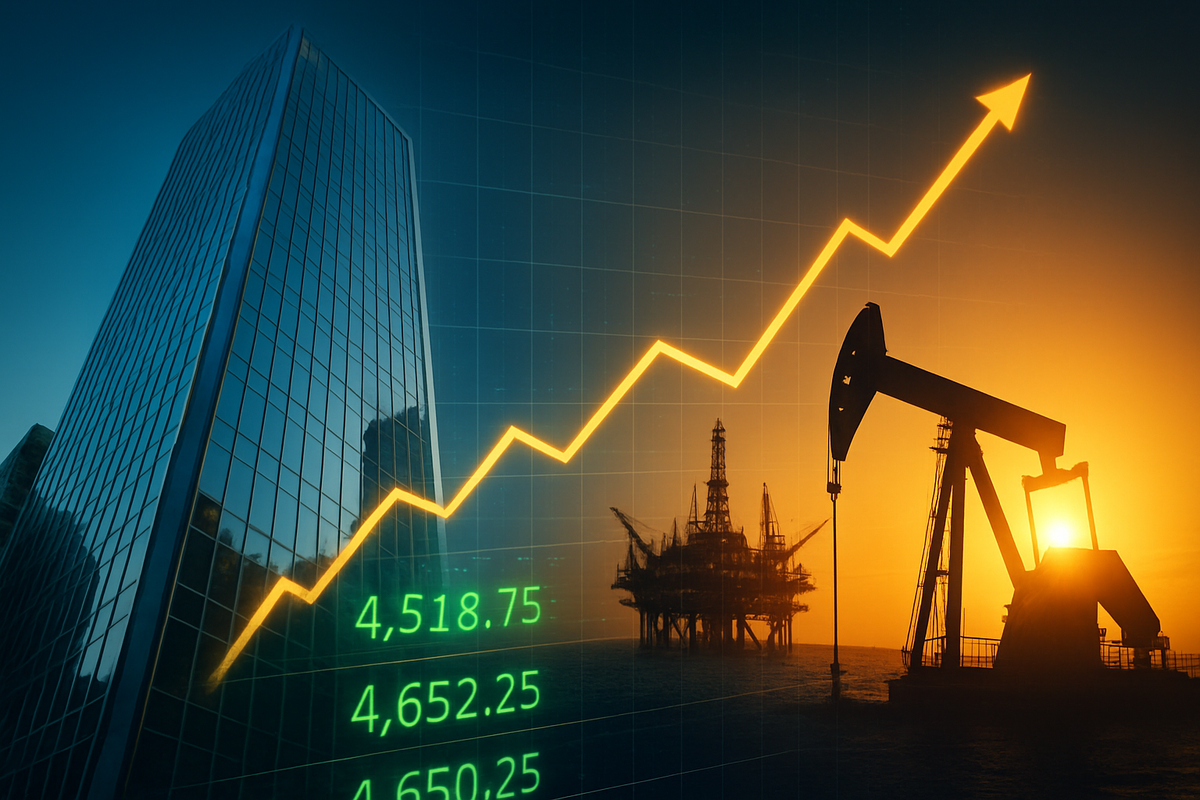
The S&P 500 climbed to start the first full trading week of 2026, bolstered by a powerful rally in the financial and energy sectors. As of the close on January 5, 2026, the S&P 500 rose 0.7% to finish near 6,894, while the Dow Jones Industrial Average surged 1.3% to hit a record high of 48,858. This upward movement reflects a growing investor preference for cyclical and value-oriented stocks, a sharp contrast to the tech-heavy dominance seen in previous years.
The dual-sector rally was catalyzed by a combination of geopolitical shifts and a recalibration of the Federal Reserve’s interest rate path. While energy stocks surged on news of significant leadership changes in Venezuela that could reshape global oil supplies, financial institutions benefited from a hawkish tilt in market sentiment. Investors are increasingly pricing in a "higher-for-longer" interest rate environment, which traditionally supports the net interest margins of major lenders.
Market Dynamics and the Venezuela Catalyst
The primary driver for the financial sector today was a renewed confidence in the banking industry's ability to thrive despite—or perhaps because of—elevated interest rates. JPMorgan Chase & Co. (NYSE: JPM) led the charge, hitting an all-time intraday high of $337.25 after Barclays raised its price target for the bank to $391. This upgrade was fueled by the bank's dominant market position and the expectation that the Federal Reserve will be slower to cut rates in 2026 than previously anticipated. The rally follows a period of relative uncertainty in late 2025, where three rate cuts brought the fed funds rate to the 3.50%–3.75% range. However, the release of the December FOMC minutes revealed a deeply divided board, with many members expressing concern that inflation remains stubbornly above the 2% target due to recent tariff increases and a resilient labor market.
Simultaneously, the energy sector experienced a "Venezuela Shock." Over the weekend, reports surfaced of a major military operation resulting in the capture of President Nicolás Maduro, sparking hopes for a democratic transition and the eventual lifting of long-standing sanctions on the country with the world’s largest oil reserves. While actual production increases from Venezuela are years away, the potential for U.S. majors to return to the region sent West Texas Intermediate (WTI) crude prices toward $58.30. This geopolitical volatility provided the spark needed for energy stocks to break out of their late-2025 slump, joining financials in lifting the broader market indices.
Winners and Losers in the New Regime
The clear winners of today’s market action are the large-cap financial institutions and integrated oil companies. JPMorgan Chase & Co. (NYSE: JPM) saw its shares rise 3.4%, as investors bet on its continued leadership in a high-yield environment. Bank of America Corp. (NYSE: BAC) also enjoyed a significant boost, climbing 2.6%. For these banks, higher-than-expected interest rates mean they can charge more for loans while keeping deposit costs relatively stable, widening their profit margins. Conversely, the "losers" in this environment are the high-growth technology firms that populate the Nasdaq Composite, which lagged the other indices with a modest 0.4% gain. As interest rate expectations rise, the present value of future earnings for these growth companies is discounted more heavily, making them less attractive compared to cash-flow-heavy value stocks.
In the energy sector, Chevron Corp. (NYSE: CVX) was the day's standout, surging 5.5%. As the only U.S. major that maintained a presence in Venezuela during the sanctions era, Chevron is uniquely positioned to capitalize on a political transition. Exxon Mobil Corp. (NYSE: XOM) also saw its shares rise 2.0% to a 52-week high of $126.48, as analysts expect the company to play a pivotal role in any future infrastructure rebuilding in South America. Oilfield service providers like Halliburton Co. (NYSE: HAL) witnessed even more dramatic gains, jumping 11% on the prospect of a massive uptick in global drilling activity and technical service demand.
Broader Significance and the Neutral Rate Debate
Today's market movement signifies a broader shift in the "2026 Sector Playbook." For much of the past decade, growth stocks and the "Magnificent Seven" have been the undisputed drivers of the S&P 500. However, the persistence of inflation and the Federal Reserve's cautious approach to rate cuts are forcing a re-evaluation of that strategy. The "neutral rate"—the interest rate that neither stimulates nor restrains the economy—is now being debated by economists as being higher than the historical 2.5% norm. This shift suggests that the era of "easy money" is firmly in the rearview mirror, favoring companies with strong balance sheets and immediate profitability over those promising growth in the distant future.
Furthermore, the geopolitical developments in Venezuela highlight the ongoing fragility of global energy supply chains. This event mirrors historical precedents where sudden political shifts in oil-producing nations have led to rapid sector rotations. The ripple effects are already being felt among competitors; as U.S. firms look toward Venezuela, European majors may face increased pressure to accelerate their own production strategies to maintain market share. Regulators and policymakers are also watching closely, as the potential for lower energy prices in the long term (due to increased Venezuelan supply) could eventually help the Fed combat the very inflation that is currently keeping interest rates high.
Future Outlook: The Path to Q1 Earnings
Looking ahead, the market is bracing for a volatile first quarter. The most immediate concern for investors is the upcoming transition at the Federal Reserve. Chair Jerome Powell’s term is set to expire in May 2026, and the uncertainty surrounding his successor is already contributing to fluctuations in the bond market. If a more hawkish candidate is nominated, we could see a further steepening of the yield curve, which would continue to benefit financials but could put additional pressure on the housing market and consumer discretionary spending.
In the short term, the Q4 2025 earnings season, which kicks off in mid-January, will be a critical litmus test. Investors will be looking for confirmation that the resilient GDP growth of 2.3% forecasted in late 2025 is translating into bottom-line results for the S&P 500. For the energy sector, the focus will remain on the ground in Caracas; any signs of instability or a stalled transition could quickly reverse today’s gains. Companies will need to remain agile, potentially pivoting their capital expenditure plans to account for new opportunities in South America while navigating the complexities of a "higher-for-longer" domestic economy.
Conclusion: A New Chapter for Market Leadership
In summary, the rally on January 5, 2026, serves as a potent reminder that the S&P 500's strength is no longer a one-note song played by the technology sector. The resurgence of financials and energy underscores a fundamental transition toward a more balanced, cyclical-driven market. Rising interest rate expectations, while a headwind for some, have provided the necessary fuel for banks to reach new heights, while geopolitical shifts have breathed new life into an energy sector that many had written off.
Moving forward, investors should keep a close eye on the "one or two cuts" scenario for 2026. If the Federal Reserve remains on pause longer than the market expects, the rotation into value stocks could become the defining trend of the year. The key takeaways are clear: diversification into cyclical sectors is becoming increasingly vital, and the ability to navigate geopolitical volatility will be the hallmark of successful portfolio management in this new economic era.
This content is intended for informational purposes only and is not financial advice