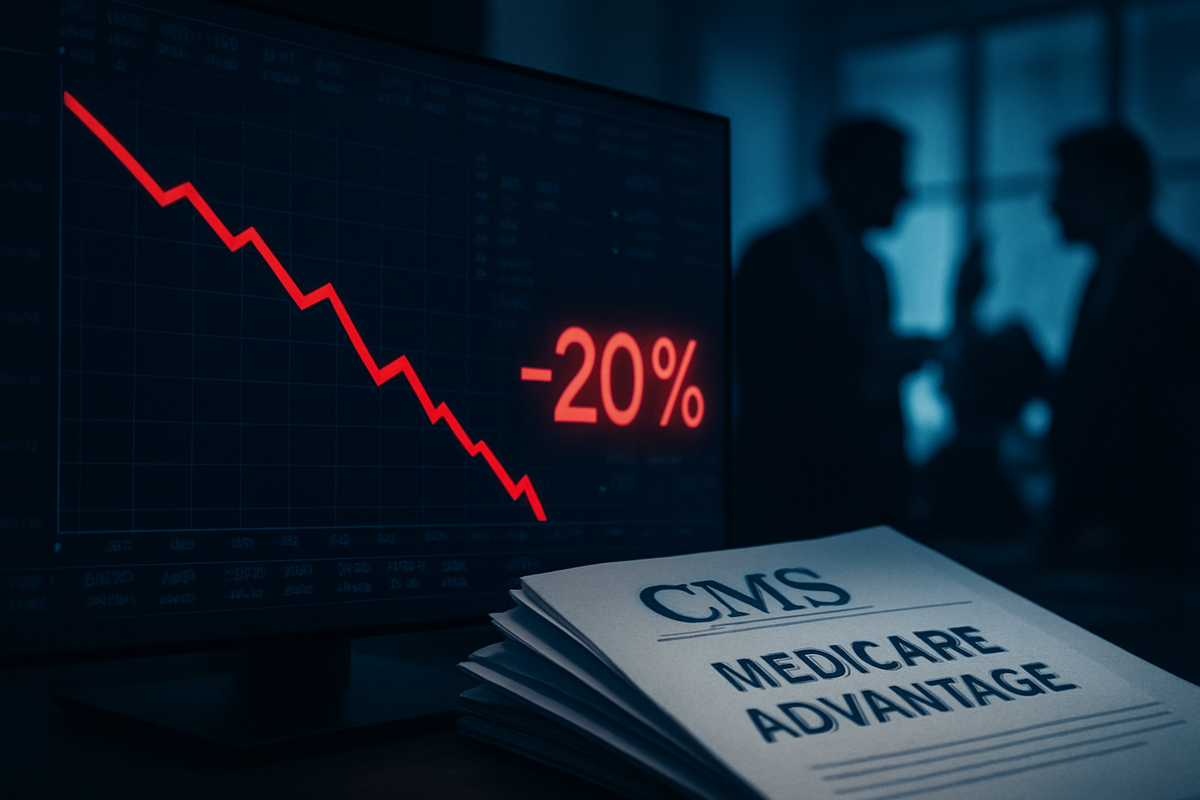
In a historic blow to the managed care sector, UnitedHealth Group (NYSE: UNH) saw its stock price plunge nearly 20% on Tuesday, marking its worst single-day performance in over three decades. The massive selloff, which erased approximately $80 billion in market value, was triggered by a surprisingly lean 2027 Advance Notice from the Centers for Medicare & Medicaid Services (CMS). The agency proposed a meager 0.09% "headline" increase in Medicare Advantage (MA) payment rates—a figure that caught Wall Street completely off guard and signaled a sharp pivot in federal reimbursement policy.
The immediate implications are staggering, as UnitedHealth’s collapse dragged the Dow Jones Industrial Average down by more than 330 points. Beyond the immediate stock ticker volatility, the announcement has ignited a fierce debate over the long-term viability of the Medicare Advantage program, which serves more than half of all eligible Medicare beneficiaries. Analysts and industry leaders are now warning of a "new era of austerity" for private insurers, potentially leading to reduced benefits for seniors and the abandonment of less profitable geographic markets.
A "Toxic Mix" of Regulatory Pressure and Rising Costs
The catalyst for the volatility began on the afternoon of Monday, January 26, 2026, when CMS released its preliminary payment rates for the 2027 calendar year. While investors and industry analysts had conservatively modeled an increase of 4% to 6%, the agency’s announced 0.09% base rate hike was essentially a "flat" adjustment that fails to keep pace with the current 3.5% rate of medical inflation. Although CMS Administrator Dr. Mehmet Oz pointed to an "all-in" revenue change of 2.54% when accounting for risk adjustment coding, the market fixated on the headline number as a clear signal of regulatory tightening.
The timing of the announcement created a "perfect storm" for UnitedHealth Group. The CMS update coincided with the company’s fourth-quarter 2025 earnings report, which revealed a stubbornly high Medical Care Ratio (MCR) of 88.9%. This metric indicated that the cost of providing care for seniors remained significantly elevated throughout late 2025, even as government reimbursement looks set to stagnate. Furthermore, UnitedHealth issued a rare revenue warning for 2026, projecting a 2% decline—the first such contraction for the healthcare giant since 1989.
The reaction from UnitedHealthcare leadership was swift and critical. CEO Tim Noel characterized the 0.09% rate as a figure that "simply doesn't reflect the reality of medical utilization or the complexity of the patients we serve." Industry advocates argued that the methodology used by CMS undercounts the true cost of care, setting the stage for a contentious comment period before the rates are finalized in April.
The Managed Care "Bloodbath": Winners and Losers
The fallout from the CMS announcement was not contained to UnitedHealth alone; it sparked a sector-wide contagion that left no major Medicare Advantage player unscathed. Humana Inc. (NYSE: HUM), which has the highest relative exposure to Medicare Advantage among its peers, saw its shares plummet between 13% and 21% during Tuesday’s session. For Humana, the razor-thin rate increase represents an existential challenge to its margins, as the company is already grappling with higher-than-expected outpatient surgical volumes.
CVS Health Corporation (NYSE: CVS), the parent company of Aetna, and Elevance Health, Inc. (NYSE: ELV) were similarly hammered, both dropping roughly 14%. These companies are now facing the grim prospect of having to "right-size" their 2027 offerings, which often means cutting popular supplemental benefits like dental, vision, or gym memberships to protect their bottom lines. Even Centene Corporation (NYSE: CNC), which focuses more heavily on Medicaid, saw its stock slide in sympathy as investors fled the entire managed care space.
While there were few "winners" in the traditional sense, some market observers pointed to technology-driven cost containment firms and companies focused on traditional fee-for-service Medicare support as potential beneficiaries of a shift away from private MA plans. However, for the majority of the healthcare ecosystem, the lack of government funding represents a net loss that will likely trickle down to providers and patients alike.
Regulatory Pivot and the End of the "Gold Rush"
The 2027 Advance Notice represents more than just a fiscal adjustment; it serves as a major policy statement from the current administration. Dr. Mehmet Oz defended the lean rates as a necessary move to "protect taxpayers from unnecessary spending" and to curb what the government perceives as "upcoding"—a practice where insurers report patients as being sicker than they are to trigger higher payments. This regulatory stance marks a definitive end to the "gold rush" era of Medicare Advantage, during which insurers enjoyed high double-digit growth and generous government subsidies.
Historically, CMS has used the Advance Notice as a starting point for negotiations, often raising the final rate slightly after lobbying from insurance groups. However, the 0.09% starting point is so far below previous precedents—such as the 5.06% hike for 2026—that even a modest upward revision in April is unlikely to satisfy investors. This shift aligns with a broader industry trend toward stricter "Value-Based Care" oversight, where the government is demanding more transparency and better outcomes for every dollar spent.
The ripple effects will likely extend to healthcare providers. If insurers receive less from the government, they will inevitably squeeze the reimbursement rates they pay to hospitals and physician groups. This could exacerbate the financial strain on rural hospitals and specialist clinics that rely heavily on Medicare Advantage patient volume.
Strategic Pivots: Navigating a Lean 2027
Looking ahead, UnitedHealth and its competitors are expected to undergo significant strategic pivots to adapt to this lower-funding environment. In the short term, companies will likely focus on "benefit design discipline," which is industry shorthand for reducing the richness of their plans. Investors should expect to see higher premiums for 2027 and a possible exit from hundreds of counties where the 0.09% rate makes the business model mathematically non-viable.
In the long term, the focus will shift toward automation and AI-driven efficiency to lower administrative costs. UnitedHealth’s Optum division may become even more central to the company’s strategy, as it seeks to capture more value by owning the doctors and clinics that provide the care, rather than just acting as the insurer. However, these "payvider" models are also under increasing regulatory scrutiny, leaving the path to growth narrow and fraught with obstacles.
The next critical milestone for the market will be the release of the Final Rate Announcement in early April 2026. Until then, volatility is expected to remain high as the industry engages in what is expected to be the most aggressive lobbying campaign in the history of the Medicare Advantage program.
Conclusion: A Paradigm Shift for Healthcare Investors
The 20% collapse of UnitedHealth Group serves as a stark reminder of the "stroke-of-the-pen" risk inherent in the heavily regulated healthcare sector. The 2027 CMS rate notice has fundamentally reset expectations for the managed care industry, moving from an era of expansion to one of consolidation and cost-cutting. Key takeaways for investors include the realization that the federal government is serious about curbing Medicare spending and that the "coding" tailwinds that previously boosted revenue are being systematically dismantled.
Moving forward, the market will be watching for two things: the final CMS rates in April and the subsequent "bid" season in June, where insurers will reveal exactly how much they plan to cut benefits. The lasting impact of this week’s selloff may be a permanent de-rating of managed care stocks, as the visibility into long-term profit margins has been significantly clouded. For now, the "United" front of the insurance industry faces its greatest challenge yet: proving it can still deliver value to shareholders while the government tightens the purse strings.
This content is intended for informational purposes only and is not financial advice.