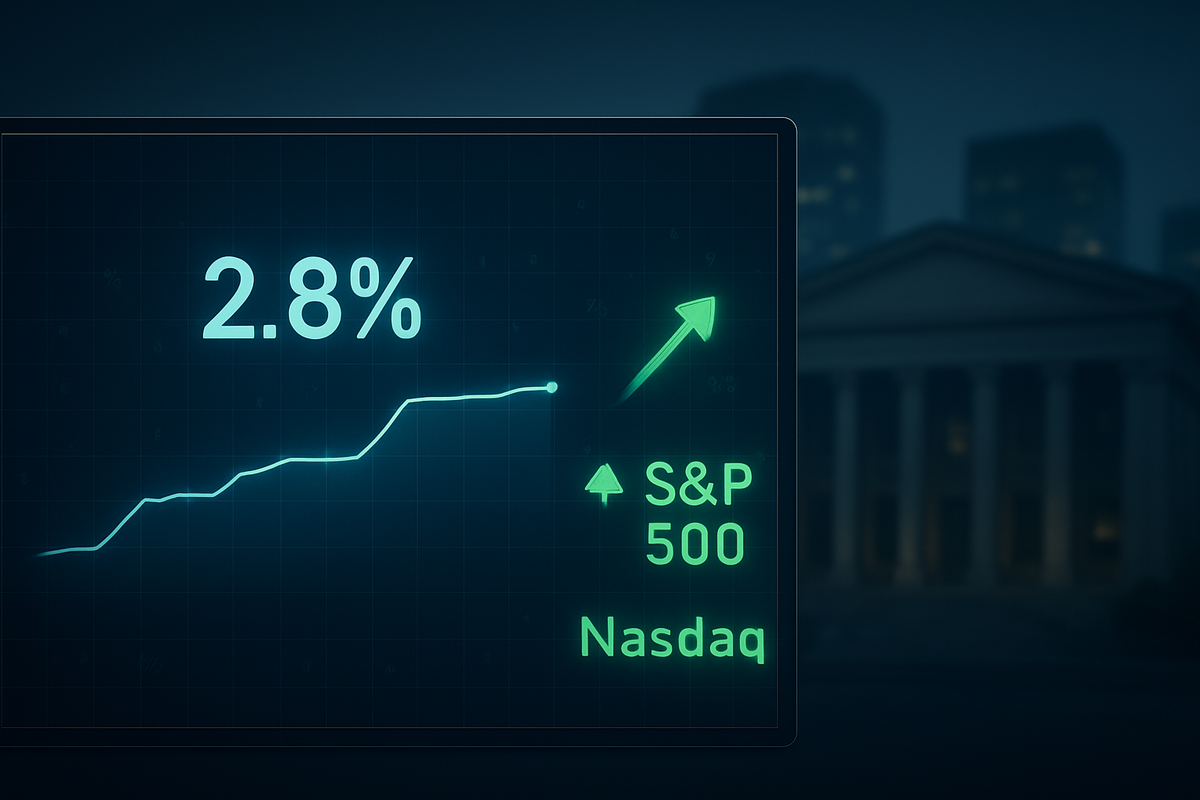
As the Federal Reserve convenes for its first policy meeting of 2026, investors are breathing a collective sigh of relief. The latest Personal Consumption Expenditures (PCE) price index—the central bank’s preferred metric for measuring inflation—held steady at a 2.8% annual rate. While this figure remains stubbornly above the Fed's 2.0% target, its stability in the face of recent economic volatility has sparked a "risk-on" rally across equity markets, signaling that the much-feared inflationary re-acceleration may be avoided for now.
The 2.8% reading, released by the Bureau of Economic Analysis (BEA), met consensus expectations and provided a much-needed anchor for a market recently unsettled by geopolitical tensions and trade policy shifts. With the data confirming that inflation has plateaued rather than spiked, the S&P 500 and the tech-heavy Nasdaq have moved higher, as traders interpret the "sticky" data as a sign that the economy is resilient enough to handle "higher-for-longer" interest rates without slipping into a deep recession.
A Plateau in the 'Last Mile': Inside the January PCE Report
The PCE report released in late January 2026 was one of the most anticipated data points in recent memory, coming on the heels of a disruptive 43-day government shutdown that had previously clouded economic visibility. According to the BEA, both headline and core PCE (which excludes volatile food and energy costs) rose 2.8% year-over-year for the most recent reporting period. This marked a slight uptick for the headline figure from 2.7% in the previous month, while core inflation remained unchanged, reinforcing the narrative that price pressures have hit a structural floor.
The timeline leading to this release was fraught with uncertainty. Throughout late 2025, a "data fog" caused by the federal shutdown left analysts at firms like Deutsche Bank (NYSE: DB) and Morgan Stanley (NYSE: MS) guessing at the true state of the economy. When the BEA finally cleared the backlog this month, the 0.2% month-over-month increase in core prices suggested that while the "easy" gains in the fight against inflation are over, the situation is not spiraling out of control. This stability was further supported by a 0.5% increase in personal consumption, indicating that American consumers are still spending, particularly in the services sector, which saw a 3.4% year-over-year jump.
Market reaction was swift and positive. On the day of the release, the S&P 500 rose 0.76%, while the Nasdaq Composite outperformed with a gain of over 1.1%. Investors seem to have found comfort in the predictability of the 2.8% figure. The 10-year Treasury yield, which had been flirting with 4.30% due to a recent "tariff scare," retreated to a more stable 4.25%, suggesting that the fixed-income market is beginning to price in a period of relative calm, even if rate cuts remain on the distant horizon.
Winners and Losers: Tech Leads While Fixed Income Fret
The "sticky but stable" inflation data has created a distinct set of winners in the equity space. Large-cap technology firms, which have spent the last year optimizing for a higher-rate environment, were the primary beneficiaries of the "risk-on" sentiment. Microsoft Corporation (NASDAQ: MSFT) and NVIDIA Corporation (NASDAQ: NVDA) saw their shares climb as the market grew more confident that the Fed would not need to enact further emergency hikes to squash the remaining 0.8% of excess inflation. For these growth-oriented giants, the removal of the "inflationary spike" tail-risk is as good as a rate cut.
On the other hand, the real estate and traditional banking sectors continue to face headwinds. With the Fed likely to maintain the federal funds rate in the 3.50%–3.75% range through the first half of 2026, mortgage rates are unlikely to see significant downward movement. Companies like JPMorgan Chase & Co. (NYSE: JPM) are navigating a complex landscape where high interest margins are offset by cooling loan demand. Similarly, long-term bondholders are finding little to celebrate; the persistence of 2.8% inflation means that "real" yields remain compressed, and those betting on a rapid return to 2% are being forced to recalibrate their portfolios.
Meanwhile, safe-haven assets are telling a more cautious story. Gold reached a fresh all-time high of over $4,930 an ounce during the same week as the PCE release. This indicates that while equity investors are cheering the stability of 2.8%, a segment of the market remains concerned that the Fed may never actually reach its 2% goal, opting instead to "settle" for a higher inflationary regime.
The 'Higher for Longer' Marathon: Wider Economic Significance
The significance of the 2.8% PCE reading lies in its confirmation of the "Last Mile" theory. Economists have long warned that bringing inflation down from 9% to 3% would be easier than the journey from 3% to 2%. This report suggests that the U.S. has officially entered the most grueling phase of that journey. This "plateau" at 2.8% fits into a broader global trend where supply chain reshoring and a tight labor market have created a higher "inflationary floor" than what was seen in the pre-pandemic era.
Historically, this period draws comparisons to the late 1970s, though with a crucial difference: the current Fed, led by Chair Jerome Powell, has maintained a much more transparent and aggressive stance to prevent inflation expectations from becoming unanchored. The current 2.8% rate is a far cry from the double-digit "stagflation" of the past, but the "stickiness" in services inflation—driven by wage growth—remains a concern for policy hawks.
Furthermore, the "Greenland framework" and recent trade policy discussions have introduced new variables. Potential tariffs and shifting trade alliances are acting as inflationary pressures that the Fed cannot control with interest rates alone. This creates a policy dilemma where the central bank must decide whether to continue squeezing the economy to hit an arbitrary 2% target or to accept 2.8% as the new "neutral" in a fragmenting global economy.
Looking Ahead: The June Pivot and the Data Fog
In the short term, all eyes are on the Federal Open Market Committee (FOMC) meeting concluding today, January 28, 2026. Market probability trackers now show a 95% chance that the Fed will hold rates steady. The "higher-for-longer" narrative has been pushed even further out, with many analysts now eyeing June 2026 as the earliest possible window for a rate cut. The Fed is expected to maintain its "well-positioned to wait and see" stance, as Chair Powell recently phrased it, prioritizing data dependency over preemptive action.
Strategic pivots will be required for both companies and investors in the coming months. Corporations will need to focus on efficiency and margin preservation, as the ability to pass on further price increases to consumers may be reaching its limit. For investors, the opportunity lies in identifying "inflation-resilient" growth stocks—companies that can grow earnings even if the cost of capital remains elevated. The challenge remains the potential for a "lagged effect" from the previous years' rate hikes to finally slow consumer spending more sharply than intended.
Final Thoughts: A New Normal for the Markets
The January PCE report confirms that the U.S. economy is in a state of high-altitude stability. A 2.8% inflation rate is neither a disaster nor a victory; it is a signal of a mature, albeit stubborn, economic cycle. For the market, the removal of extreme volatility is a catalyst for growth, even if the "easy money" era remains a relic of the past.
As we move forward into 2026, the key takeaway for investors is that "sticky" is the new "stable." The market has accepted that the journey to 2% will be a marathon, not a sprint. The critical factors to watch in the coming months will be the strength of the labor market and the resilience of corporate earnings during the Q1 reporting season. If the economy can continue to grow at this level of inflation without a spike, the "soft landing" that once seemed impossible may finally be within reach.
This content is intended for informational purposes only and is not financial advice