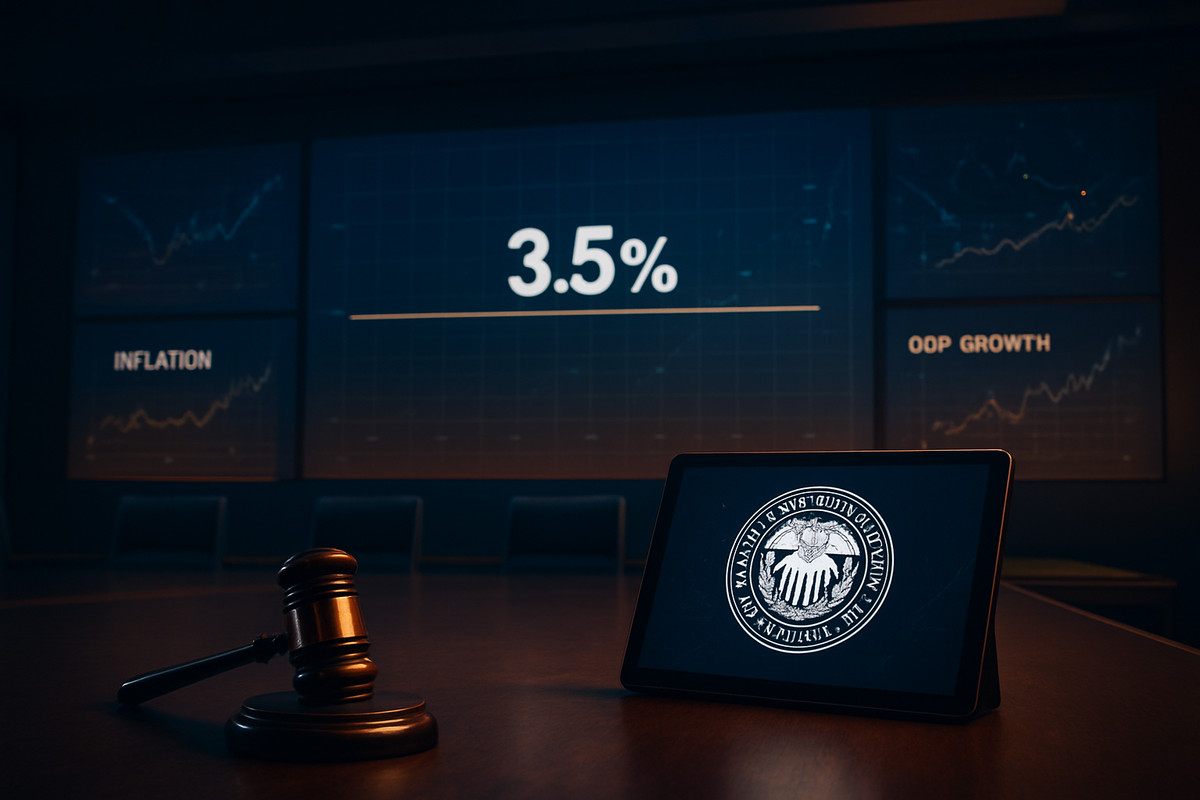
In a widely anticipated move that underscores the complexity of the current economic landscape, the Federal Reserve’s Federal Open Market Committee (FOMC) voted today, January 28, 2026, to maintain the federal funds rate at a target range of 3.50% to 3.75%. This "hawkish hold" marks a definitive pause in the easing cycle that began in the final months of 2025, signaling that the central bank is prepared to wait for clearer signs of cooling inflation before providing further relief to the economy.
The immediate implications are a "wait-and-see" environment for investors and consumers alike. While the markets had largely priced in a pause—with the CME FedWatch Tool showing a 97% probability of no change—the decision reflects a delicate balancing act. Federal Reserve Chair Jerome Powell, in his post-meeting press conference, emphasized that while the era of aggressive tightening is over, the path to the Fed’s 2.0% inflation target remains "bumpy," requiring a period of high-interest rates to ensure price stability does not slip away.
A 10-2 Split: Navigating the "Sticky" Last Mile
The January 2026 FOMC meeting was not without internal friction, revealing growing philosophical divides within the central bank. The committee voted 10–2 to hold rates steady, with Governors Stephen Miran and Christopher Waller casting dissenting votes. Both dissenters argued for a further 25-basis-point cut, citing a sharp slowdown in hiring and the lingering economic scars from the brief government shutdown in late 2025. This internal disagreement suggests that the consensus for a "higher-for-longer" stance is beginning to fray as the labor market shows signs of softening.
The timeline leading to this decision has been a volatile one. After a series of "insurance cuts" totaling 75 basis points in September, October, and December 2025, many expected the Fed to continue its descent toward a neutral rate. However, recent data has complicated the narrative. The December 2025 Consumer Price Index (CPI) report showed headline inflation at 2.7%, with core inflation stuck at 2.6%—levels that have remained stubbornly stagnant for several months. Chair Powell noted that while progress has been made, the "last mile" of inflation reduction is proving to be the most difficult, largely driven by persistent shelter costs and rising utility prices.
Market reactions were relatively clinical, as the "priced-in" nature of the decision prevented a broad sell-off. However, the tone of Powell’s press conference shifted the focus from when the next cut will happen to if it will happen before the second half of the year. Powell was firm on the Fed's independence, pushing back against political pressure and emphasizing that policy will remain strictly data-dependent. This stance effectively pushed back analyst expectations for the next rate cut to at least June or July 2026.
Winners and Losers: The Great Divergence
The "hawkish hold" has created a stark divide between sectors capable of thriving in a high-cost-of-capital environment and those weighed down by it. Large-cap financial institutions emerged as the day's clear winners. JPMorgan Chase & Co. (NYSE: JPM) saw its stock rise 1.12% to close near $301, as investors anticipate sustained Net Interest Margins (NIM) in the 3.5%–3.75% range. Similarly, Bank of America Corp. (NYSE: BAC) stabilized at $52.20, with analysts projecting 5%–7% growth in net interest income for 2026, benefiting from the stable yield curve.
In the technology sector, the reaction revealed a "decoupling" of AI-centric titans from interest rate sensitivities. Microsoft Corp. (NASDAQ: MSFT) climbed 2.19% to $480.58, buoyed by strong fiscal Q2 2026 earnings and massive enterprise demand for AI services. NVIDIA Corp. (NASDAQ: NVDA) followed suit, advancing 1.34% to $191.06. For these companies, the "AI Supercycle" and robust cash flows have rendered traditional rate concerns secondary to their massive capital expenditure and growth trajectories. Analysts now view these firms as "recession-proof" pillars of the 2026 economy.
Conversely, the real estate and regional banking sectors faced renewed pressure. Real Estate Investment Trusts (REITs) like American Tower Corp. (NYSE: AMT) and Prologis, Inc. (NYSE: PLD) struggled, with AMT shares remaining volatile and PLD sliding 0.57% to $126.43. The persistence of rates above 3.5% maintains a high floor for financing costs, curbing expansion plans for tower infrastructure and industrial warehouses. Meanwhile, regional players like Regions Financial Corp. (NYSE: RF) and Capital One Financial Corp. (NYSE: COF) saw increased volatility, as analysts warned that a sustained "higher-for-longer" environment could eventually strain commercial real estate (CRE) portfolios and small business borrowers.
The AI Anomaly and Historical Precedents
The current economic landscape is historically unique, characterized by what some economists are calling "jobless growth" or an "AI-driven buffer." Despite a cooling labor market with unemployment at 4.4%, the US economy showed surprising resilience with a Q3 2025 GDP growth rate of 4.4%. This strength is largely attributed to massive productivity gains and investments in artificial intelligence, which have allowed the economy to expand even as traditional job gains have slowed to a sluggish 50,000 per month.
This situation echoes the mid-1990s, where productivity gains from the early internet era allowed the Fed to maintain relatively high rates without triggering a recession. However, the 2026 context is complicated by fiscal volatility and the looming threat of new tariffs, which could reignite inflationary pressures. The Fed's current "strategic plateau" is an attempt to avoid the mistakes of the 1970s, where premature rate cuts led to a second wave of inflation. By holding steady now, Powell is signaling that the Fed would rather risk a mild slowdown than a resurgence of price instability.
Furthermore, the broader industry trend shows a shift toward fiscal dominance. With the Trump administration and Congress engaged in significant fiscal stimulus and trade restructuring, the Fed’s role has shifted from the primary driver of the economy to a "stabilizing brake." The "hawkish hold" serves as a reminder that while the government may be pushing for growth, the central bank remains the ultimate arbiter of the currency's value.
The Road to Summer 2026: What Comes Next?
Looking ahead, the Federal Reserve is unlikely to move rates in either direction for the next several months. The short-term strategy for corporations will likely focus on "optimizing for 3.5%," as the hope for a return to the near-zero rates of the previous decade has all but evaporated. Strategic pivots are already underway; companies that relied on cheap debt for expansion are moving toward leaner operations, while cash-rich entities are looking for acquisition opportunities among struggling mid-cap competitors.
The potential for a "soft landing" remains the base case, but the risks are tilted toward the labor market. If unemployment continues to drift higher toward 5.0% without a corresponding drop in core inflation, the Fed will face a "stagflationary" dilemma that would require a much more aggressive policy shift. Conversely, if AI-driven productivity continues to boost GDP while cooling the labor market naturally, the Fed may be able to hold rates at this plateau for the remainder of 2026.
Market participants should watch for potential "credit cracks" in the commercial real estate sector and the upcoming spring 2026 inflation readings. Any surprise dip in Core PCE (Personal Consumption Expenditures) below 2.3% could provide the cover needed for the FOMC to resume cuts in the summer. Until then, the market is likely to remain in a state of "selective bullishness," where earnings quality and balance sheet strength are more important than general market momentum.
Wrap-Up: A Policy of Patience
The Federal Reserve's decision to hold rates steady on January 28, 2026, represents a calculated pause in an era of high economic uncertainty. By choosing the "strategic plateau," Jerome Powell and the FOMC have prioritized the long-term goal of 2.0% inflation over the short-term pressure for monetary relief. The decision highlights the Fed’s commitment to institutional independence and its cautious approach to a "mixed-signal" economy where AI-driven growth coexists with a softening labor market.
For investors, the key takeaway is that the "Fed pivot" is currently on ice. The market has moved into a more discerning phase where winners are defined by their ability to generate cash flow regardless of borrowing costs. The success of the "Mega-Cap" tech sector suggests that the economy is evolving to handle higher rates, but the vulnerability of REITs and regional banks serves as a warning that the transition is not yet complete.
As we move further into 2026, the focus will remain on the labor market and the Fed's "data-dependent" triggers. Investors should maintain a defensive posture in rate-sensitive sectors while looking for opportunities in companies that can leverage productivity gains to offset the "higher-for-longer" reality. The Fed has laid its cards on the table; now, the market must decide how to play the hand.
This content is intended for informational purposes only and is not financial advice.