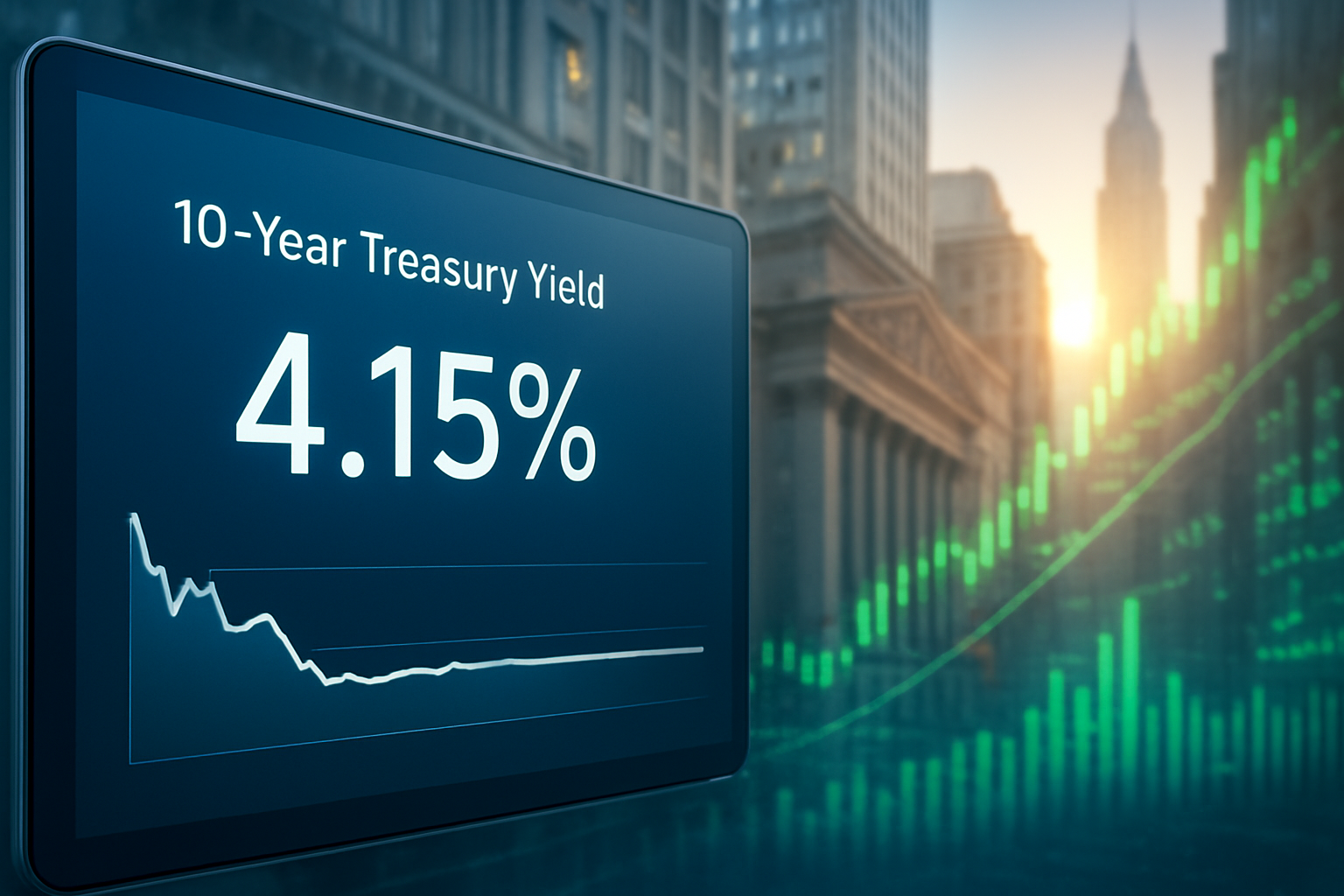
As the first two weeks of 2026 draw to a close, the financial markets have found an unlikely hero in the form of the benchmark 10-year Treasury yield. Holding steady at approximately 4.15%, the yield has provided a "Goldilocks" environment—neither too hot to trigger valuation fears nor too cold to signal economic recession—allowing the S&P 500 and Nasdaq to extend their year-end momentum into a robust January rally.
This newfound stability in the fixed-income market is acting as a critical anchor for risk assets. With the volatility that plagued 2024 and 2025 seemingly in the rearview mirror, investors are shifting their focus from interest rate anxiety toward corporate earnings growth. The predictability of the 4.15% level has allowed institutional desks to price equities with greater confidence, leading to a broadening of the market rally beyond just the traditional technology titans.
The Path to 4.15%: A Story of Resilience and Calibration
The journey to the current 4.15% yield was paved by a series of strategic maneuvers by the Federal Reserve in the final quarter of 2025. Following a period of "higher for longer" rhetoric, the Fed delivered three consecutive 25-basis-point cuts in late 2025 to preempt a cooling labor market. These "insurance cuts" successfully guided the economy toward the elusive "soft landing," with real GDP growth for early 2026 currently tracking at a resilient 2.1%.
By the time markets opened on January 2, 2026, the 10-year yield had settled into a tight range between 4.10% and 4.20%. This stabilization followed a mid-2025 peak where yields flirted with 5% on fears of re-accelerating inflation. However, as the Consumer Price Index (CPI) moderated to a steady 2.8% range, the "inflation premium" embedded in long-term bonds began to evaporate. The initial market reaction in the first two weeks of January has been one of relief, with the CBOE Volatility Index (VIX) dropping to its lowest level in eighteen months.
Market stakeholders, including major asset managers like BlackRock and Vanguard, have noted that the "bull steepening" of the yield curve—where short-term rates fall faster than long-term rates—is a classic signal of early-cycle expansion. This shift has encouraged a return of capital to the equity markets, as the "fear of missing out" (FOMO) replaces the "fear of the Fed" that dominated the previous two years.
Sector Winners: Tech, Finance, and the Real Estate Rebound
The primary beneficiaries of this stable rate environment are the growth-oriented sectors, led by the "Magnificent Seven" and their AI-centric peers. Microsoft (NASDAQ: MSFT) and Amazon (NASDAQ: AMZN) have seen significant inflows as the cost of capital for their massive AI infrastructure projects becomes more predictable. Meanwhile, the semiconductor space remains white-hot, with Nvidia (NASDAQ: NVDA) and Micron Technology (NASDAQ: MU) capitalizing on a surge in demand for data center upgrades, further bolstered by the absence of "rate shock" that typically punishes high-multiple stocks.
The financial sector is also experiencing a renaissance. Large-cap banks, most notably JPMorgan Chase (NYSE: JPM), which recently crossed a record $900 billion market capitalization, are benefiting from an un-inverted yield curve. This allows banks to borrow at lower short-term rates and lend at the higher 10-year benchmark, significantly boosting Net Interest Margins (NIM). Investment banks like Goldman Sachs (NYSE: GS) and Morgan Stanley (NYSE: MS) are reporting a "thawing" of the M&A and IPO pipelines, as corporate boards feel more comfortable executing deals in a stable rate environment.
Even the beleaguered real estate sector is showing signs of life. With the 10-year yield holding at 4.15%, mortgage rates have stabilized near 6.2%, enticing buyers back into the residential market. Homebuilders and commercial REITs such as Prologis (NYSE: PLD) are seeing renewed interest as the "maturity wall" of debt refinancing appears less daunting at these levels. Investors are increasingly viewing real estate not just as a defensive play, but as a tactical growth opportunity for the 2026 calendar year.
Beyond the Numbers: The Rebirth of Diversification
The current yield environment marks a significant shift in broader industry trends, most notably the return of the classic 60/40 portfolio. For years, the lack of "real yield"—nominal yield minus inflation—made bonds an unattractive hedge for equities. However, with the 10-year at 4.15% and inflation at 2.8%, investors are finally seeing a positive real yield of roughly 1.35%. This has revitalized the case for diversification, drawing "dry powder" from money market funds back into intermediate-term Treasuries and corporate bonds.
This stability also has global ripple effects. As the U.S. 10-year yield holds steady, it provides a floor for the U.S. Dollar, maintaining its strength against the Euro and Yen without the disruptive volatility seen in 2024. This allows multinational companies to forecast their currency-adjusted earnings with greater precision. Historically, similar periods of yield stability—such as the mid-1990s—preceded prolonged periods of equity outperformance, a precedent that many analysts are now citing as a roadmap for the current decade.
From a policy perspective, the 4.15% yield is a testament to the Fed's successful communication strategy. By signaling a pause in early 2026, the central bank has managed to keep long-term inflation expectations anchored. This is particularly crucial as the market eyes the upcoming transition of the Federal Reserve Chairmanship in May 2026, with the current yield levels suggesting that investors expect a "steady hand" successor to Jerome Powell.
The Horizon: What Lies Ahead for Investors
Looking toward the remainder of 2026, the short-term outlook remains bullish, though not without potential pitfalls. The market is currently pricing in a "pause and assess" period for the Fed through the first half of the year. The primary strategic pivot for investors will be moving away from "cash is king" strategies and toward duration in fixed income and quality growth in equities. The opportunity cost of sitting in 5% cash is rising as the equity rally broadens.
However, challenges remain. Any unexpected spike in energy prices or a reversal in the cooling of services inflation could force yields back toward the 4.5% level, which would likely stall the equity rally. Additionally, the geopolitical landscape remains a wildcard, with a $1.5 trillion defense budget target for 2027 already influencing the valuations of defense giants like BAE Systems (OTCPK:BAESY). Investors should be prepared for potential volatility spikes around the Fed leadership transition in late spring.
The Wrap-Up: A Market in Equilibrium
In summary, the 10-year Treasury yield at 4.15% has become the "linchpin" of the early 2026 market narrative. It represents a hard-won equilibrium between growth and inflation, providing the necessary clarity for a sustainable equity rally. The move away from the high-volatility regime of the previous two years is perhaps the most significant takeaway for the public, signaling a return to more traditional market dynamics where fundamentals—rather than just Fed speeches—drive prices.
As we move forward, the market appears positioned for continued growth, but the margin for error is slim. The "Goldilocks" environment depends heavily on inflation staying within its current 2.7%–3.0% range and the labor market remaining in its state of "stable stasis." Investors should watch for the February inflation data and any shifts in Fed rhetoric regarding the "terminal rate," as these will be the next major tests for the 4.15% yield anchor. For now, the "diversification case" is back in vogue, and the early 2026 rally has plenty of room to run.
This content is intended for informational purposes only and is not financial advice.