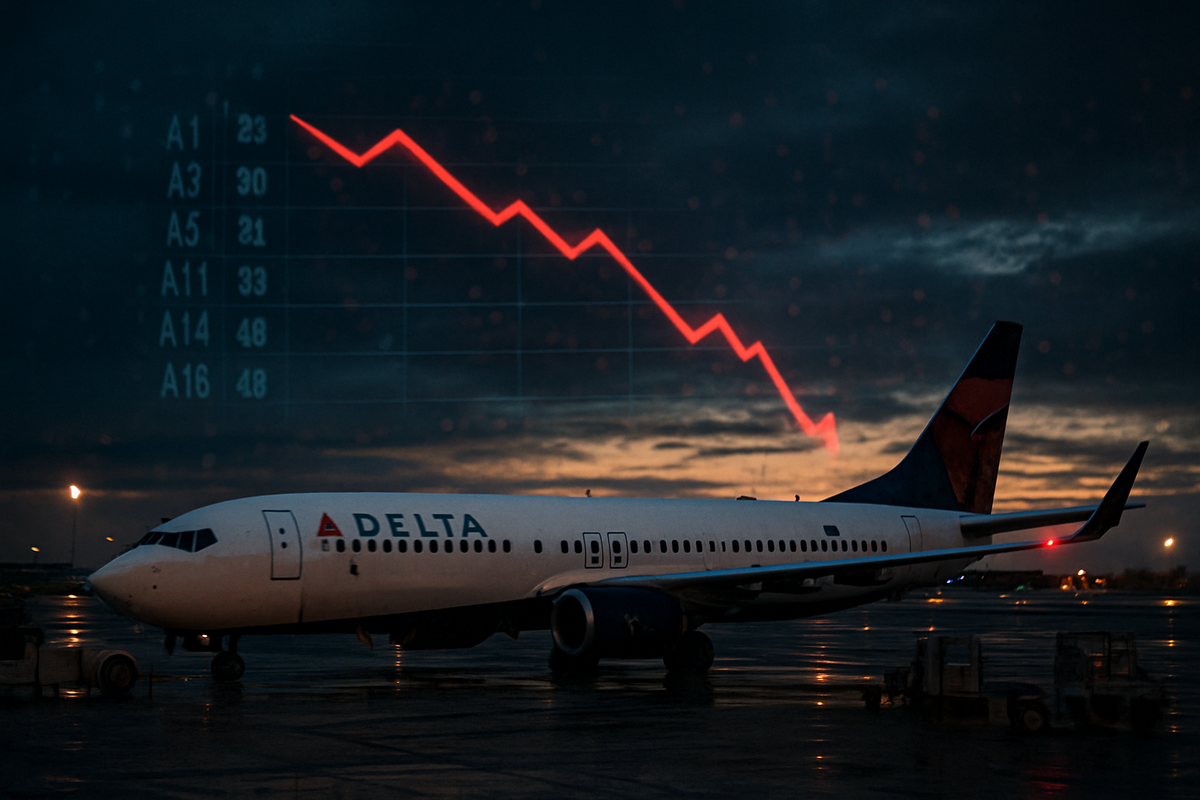
ATLANTA — Shares of Delta Air Lines (NYSE: DAL) tumbled more than 5% on Tuesday after the carrier released its fourth-quarter 2025 earnings report. While the airline managed to post record annual revenue and narrowly beat earnings expectations for the final quarter of the year, a combination of cautious forward-looking guidance and the lingering financial scars from a late-year government shutdown left investors heading for the exits.
The market reaction highlights a growing divide in the aviation industry, where high-end "premium" travel continues to flourish while the broader, price-sensitive consumer market shows signs of significant fatigue. Delta’s report, traditionally a bellwether for the sector, has raised immediate concerns about the health of the travel industry heading into 2026, as rising labor costs and new trade tariffs begin to squeeze profit margins across the board.
Turbulence in the Numbers: A Mixed Q4 Performance
On the morning of January 13, 2026, Delta Air Lines reported an adjusted earnings per share (EPS) of $1.55 for the fourth quarter of 2025, slightly exceeding the analyst consensus of $1.53. Total operating revenue for the quarter reached $16.0 billion, a 2.9% increase year-over-year. However, the underlying metrics told a more complicated story. Adjusted revenue came in at $14.61 billion, missing the $14.68 billion expected by Wall Street, and operating margins contracted to 9.2% from 11.0% in the same period the previous year.
The primary culprit for the immediate stock slide was the company’s outlook for 2026. Delta projected full-year earnings between $6.50 and $7.50 per share, with the midpoint significantly trailing the analyst consensus of $7.32. Management also revealed that a 43-day U.S. government shutdown in late 2025 had a far more damaging impact than previously estimated, resulting in a $200 million pre-tax profit headwind. This disruption caused tens of thousands of flight cancellations and shaved two percentage points off domestic revenue growth during the critical holiday travel season.
Furthermore, a stark divergence in passenger spending emerged. While Delta’s premium cabin revenue—a cornerstone of its long-term strategy—surged by 9%, main-cabin ticket revenue plummeted by 7%. This "K-shaped" demand profile suggests that while affluent travelers are still willing to pay for luxury, the average consumer is increasingly priced out or opting for cheaper alternatives, a trend that threatens the airline's traditional volume-based revenue streams.
Winners and Losers in a Shifting Sky
The fallout from Delta’s earnings report sent shockwaves through the airline sector, but the impact was not uniform. Delta Air Lines (NYSE: DAL) itself was the primary loser of the day, seeing its market capitalization shrink as investors recalibrated their growth expectations. However, the report also cast a shadow over low-cost carriers (LCCs) such as Southwest Airlines (NYSE: LUV) and JetBlue Airways (NASDAQ: JBLU). Analysts worry that if a giant like Delta is seeing a 7% drop in main-cabin revenue, budget-focused airlines with thinner margins may face an even more existential threat from declining consumer purchasing power.
Conversely, The Boeing Company (NYSE: BA) emerged as a surprising beneficiary of the day's strategic announcements. Despite the earnings gloom, Delta announced a massive commitment to modernize its fleet by ordering 30 Boeing 787-10 widebody aircraft, with options for 30 more. This deal provides a much-needed boost to Boeing’s long-haul order book and signals Delta’s intent to double down on fuel efficiency and international premium capacity, even as domestic markets soften.
Major competitors like United Airlines (NASDAQ: UAL) and American Airlines (NASDAQ: AAL) saw their shares dip in sympathy with Delta, but they may find a silver lining if they can prove their own premium strategies are more resilient. United, in particular, has been locked in a race with Delta for the title of the nation’s premier "lifestyle" airline. If United’s upcoming report shows better control over non-fuel unit costs, it could potentially peel away investors looking for a more stable alternative in the legacy carrier space.
Macro Pressures and the "Premium" Pivot
Delta’s current predicament is a reflection of broader industry trends that have been building throughout 2025. The airline industry is currently grappling with a "triple threat" of rising costs: labor, supply chain, and environmental regulations. Delta’s non-fuel unit costs (CASM-Ex) rose 4% in the fourth quarter, driven largely by a series of annual pay raises for non-union employees and the increased cost of aircraft parts.
The introduction of new U.S. trade tariffs in early 2025 has also begun to bite. These tariffs have not only increased the cost of imported components for maintenance but have also dented general consumer confidence. Delta management explicitly cited these "tariff shocks" as a contributing factor to the cooling demand in the main cabin. Additionally, the rising cost of Sustainable Aviation Fuel (SAF) and carbon offsetting requirements under the Carbon Offsetting and Reduction Scheme for International Aviation (CORSIA) are starting to become permanent fixtures on the balance sheet, pressuring long-term margins.
Historically, airlines have struggled to pass these types of structural cost increases onto consumers during periods of economic uncertainty. Delta’s pivot toward becoming a "premium-first lifestyle brand"—where premium products now account for 60% of total revenue—is a direct response to this challenge. By catering to a demographic that is less sensitive to price hikes, Delta hopes to insulate itself from the volatility of the mass market, though today’s stock drop suggests the market is skeptical about how quickly that transition can offset traditional headwinds.
Navigating the 2026 Horizon
Looking ahead, Delta faces a delicate balancing act. In the short term, the company must find ways to recapture the momentum lost during the government shutdown and stabilize its main-cabin revenue. Management has indicated a shift toward "efficiency over expansion," with capacity growth planned at a modest 3% for 2026. This conservative approach is designed to protect margins, but it also leaves the door open for competitors to snatch market share if demand recovers faster than anticipated.
In the long term, the delivery of the newly ordered Boeing 787-10s starting in 2031 will be a cornerstone of Delta’s strategy to lower its carbon footprint and improve operational reliability. However, the immediate challenge will be navigating the "K-shaped" economy. If the softness in main-cabin demand persists, Delta may be forced to rethink its pricing structures or introduce more aggressive loyalty program incentives to keep its planes full without further eroding its brand's premium luster.
Strategic pivots may also include a heavier reliance on non-ticket revenue, such as its partnership with American Express. As the airline moves toward its goal of becoming a "lifestyle brand," the high-margin revenue generated from credit card spend and loyalty partnerships will become even more critical to offsetting the rising costs of physical flight operations.
Summary and Investor Outlook
Delta’s Q4 2025 earnings report serves as a stark reminder that even record-breaking revenue cannot fully shield an airline from the realities of a shifting macroeconomic landscape. The combination of a $200 million hit from government instability, rising labor and tariff costs, and a cooling of the mass-market travel boom has created a perfect storm for the Atlanta-based carrier.
For investors, the key takeaway is that the "easy growth" of the post-pandemic travel surge has officially concluded. Moving forward, the market will likely reward airlines that can demonstrate rigorous cost control and a successful capture of the high-margin premium segment. Delta remains a leader in this regard, but its conservative 2026 guidance suggests that the climb ahead will be steep.
In the coming months, investors should closely watch the earnings reports of United and American Airlines to see if Delta’s main-cabin weakness is an isolated incident or an industry-wide contagion. Additionally, any further developments in trade policy or government stability will be paramount, as the airline industry remains uniquely vulnerable to the whims of both the consumer and the regulator.
This content is intended for informational purposes only and is not financial advice.