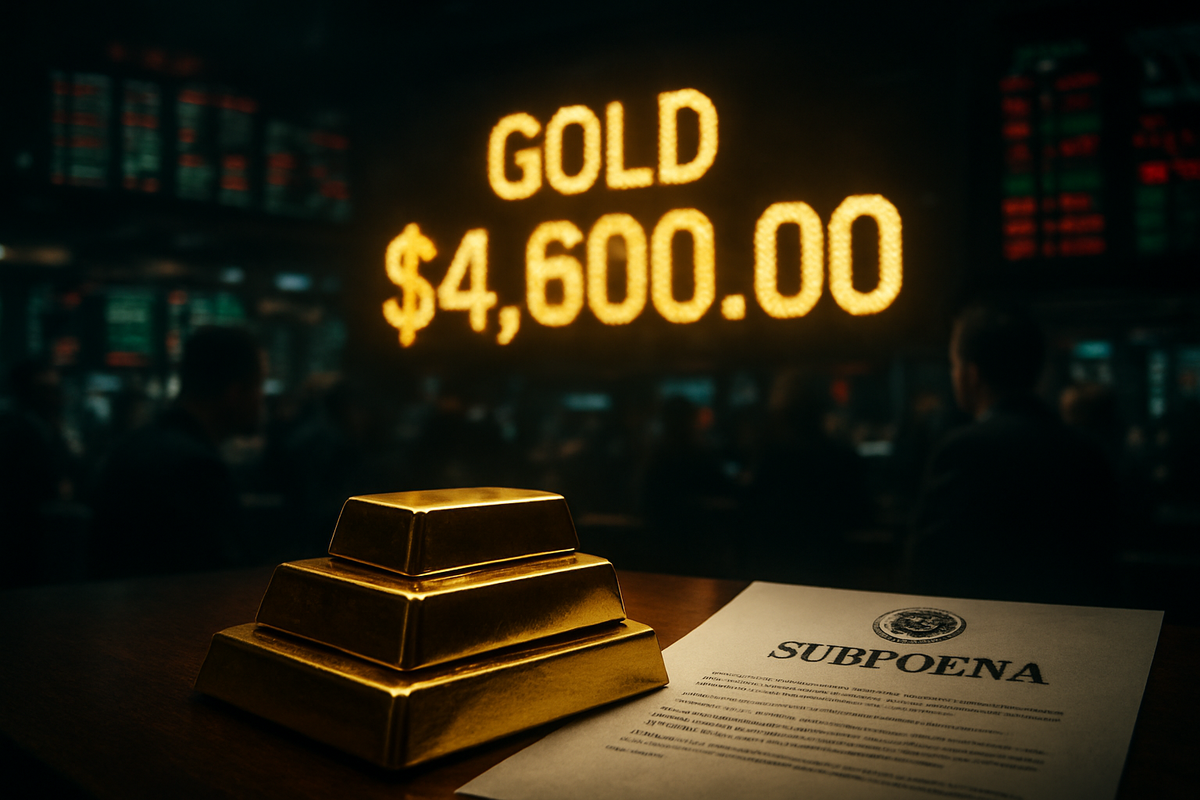
In an unprecedented day of trading that has fundamentally reshaped the global financial landscape, gold prices surged past the historic $4,600 per ounce milestone on January 12, 2026. This meteoric rise, representing a staggering 70% increase from 2024 levels, comes as a "perfect storm" of domestic political upheaval and escalating international conflict sends shockwaves through traditional markets. Investors are fleeing equities and the U.S. dollar in favor of hard assets, driven by a direct challenge to the independence of the U.S. Federal Reserve and the specter of a major regional war in the Middle East.
The immediate implications of this surge are profound, signaling a massive "debasement trade" where trust in fiat currency and institutional stability is rapidly eroding. As spot gold hit an intraday peak of $4,601.29, the U.S. dollar weakened significantly, and capital began hemorrhaging from major indices. The suddenness of the move has left analysts recalibrating their outlooks for the remainder of 2026, with many now viewing gold not just as a hedge, but as the primary anchor for global portfolios in an era of extreme volatility.
Political and Geopolitical Triggers
The catalyst for this historic rally was a dual-pronged crisis that reached a breaking point over the weekend. On January 11, 2026, news broke that Federal Reserve Chair Jerome Powell had been served with grand jury subpoenas by the U.S. Department of Justice (DOJ). The investigation officially centers on a $2.5 billion renovation of the Federal Reserve’s headquarters in Washington, D.C., with prosecutors alleging that Powell made false statements to Congress in June 2025 regarding the project’s spiraling costs. However, the market viewed this through a much more cynical lens.
In a defiant video statement released shortly after the news, Powell labeled the subpoenas a "pretext" for political intimidation. He suggested the legal action was a direct consequence of the Fed’s refusal to lower interest rates in line with the administration's demands, marking the most severe clash between the executive branch and the central bank in modern history. This perceived threat to the Fed's autonomy triggered an immediate $8 billion outflow from the SPDR S&P 500 ETF Trust (NYSE: SPY) within the first week of January, as investors feared a total breakdown of U.S. monetary credibility.
Simultaneously, the geopolitical situation in the Middle East deteriorated to its most dangerous level in decades. Deadly anti-government protests in Iran have resulted in over 500 deaths and a total internet blackout. The U.S. administration has publicly weighed "strong options," including potential military strikes, to support the uprising. Tehran, in turn, has threatened retaliatory strikes on U.S. military bases throughout the region. This tension was further compounded by the recent U.S. capture of Venezuelan leader Nicolás Maduro on drug-trafficking charges, an event that had already pushed energy and metal markets into a state of high alert.
Winners and Losers in the Metals Market
The primary beneficiaries of this price explosion are the world’s leading gold producers, whose profit margins are expanding at an astronomical rate. Newmont Corporation (NYSE: NEM) saw its stock price cross the psychological $100 barrier for the first time, trading near $108.97—a 178% increase over the trailing 12 months. Similarly, Barrick Gold (NYSE: GOLD) has seen its shares climb into the $39 to $48 range, with analysts projecting a 48% growth in earnings per share for the coming year. These companies are now generating record-breaking free cash flow, allowing for significant dividend hikes and aggressive debt reduction.
Agnico Eagle Mines (NYSE: AEM) has also emerged as a major winner, with shares climbing past $205. Investors are rewarding the company for its stable operational margins and lower-risk jurisdictions, which provide a safer exposure to the gold rally than peers with more volatile geographical footprints. Kinross Gold (NYSE: KGC) also logged substantial pre-market gains of over 3% as bullion hit the $4,600 mark, reflecting broad-based buying across the entire mining sector.
Conversely, the losers in this scenario include traditional banking institutions and consumer-facing sectors that are sensitive to rising inflation and a weakening dollar. The broader equity market, particularly tech and discretionary spending stocks, is facing a liquidity drain as capital rotates into the SPDR Gold Shares (NYSE: GLD) and physical bullion. Companies reliant on stable interest rate environments are now operating in a vacuum of uncertainty, as the subpoenas against Powell have cast doubt on the Federal Reserve's ability to function as a predictable arbiter of monetary policy.
Wider Significance and Historical Context
The significance of gold reaching $4,600 cannot be overstated; it represents a fundamental shift in how the market perceives the U.S. financial system. Historically, the Federal Reserve's independence has been the bedrock of the global economy. The DOJ's move to subpoena Powell creates a constitutional and financial precedent that rivals the 1971 "Nixon Shock" when the gold standard was abandoned. This event fits into a broader trend of "de-dollarization," where sovereign nations and institutional investors are diversifying away from U.S. Treasuries in favor of tangible assets that cannot be manipulated by political infighting.
The ripple effects are already being felt among U.S. allies and competitors. Central banks in Asia and Europe are reportedly increasing their gold reserves at the fastest pace since the 1960s, fearing that the U.S. political crisis could lead to a prolonged period of dollar instability. This is not merely a "flight to safety" in the traditional sense; it is a structural realignment of the global monetary order. The historical comparison most cited by market historians today is the stagflation era of the 1970s, though the current speed of the ascent suggests a much more compressed and violent transition.
Regulatory implications are also looming. With the Fed under legal fire, there are growing calls in Congress for a total overhaul of the Federal Reserve Act. Some lawmakers are even suggesting a return to a commodity-backed currency to restore trust. While such a move remains a distant possibility, the fact that it is being discussed in mainstream circles illustrates the gravity of the current situation. The metals market is no longer just a barometer of inflation; it has become a scoreboard for the survival of the current financial regime.
Future Outlook and Strategic Pivots
In the short term, the market is bracing for extreme volatility. While the fundamental drivers for gold remain strong, the rapid ascent to $4,600 has left the metal in "overbought" territory, making a technical correction likely as some traders move to lock in profits. However, institutional heavyweights like Goldman Sachs and HSBC have already raised their price targets to $5,000 per ounce by mid-2026, citing the lack of any clear resolution to the Powell subpoena crisis or the Iranian standoff.
Strategic pivots will be required for both investors and corporations. We are likely to see a surge in gold exploration and M&A activity as mining companies use their newly inflated valuations to acquire smaller rivals and expand their reserves. For the broader market, the challenge will be navigating a "high-for-longer" gold price environment that could act as a persistent drag on the U.S. dollar, potentially leading to higher import costs and sustained domestic inflation.
Potential scenarios range from a stabilization of the political situation, which could see gold settle in the $4,000 range, to a full-blown constitutional crisis that sends bullion well past $5,000. If the DOJ proceeds with an actual indictment of Chair Powell, the resulting market panic could trigger a "limit-up" scenario for precious metals, where trading is halted due to excessive demand.
Summary and Market Assessment
The surge of gold to $4,600 marks a watershed moment for the global economy. The combination of a legal assault on the Federal Reserve's leadership and a powder-keg situation in the Middle East has validated the "gold bug" thesis in a way few could have predicted only two years ago. The key takeaways are clear: institutional trust is at a multi-decade low, geopolitical risk is at a multi-decade high, and gold has reclaimed its throne as the ultimate store of value.
Moving forward, the market will remain hyper-sensitive to every headline regarding the grand jury's findings and any military movements in the Persian Gulf. Investors should watch for signs of "contagion" in the bond market, as a loss of faith in the Fed could lead to a spike in Treasury yields, further complicating the economic outlook. While the path ahead is fraught with uncertainty, one thing is certain: the era of "easy" monetary policy and undisputed U.S. financial hegemony is facing its greatest test yet.
The coming months will determine if $4,600 was a peak or merely a pit stop on the way to a new economic reality. For now, the world is watching the gold tickers and the headlines from Washington with equal parts fascination and dread.
This content is intended for informational purposes only and is not financial advice.